huffpost Press
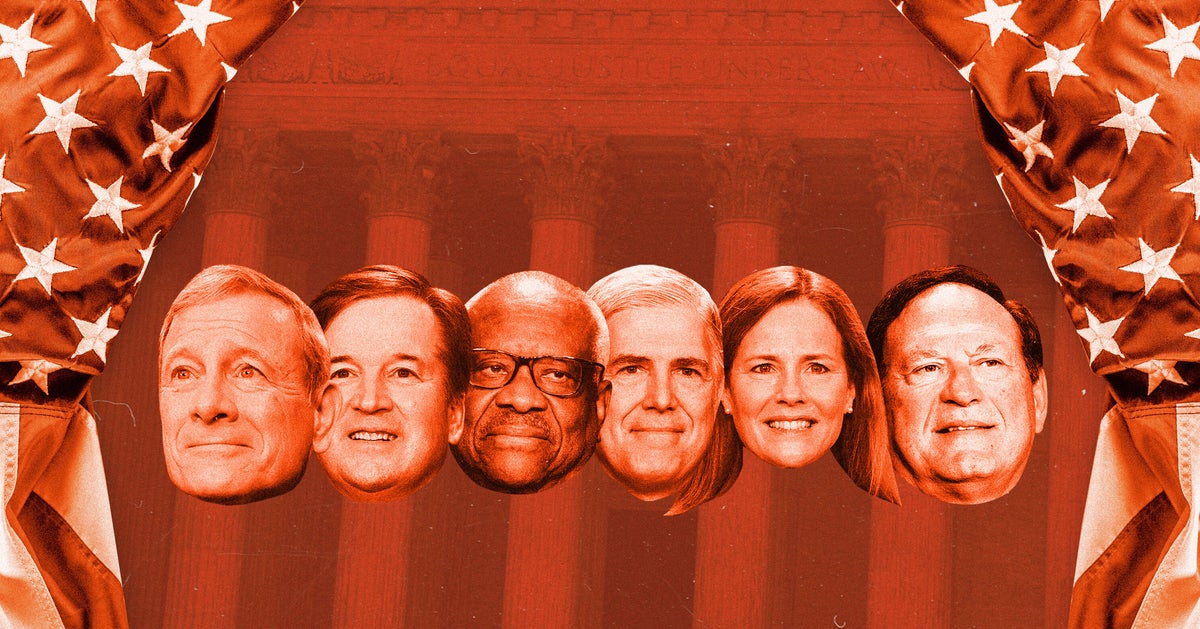
The Supreme Court Just Wrapped Its Most Damaging Term Yet — And Then Tried To Take A Victory Lap
Images
1 / 6

2 / 6

3 / 6

4 / 6

5 / 6

6 / 6
WASHINGTON — The final ruling of the Supreme Court term is over, but the stench of hypocrisy lingers.

If you were to read only one opinion that emerged as the final bell rung, it would likely be the birthright citizenship ruling that stopped President Donald Trump from telling people born on U.S. soil they aren’t Americans. From that ruling alone, one might believe the court’s image of itself as an unshakeable, immovable defender of the Constitution.

“The Framers of the Fourteenth Amendment extended that promise to ‘every free-born person in this land.’ We keep that promise today,” Chief Justice John Roberts wrote in the majority opinion.

But the justices closed out their term with a handful of more questionable decisions.

They supercharged the power of the executive branch yet again by giving Trump — and any successor — nearly unfettered power to fire independent agency officials, upending 90 years of precedent and blowing apart congressional oversight. The court also removed limits on how much money political committees can spend when coordinating with single candidates during an election, meaning corporate donors and billionaires will have more opportunity to influence elections.

And in a final swipe — of many this year — on equal protection laws, the justices upheld a ban on trans girls’ and women’s participation in sports while openly disparaging transgender identity as a “lie to the public.”

Altogether, the decisions reveal disturbing truths about the court’s credibility — and why some of the justices have seemed hellbent on gaslighting the American public about their legitimacy.

Writ large, the court’s rulings have become increasingly ideologically extreme, Stasha Rhodes, executive director of United for Democracy, a nonprofit Supreme Court watchdog group, told HuffPost in an interview Tuesday.

“I think you’re seeing [this dynamic where the] court creates just enough distance from [the] administration on a single case to preserve the appearance of balance while the underlying patterns continue to change,” she said.

Polling on the Supreme Court shows Americans are unhappy with how things are going. Approval is down from a roughly 70% favorability rating five years ago; today, just under half of Americans view the court favorably. Although Justices Amy Coney Barrett and Samuel Alito blame the court’s worsening reputation on the media, public approval has been on a steady decline.

“That’s not a partisan talking point,” Rhodes said. “That’s the country looking at this institution in real time and seeing that something fundamental has changed about what it is and who it serves.”

The court has “converted a credibility problem into a legitimacy problem,” she said.

“And there’s an important distinction there. Disapproval means people don’t like the outcomes. Legitimacy means people no longer believe the institution is playing it straight,” Rhodes said.

The ruling in the birthright citizenship case was a great illustration of the difference. Many people are happy that the 14th Amendment was upheld. But just how close the justices came to eliminating the 14th Amendment via executive order, Rhodes said, is a huge red flag.

And even last week, in a tortured majority ruling from the conservative majority, they unrepentantly gutted America’s asylum promise in the cases Mullin v. Al Otro Lado and Mullin v. Doe.

In the Mullin v. Doe case, justices ignored equal protection rights and blessed a racist decision to strip temporary protection status from 400,000 people fleeing countries steeped in violence and poverty. Alito brushed off the racism by chalking it up to a change in how politicians talk, though he would not in his own ruling even repeat the same phrases uttered by Trump against Haitians, including that they came from a “shithole” country, “probably have AIDS” and are “poisoning the blood” of America.

“Whatever one may think of the cited statements, they are insufficient to show that the termination of Haiti’s TPS designation was based on the race of the Haitian people,” he wrote.

“These cases are organized for release to create that sort of notion that they are being even-handed when that is not the case,” Lisa Graves, co-founder of Court Accountability, told HuffPost.

And all of this was preceded by a year of decisions that baldly accelerated the Trump administration’s political agenda: embracing racial profiling to aid mass deportation efforts in Noem v. Vasquez Perdomo, eviscerating the Voting Rights Act in Louisiana v. Callais, and abetting attacks on the LGBTQ+ community including telling trans people they can’t serve in the military in Shilling v. United States, choose the sex representing their gender identity on their passports in Trump v. Orr, or seek gender-affirming care in U.S. v. Skrmetti.

Meanwhile, as the court invested heavily into expanding executive reach, the justices would occasionally throw a bone to the Constitution, including this week when it ruled that a president could not fire the governor of the Federal Reserve for any old reason.

This minority share of rulings that do respect the balance of powers in the U.S. government isn’t enough to inspire confidence, Graves said.

“When these cases get stacked this way, it gives this false impression that Roberts is going to save us. He is not going to save us. He is already destroying modern American law,” said Graves, the author of “Without Precedent: How Chief Justice Roberts and His Accomplices Rewrote the Constitution and Dismantled Our Rights.”

“This court has demonstrated over and over this term, and in recent years, its willingness to discard longstanding, well-respected legal precedents in order to accomplish this ideological agenda and its willingness to disregard the plain language of the statutes and the Constitution when it wants to,” she added.

Birthright should have been a unanimous decision, Graves said, because of how clearly the 14th Amendment was written.

“Instead, it was… a heartbeat away from five potential judges just declaring that a president can strike out one of the most fundamental guarantees of American rights,” she said.

And Roberts, she added, got to “play the hero.”

Roberts has long been motivated to push forward an “extreme revision of the law” that is rooted in right-wing ideology, including sweeping executive power and destruction of the administrative state, Graves said. Eradicating birthright citizenship may not have been on his agenda, but the destruction of the Voting Rights Act, for example, was.

“In some ways Trump has been a very convenient vehicle for John Roberts to carry out his agenda,” Graves said.

Reforming the court is a tremendously huge order. But both Graves and Rhodes agreed the moment is ripe for momentum to start building.

“I think Americans are feeling frustrated that we have a political system that no longer works for working families but is working really well for the powerful and well-connected. I think the Supreme Court has been a shining example of that dynamic,” Rhodes said.

But single-serve solutions like term limits for justices instead of lifetime appointments, stronger ethics codes to be enforced or even packing the court with more justices won’t be good enough. Reform must also include structural changes like accountability mechanisms, addressing money in politics, and redistributing consolidated power.

“Anything less than a comprehensive approach risks Congress passing something that sounds responsive but doesn’t actually change the trajectory we’re on,” Rhodes said.

Whatever is decided, the influence of the Supreme Court must be reined in, Graves said.

“We have to look at how we have ceded so much power to the Supreme Court and in the way we wait every June to see what the Oracle of Delphi will decide on whether we have rights or not,” she said. “That’s not how our Constitution is supposed to work. It’s supposed to protect our rights, our enduring rights, notwithstanding these unaccountable appointees who have been chosen, at least in part, to destroy some of our rights.”

Rhodes said Americans should be savvy to the “slow game” unfolding in front of their eyes — one which America as an institution is losing.

“The way they change and reshape important facets of American life is by seeding the long game narrative. We see that with the overturning of Roe v. Wade. They waited 30, 40 years, but it’s something they were able to seed in their broader narrative,” she said. “I think birthright citizenship might be their new argument or narrative that they champion.”

By entering your email and clicking Sign Up, you're agreeing to let us send you customized marketing messages about us and our advertising partners. You are also agreeing to our Terms of Service and Privacy Policy.
Comments
You must be logged in to comment.