yahoo Press
The Supreme Court just made the DNC’s fundraising woes a much bigger problem
Images
1 / 7
2 / 7

3 / 7

4 / 7
5 / 7

6 / 7

7 / 7
Republicans' cash advantage just got a lot more powerful thanks to the Supreme Court — and the Democratic National Committee’s fundraising struggles just got a lot more concerning for their party.

Democrats argue that the court’s Tuesday decision, which allows political parties to freely coordinate with candidates, will give the GOP the ability to offset Democratic candidates’ fundraising lead in battlegrounds.

Republicans have a cash edge with the Senate and House Republican committees. But the starkest cash disparity by far is for the Republican National Committee, which has $125 million in the bank, while the Democratic National Committee has more debt than cash on hand, $18.3 million to $14.8 million.

That disparity was already going to matter for the GOP. But with the Supreme Court decision, they can spend without constraint — and their dollars will go a lot further, erasing Democrats’ cash advantage in some battlegrounds while allowing the GOP to level up. That’s especially important for expensive campaign advertising: Candidates have long gotten reduced rates, but parties now can get that rate, too.

More than a dozen Democrats working on key midterms races from North Carolina to Maine expressed various levels of concern over the Supreme Court decision Tuesday.

Brian Derrick, who runs the Democratic fundraising platform Oath, said the decision “unequivocally” benefits the RNC .

“They're gonna be able to deploy those funds in more highly-leveraged scenarios to make up for the gap in candidate funding,” Derrick said. “It's definitely a boost for the Republican Party in the midterms, and it's a shame for the country overall.”

Before the court’s ruling on Tuesday, party committees were capped at the amount of money they could directly coordinate with candidates. For House races, the cap was between $63,600 and $127,200, and for Senate races they were capped at between $127,200 to $3,946,100, depending on the size of the district or state. Those funds often go to purchasing television ads, which are anywhere from three to 10 times cheaper when bought in concert with a campaign than entirely by outside groups, depending on the market.

But now, that spending is unlimited.

On the House and Senate side, Republicans also have an advantage, though it is far narrower than the gap that exists between the DNC and RNC. The National Republican Congressional Committee is sitting on about $9 million more than the Democratic Congressional Campaign Committee, and the National Republican Senatorial Committee has an advantage of roughly $10 million over the Democratic Senatorial Campaign Committee.

Democratic candidates have in recent history been better overall at directly raising campaign contributions, with President Donald Trump one of the few strong fundraisers on the GOP side. Republicans have long been better at bringing in large donations to the campaign committees, but that money didn’t go as far because of the limits. Now, the candidate and committee dollars can be spent at the same rate, a big boost for the GOP. “Republicans have struggled to raise money into their individual campaigns but have been tremendously successful at raising into their national committees,” said a North Carolina Democratic operative, granted anonymity to speak candidly. “This will allow the national committees to make up the candidate deficit and then some. It’s a huge deal.”

“We have to really take seriously the fact that we just lost a major advantage that the Democratic Party has had in the last decade,” said Danielle Butterfield, president of Priorities USA, a top Democratic super PAC.

Republicans hailed the decision as a way to close their small-dollar disadvantages.

“Democrats have gotten accustomed to having enormous, overwhelming spending advantages in competitive campaigns,” said Tim Saler, the chief data consultant for Trump-aligned super PAC MAGA Inc. “Those days are over.”

North Carolina is one state where Democrats are particularly anxious about the impact. Former Democratic Gov. Roy Cooper has outpaced Republican Senate nominee Michael Whatley in cash on hand by $18.5 million to $2.5 million. But Whatley might get some particular interest from the RNC as its former national chair.

“The RNC has been stockpiling their money because they knew their former chairman Michael Whatley would need to get bailed out,” Jeff Allen, the campaign manager for Cooper’s Senate bid, said in a statement after the ruling. “Whatley’s elite D.C. connections and party loyalty means he’s first in line for the RNC’s $120 million warchest.”

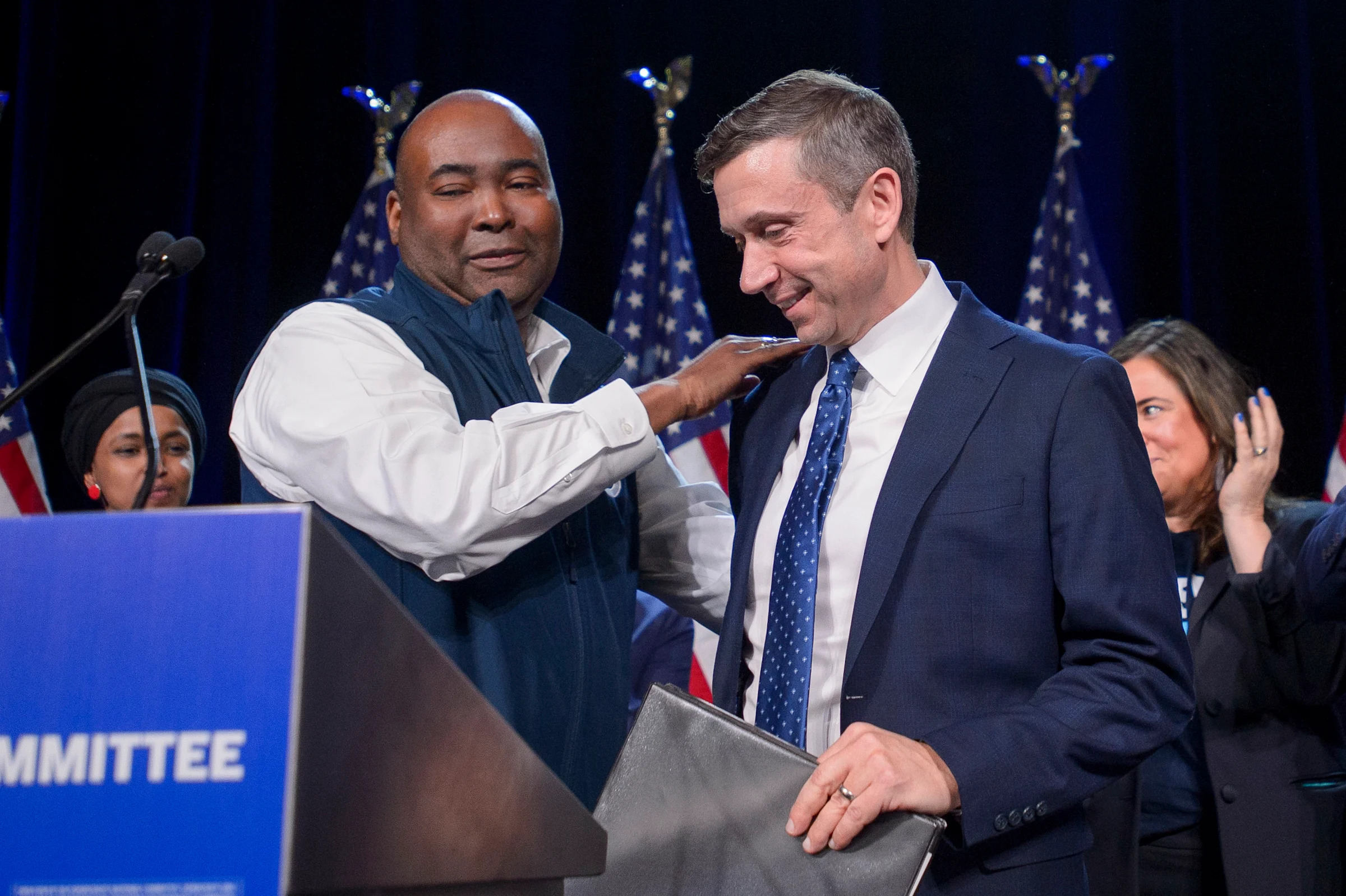
The ruling swiftly ratcheted up scrutiny of embattled DNC Chair Ken Martin, who has long faced external frustrations over the committee’s lagging fundraising efforts. It reignited complaints about Martin’s fundraising struggles and his already-divisive strategy of funneling millions of dollars to state parties to boost their infrastructure rather than hoard the cash for swing states.

“If you are the chair of one of the major party committees and you are not able to raise funds that are competitive with your counterpart across the aisle, then you need to either figure out a strategy to raise funds and remain competitive or you should think about doing something else,” said Adrienne Elrod, a longtime Democratic party operative who has worked on several presidential campaigns.

Martin and his allies have defended the DNC’s fundraising under his tenure and expressed hope Tuesday that the ruling would spur more donors off the sidelines. Martin told members at a DNC meeting in April that Democrats “don’t need to out-raise the Republicans. We just need to raise enough money to be in the ring. To be able to compete. To fight back.”

Jane Kleeb, a Martin ally and Nebraska state party chair who leads the Association of State Democratic Committees, said Tuesday that Democrats would need to lean in more to the state-level organizing structure Martin is bankrolling to cut into Republicans’ advantages on the airwaves.

“You may be able to do unlimited spending on TV. But you still need to run ground campaigns,” Kleeb said. “We have the infrastructure … to win.”

While the case will have broad implications on how both parties in Washington operate with candidates, from hiring campaign staff to buying donor lists or placing digital advertising buys, the most immediate impact will be on television.

Both parties had been expecting the ruling to go Republicans’ way. Neither of the top House party committees set up their independent expenditure arms this spring, the typical timeline for such a move, expecting the ruling would make them obsolete. And on Tuesday, the NRSC formally sunset its IE arm, a move political director Brendan Jaspers said will “achieve unprecedented scale and efficiency.”

“By striking down the coordinated spending limits, Republicans can now use that money to buy cheaper ads that are better synchronized and coordinated with their candidates and the messages that are most effective,” said Sean Cooksey, a Republican former FEC commissioner.

The court did not directly address whether party committees can access the lower candidate rate, leaving some Democrats hopeful that another case levied by the party will go its way.

“Republicans will now claim that this gives their national party committees access to the lowest unit rate for television advertising, but that is not what the law requires,” Democratic-aligned Elias Law Group partners Jacquelyn Lopez and Rachel Jacobs said in a statement.

For now, however, the Federal Communications Commission’s guidance will apply the lower TV rate to the parties, and it remains unclear whether any station will object to that guidance and deny the lower rate.

Regardless, Democrats are worried that they’re about to be outspent and the DNC has no way of saving them.

“The DNC doesn't have the money to give right now,” said a Democratic strategist working on multiple battleground races, granted anonymity to discuss the DNC’s fundraising candidly. “That's obviously a problem. You don't need me to tell you that's a problem.”
Comments
You must be logged in to comment.