yahoo Press
Platner campaign ‘being blown completely out of the water’ by outside GOP spending: Memo
Images
1 / 6

2 / 6

3 / 6
4 / 6

5 / 6

6 / 6
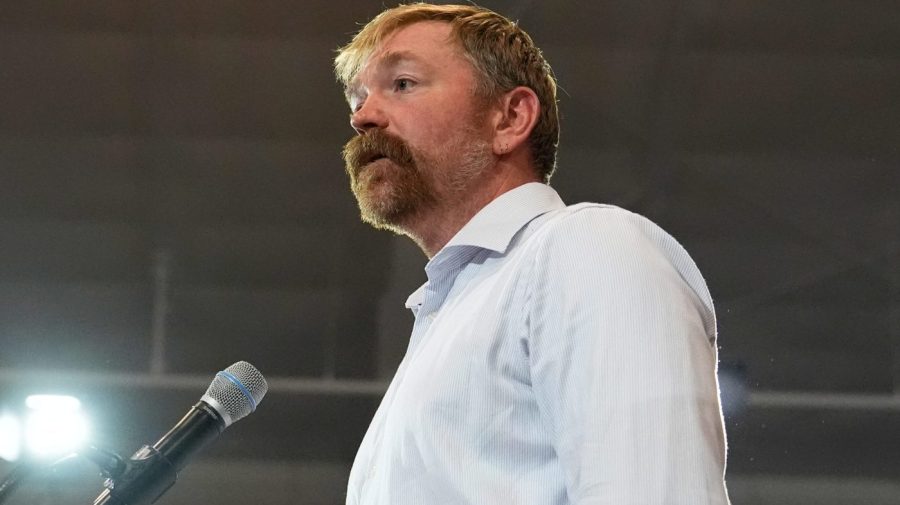
A Monday memo from Graham Platner’s campaign shows the Democratic nominee for Senate in Maine is battling an onslaught of outside GOP spending.

The memo, obtained by Politico, says Republicans spent $4.3 million on the race between Platner and incumbent Sen. Susan Collins (R-Maine) from last Tuesday through Monday. Collins’s campaign spent $500,000, while PACs supporting her spent $3.7 million.

Platner’s campaign, meanwhile, spent $440,000 during the aforementioned time period. When including ad buys from the League of Labor Voters, Common Defense and Majority Forward in support of the Democrat, the party’s spending in the race hit $1.6 million.

The memo also noted GOP groups will outspend Democrats 4-to-1 in the race over the upcoming week. Pine Tree Results PAC, which backs Collins, is spending roughly $1.5 million weekly and is slated to spend nearly $10 million more by early August, the document shows.

“The GOP understands the stakes of this race, which is why they are investing millions of dollars every week to protect Susan Collins,” the memo reads. “In order to remain in a strong position to win in November, the campaign needs the resources to fight back against this onslaught of GOP spending.”

Shawn Roderick, Collins’s campaign spokesman, said Tuesday the memo shows Platner “has no problem benefitting” from Democratic super PACs and wealthy donors, despite his populist rhetoric on the campaign trail.

“If ‘big money’ is corrupting politics, that principle should apply regardless of which side is writing the checks,” Roderick added in a statement.

Ben Chin, Platner’s campaign manager, acknowledged the spending mismatch on Tuesday but said the campaign is “eager for this fight” with Republicans.

“We are absolutely very concerned about it, but I will say that we are also very excited about the fact that all the grassroots momentum that we have,” Chin told reporters on a press call, highlighting the campaign’s door-knocking efforts and Platner’s town halls around the state.

Politico also reported Tuesday that the Democratic Senatorial Campaign Committee (DSCC) is forming a joint fundraising committee with Platner. The Hill has reached out to the DSCC for comment.

On Tuesday, the Supreme Court ruled that federal limits on how much parties can spend in coordination with their candidates are unconstitutional.

During Tuesday’s press call, the Maine Democrat said his campaign is “building relationships” throughout the party.

“We’re very happy with where we’re at, we’re very happy with the relationships we’re building and where things feel like they’re going,” he told reporters.

Despite Collins’s spending edge to date, polling shows Platner and the incumbent are neck and neck in support with nearly four months until Election Day.

A recent survey by The New York Times/Portland Press Herald/Siena University, conducted from June 19 to 26, found that 49 percent of respondents backed Platner, while 47 percent supported Collins — who is seeking a sixth term in the upper chamber.

Platner’s lead among 608 likely voters in the Northeastern state is within the margin of error of 5.4 percentage points.

He also held an 8-point edge among women, while the incumbent led by 7 points among men. While the Democratic hopeful has centered his campaign on the working class, Collins leads him by 21 points among respondents without a bachelor’s degree.

Caroline Vakil contributed reporting.

Updated at 6:17 p.m. EDT

Copyright 2026 Nexstar Media, Inc. All rights reserved. This material may not be published, broadcast, rewritten, or redistributed.

For the latest news, weather, sports, and streaming video, head to The Hill.
Comments
You must be logged in to comment.