yahoo Press
The Race to Revive Venezuela’s Vast Oil Wealth Is Underway
Images
1 / 4
2 / 4

3 / 4

4 / 4
The above button links to Coinbase. Yahoo Finance is not a broker-dealer or investment adviser and does not offer securities or cryptocurrencies for sale or facilitate trading. Coinbase pays us for certain activity generated through this link. Prices displayed are informational.

After Washington snatched Venezuela’s authoritarian president, Nicolas Maduro, in a daring January 2026 night raid, the country’s long road to recovery began. Under the leadership of Maduro’s former vice-president, Delcy Rodriguez, economically crucial oil production and exports are rising. President Trump is pressing Caracas to raise output, all while the U.S. president urges big oil to invest in the near-failed state. While doubts linger over whether production can return to historic highs, Venezuela recently recorded its highest monthly output in years.

By early January 2026, Trump was bullishly predicting that Big Oil would be investing tens of billions of dollars in Venezuela’s heavily corroded oil industry. This was despite ExxonMobil CEO Darren Wood bravely pouring cold water on Trump’s aggressive sales pitch, calling Venezuela uninvestable without major reforms. Exxon’s CEO went on to say, “If we look at the legal and commercial constructs and frameworks in place today in Venezuela, it’s uninvestable,”

The key reason for this response was a deep concern over the legal and regulatory environment, which offered no protection for foreign oil companies that were being called upon to invest potentially hundreds of millions of dollars. Non-existent legal protections and a hostile regulatory environment dominated by PDVSA’s monopoly over hydrocarbon development were major deterrents for foreign oil companies. Chronic malfeasance and corruption magnified the risks associated with acquiring oil projects, particularly with Venezuela’s history of asset expropriation.

During 2007, President Hugo Chavez nationalized Venezuela’s oil industry for the second time, the first such event occurring in January 1976, during Carlos Andrés Pérez’s presidency. From that year onward, Chavez seized various petroleum assets, which were handed over to the national oil company PDVSA, which held a monopoly over industry operations. The assets expropriated included those owned by Exxon, notably the Cerro Negro heavy oil project, which cost the supermajor $1.6 billion.

There are also serious doubts about whether it is possible to restore Venezuela’s oil production to historic highs after decades of chronic corruption, malfeasance, and neglect. Key energy infrastructure, including wellheads, derricks, storage tanks, and pipelines, is so badly corroded that most facilities are inoperable. The parlous state of Venezuela’s petroleum infrastructure is responsible for creating one of the world’s worst environmental disasters, with oil leaching into the environment from energy facilities across the country.

Estimates vary, but rebuilding Venezuela’s deteriorated oil infrastructure will likely cost at least $100 billion over a decade. Some industry experts put the figure as high as $220 billion, estimating it will take more than 10 years to rebuild Venezuela’s energy infrastructure to the point where production recovers to historical levels. This risk is deterring foreign energy investment, especially with an immense environmental disaster unfolding across the country because of frequent oil spills, emissions, and leaks from severely deteriorated facilities.

To address Big Oil’s concerns that Venezuela was uninvestable, Caracas yielded to White House pressure and enacted major industry-wide reforms in early 2026. During late January 2026, the government of Delcy Rodriguez introduced a series of wide-ranging changes to the laws that govern Venezuela’s petroleum industry. Venezuela’s National Assembly approved the new legislation at the end of January. Those amendments effectively reversed most of the legislation introduced in 2007 when Chavez initiated his plans to nationalize petroleum assets.

The sweeping reforms removed state-controlled PDVSA’s monopoly on the control of energy assets, giving foreign oil companies control over petroleum operations in Venezuela. Aside from boosting legal protections for privately controlled drillers, the newly approved industry regulation made energy assets more profitable to exploit by reducing royalties and taxes payable to Caracas. While those reforms allayed the concerns voiced by Exxon’s CEO, they didn’t go as far as some industry insiders desired, with PDVSA remaining intact and under government control.

As a result of those developments, petroleum production is growing at a steady clip. According to OPEC data sourced from the U.S.-backed regime in Caracas, Venezuela lifted 1.179 million barrels per day for May 2026. This represents a 3.8% increase over April 2026 and is 10.6% greater than a year earlier. For April 2026, Venezuela lifted slightly more than double the 582,000 barrels produced during May 2021. Those numbers show petroleum production is experiencing solid growth, which bodes well for a faster-than-anticipated economic recovery.

The latest events illustrate how quickly Venezuela’s crude oil production has rebounded since the White House took control of the country and substantially eased sanctions, which were a major deterrent for U.S. and European energy companies. Indeed, the outlook for Venezuela appears so positive that it was announced during May 2026 that Exxon was in negotiations to return to the country. According to The New York Times, the supermajor is in talks to acquire rights to produce oil from up to six oilfields across Venezuela.

This represents a significant turnaround for Exxon, especially considering the considerable near risk-free success the company is enjoying in the Stabroek Block in neighboring Guyana. That development underscores the growing interests of foreign energy companies, including Big Oil, to return to Venezuela, which with 303 billion barrels of proven reserves contains the world’s largest exploitable oil resources. Nearly all that petroleum is contained in the Orinoco Belt, with extra-heavy crude grades especially attractive to U.S. Gulf Coast refineries.

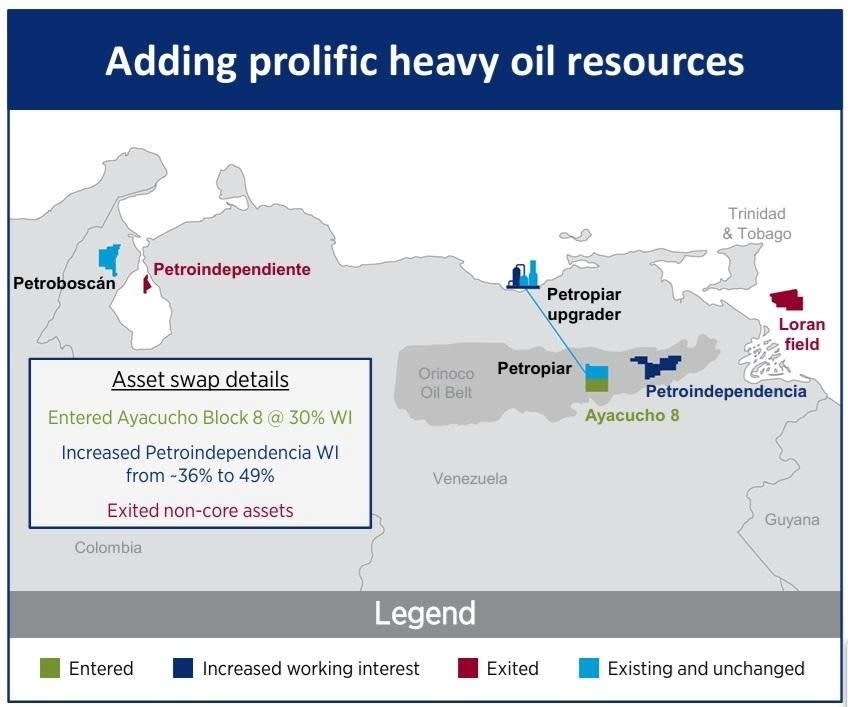
The second-largest U.S.-listed oil company, Chevron, announced during April 2026 the expansion of its operations in Venezuela. This was done by way of an asset swap with PDVSA, giving the supermajor an additional 13.21% working interest in the Petroindependencia joint venture, increasing the company’s holding to 49%. Chevron also secured rights to develop Ayacucho 8 in the Orinoco Belt, home to most of Venezuela’s proven oil reserves, further strengthening the supermajor’s position in the country.

This came after a January 2026 statement where Chevron said it saw a pathway to grow production in Venezuela by 50% over the next 18 to 24 months. The supermajor will finance this expansion with cash flow from existing operations in Venezuela, which are producing around 260,000 barrels per day. While most U.S. and European companies exited oil-rich Venezuela after Chavez nationalized the petroleum industry, Chevron remained, gaining an early-mover advantage and deep familiarity with the geopolitical and regulatory landscape.

Chevron operates in partnership with PDVSA, holding a 39.2% in the Petroboscan facility, 30% of the Pertropiar operations, and 49% in the Petroindependencia project.

Chevron Assets in Venezuela

Source: Chevron 2026 Investor Presentation.

Those facilities produce around 250,000 barrels per day, though the need for debt recovery limits their contribution to Chevron’s operating cash flow to roughly 1% to 2%. That will, however, change, particularly after the assets swap with PDVSA, with cash flow expected to expand significantly over the short to medium term. This will support Chevron’s plans to grow output in Venezuela by 50% or 125,000 barrels per day, lifting production to as much as 375,000 barrels daily.

Most of the oil produced will be extra-heavy crude from the Orinoco Belt, a preferred feedstock for U.S. Gulf Coast refineries. Chevron, by virtue of remaining in Venezuela when most drillers left, is well placed to re-emerge as a leading crude oil producer in Venezuela’s Orinoco Belt. Over time, this will give the supermajor’s cash flow and bottom line a solid boost, especially as demand from U.S. Gulf Coast refineries for the extra-heavy crude produced in the Orinoco Belt grows.

Like Chevron, Spain’s Repsol, and Italy’s Eni, despite the hostile and unprofitable operating environment, chose to hold interests in hydrocarbon assets in Venezuela. Repsol began operations in the oil-rich country in 1993 and now holds working interests in four projects. The offshore Perla field in the Cardón IV block, Venezuela’s only active offshore natural gas field, produces 580 million cubic feet per day and is jointly owned by Repsol and Eni.

Respol also holds 60% of the Quirique natural gas project, a 40% interest in the Petroquiriquire oil facility located on the eastern shore of Lake Maracaibo, and 11% of the Petrocarabobo facility. The Spanish energy major pumps around 45,000 barrels of oil equivalent from its assets in Venezuela. Repsol will invest in expanding its operations and recently signed an agreement with Caracas to incorporate the Horcon oilfield into the company’s portfolio. The driller also signed agreements to secure the Perla gas project and expand the Petroquiriquire joint venture.

Eni, along with its 50% working interest in the La Perla project, holds a 40% stake in the Junin-5 heavy oil block in the Orinoco Belt and 26% of the Petroscure venture, which operates the Corocoro offshore oil field. Eni produces an estimated 64,000 barrels per day of oil equivalent in Venezuela. Both European energy majors are focused on expanding operations and production in Venezuela, meeting with the Rodriguez administration to discuss future opportunities while flagging plans to further invest in existing projects.

These developments make Venezuela, along with Guyana and Brazil, a key participant in South America’s export-led oil boom. They also bode well for higher production, which is forecast to reach up to 1.5 million barrels per day during 2027. If oil prices remain elevated, thereby attracting greater foreign investment than anticipated, production growth will accelerate beyond current forecasts. Although significant roadblocks remain, notably the tens of billions of dollars needed to rebuild shattered oil infrastructure and the massive ecological debt created by Caracas’ drill at all costs mentality, which will cost billions to clean up.

By Matthew Smith for Oilprice.com

More Top Reads From Oilprice.com

Qatar Races to Restore LNG Exports Despite Ras Laffan Setback

India Receives First Post-Deal LNG Cargo Through Strait Of Hormuz

Beijing Steps Up Scrutiny of Indium Exports as AI Chip Demand Soars

Oilprice Intelligence brings you the signals before they become front-page news. This is the same expert analysis read by veteran traders and political advisors. Get it free, twice a week, and you'll always know why the market is moving before everyone else.

You get the geopolitical intelligence, the hidden inventory data, and the market whispers that move billions - and we'll send you $389 in premium energy intelligence, on us, just for subscribing. Join 400,000+ readers today. Get access immediately by clicking here.
Comments
You must be logged in to comment.