yahoo Press
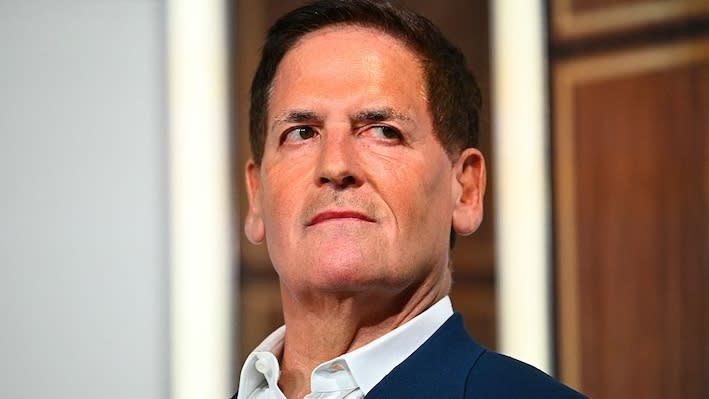
Mark Cuban says your 401(k) is why billionaires get 'insanely rich' — and argues their wealth is building yours too
Images
1 / 4
2 / 4

3 / 4

4 / 4
When billionaire entrepreneur Mark Cuban recently weighed in on the debate over wealth inequality, he offered a perspective that often gets lost in political arguments about the ultra wealthy.

The reason people like Elon Musk become extraordinarily rich, Cuban argued in a June 13 post on X (1), isn’t simply because they founded successful companies. It’s because millions of Americans voluntarily buy and hold shares of those companies through brokerage accounts, mutual funds, pensions and retirement plans.

The ultra-rich use these 5 real estate strategies to build wealth while they sleep — you can start with just $100

Robert Kiyosaki says this 1 asset will surge 400% in a year and begs investors not to miss this ‘explosion’

Millionaires under 43 hold only 25% of their wealth in stocks. Surprised? Here’s where their money is actually going

Cuban took to X to respond to criticism from another poster, who sarcastically wrote (2) that “Capitalism is better than socialism because one man gets to be a trillionaire instead of everyone having healthcare.”

Cuban replied: “The reason anyone gets insanely rich is almost always because of the stock market. It certainly how @elonmusk (3) did.”

But he didn’t stop there.

“And the reason they get rich from the stock market,” Cuban wrote, “is because 150m Americans decided they wanted to own shares of stocks directly, or through their retirement plans, or through other approaches as a way of building their net worth and trying to create a better life for themselves.”

The numbers support at least part of his argument. Data from Gallup shows 62% of Americans report investing (4) in (4)the market through either a self-directed retirement account, mutual funds or individual stock.

In other words, when the stock price of companies such as Tesla or SpaceX rises, it doesn’t just boost the net worth of billionaires. It also helps fund the retirement accounts and investment portfolios of millions of ordinary Americans.

Cuban’s central point is straightforward: Billionaire wealth is often tied to company ownership that’s upheld by the average investor.

When investors believe a company will generate future profits, they bid up the value of its shares. Founders who still own large stakes can see their net worth soar as a result. Musk knows this very well: The IPO and early-days trading of Musk’s SpaceX stock has vaulted his net worth to more than $1 trillion (5).

That same process benefits everyday investors. Americans held a record share of their wealth in stocks (6) at the end of 2025, with household exposure to equities reaching historic highs in recent years. Rising markets have helped drive retirement-account balances higher and contributed to significant household wealth creation.

Of course, critics note that stock ownership remains highly concentrated. Research shows the wealthiest households routinely own the vast majority of corporate equities (7), meaning the biggest gains from market rallies still flow disproportionately to the top.

Read More: About 1 in 5 Americans over 50 has zero retirement savings. Here's why it's not too late

Cuban then addressed the X poster’s healthcare jab, saying that billionaire wealth isn’t so much the problem, and that “behemoth [health care] conglomerates” are the bigger issue at hand.

For years, he has criticized opaque pricing systems, pharmacy benefit managers and large healthcare intermediaries that he believes drive up costs for employers and consumers. Through ventures such as his Cost Plus pharmacy business (8) and newer direct-contracting healthcare initiatives, Cuban has pushed for more transparent pricing and direct relationships between employers and healthcare providers.

Whether that vision can be scaled nationwide remains an open question. Healthcare economists point to a complex web of insurers, providers, drug manufacturers and regulators that all influence costs.

Cuban’s comments highlight a tension that sits at the center of America’s economic debate: Many Americans are uncomfortable with the existence of billionaires.

Pew (9) found in 2021 that 29% of U.S. adults said billionaires were a bad thing for the country, 15% said they were a good thing and 55% were neutral. Meanwhile, a 2025 Harris Poll (10) reported that 53% of Americans view billionaires as a threat to U.S. democracy.

At the same time, millions depend on the stock market to build retirement savings, fund college accounts and create long-term wealth. Those two realities are more connected than they may appear.

When successful companies create value, founders, institutional investors and ordinary retirement savers often benefit together. The challenge for policymakers is figuring out how to broaden those gains while addressing concerns about healthcare costs, affordability and economic inequality without undermining the investment system that so many Americans now rely upon.

Dave Ramsey warns this is America's most common retirement mistake — here's how to fix it ASAP

Insurance companies profit most from drivers who auto-renew without shopping around. Comparing 100+ quotes takes 2 minutes and costs nothing

Thanks to Jeff Bezos, you can now become a landlord for as little as $100 — without managing a single property

Here are the 4 costs Americans (still) overpay for every single month. How many of these are sabotaging your budget?

Join 250,000+ readers and get Moneywise’s best stories and exclusive interviews first — clear insights curated and delivered weekly. Subscribe now.

We rely only on vetted sources and credible third-party reporting. For details, see our ethics and guidelines.

X (1), (2), (3); Gallup (4); Forbes (5); Axios (6); CNBC (7); Mark Cuban Cost Plus Drug Company (8); Pew Research Center (9); The Harris Poll (10)

This article originally appeared on Moneywise.com under the title: Mark Cuban says your 401(k) is why billionaires get 'insanely rich' — and argues their wealth is building yours too

This article provides information only and should not be construed as advice. It is provided without warranty of any kind.
Comments
You must be logged in to comment.