yahoo Press
Fed meeting live: Kevin Warsh faces challenging inflation backdrop in his first meeting as Fed chairman
Images
1 / 5

2 / 5

3 / 5

4 / 5

5 / 5
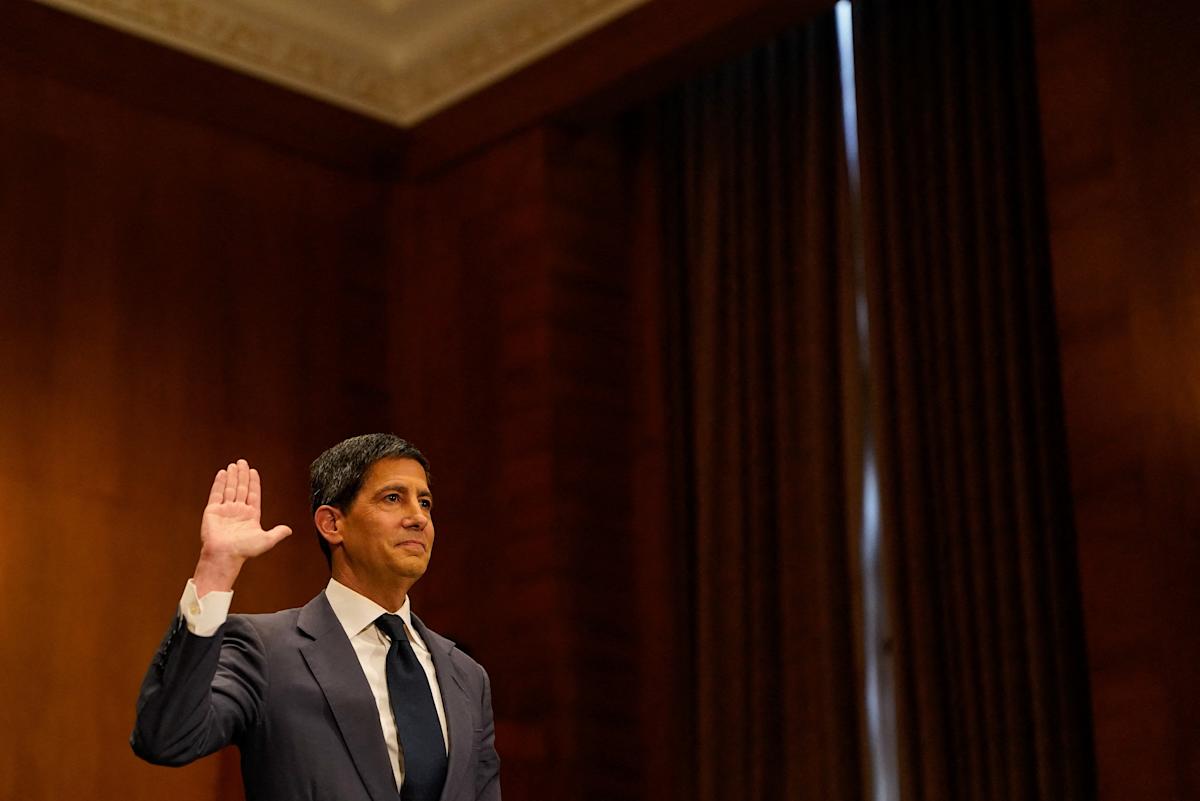
The Federal Reserve is widely expected to hold interest rates steady in the range of 3.5%-3.75% at 2 p.m. ET on Wednesday at the conclusion of its two-day policy meeting. The decision comes at a pivotal time for the Fed and central banks around the world. The June meeting, which kicked off Tuesday, is Kevin Warsh's first as the central bank's chairman. Warsh has suggested he will adopt a different governing approach from former Fed Chair Jerome Powell and aims to emulate former Fed Chair Alan Greenspan. Notably, Warsh has not committed to holding press conferences after every policy meeting, a practice Powell instituted, though the Fed confirmed there will be a press conference on Wednesday. The central bank will also issue its Summary of Economic Projections and the highly anticipated "dot plot," providing markets with insight into how FOMC members view the direction of monetary policy for the remainder of the year. The latest dot plot, released after the March meeting, showed Fed officials forecast just one rate cut in 2026. Market watchers will be scrutinizing Warsh to better understand his views, while also watching for ongoing signs of division at the Fed as the global energy shock from the war in Iran drives higher inflation and growth risks, putting new pressure on the central bank. Economists’ views on the economy and Fed interest rate policy are divided as they mull several colliding factors, including ongoing tensions between the US and Iran, an artificial intelligence spending boom, an unsettled tariff policy environment, and a new Fed chair. Reuters reports: For Fed rate policy "the next move will be lower. (Inflation) expectations are anchored, real wage gains are negative," said Chris Hodge, head U.S. economist at Natixis CIB Americas, with two quarter-percentage-point rate cuts in coming months as consumer weakness and the impact of falling inflation-adjusted wages starts to be felt. "Are they going to want to hike in an environment when inflation is driven by supply considerations?" Indeed, since the announcement of a U.S.-Iran deal reopening the Strait of Hormuz, global benchmark oil prices have plummeted to below $80 a barrel and are now barely 10% above where they were before the start of U.S.-backed bombing led Iran to shut the strategic waterway. Citi economists see even more potential for dovishness, and expect sequential rate cuts at Fed meetings in September, October and December. At PGIM, by contrast, Chief Economist Robert Sockin sees three rate hikes coming in an economy that "continues to power along with above-trend growth, above-target inflation, and now a warming labor market" that after a slow start of the year is producing jobs at a pace more comparable to the years before the pandemic. Read more here. Yahoo Finance's Sarah C. Brady writes: The dot plot is a chart that shows how the Fed's top policymakers — members of the Federal Open Market Committee (FOMC) — think the Fed will change short-term interest rates over the next few years. There are up to 19 dots on the Fed's dot plot, each one representing the prediction of one anonymous member of the Federal Reserve Board. Those predictions are updated at each FOMC meeting based on a review of what's happening with the economy and the outcomes each member believes are most likely in the future. The Federal Reserve began publishing the chart in 2012 as part of an effort to increase transparency around its policies. The dot plot can now be found in the Summary of Economic Projections published each March, June, September, and December. The Y axis (vertical) shows the target percent for the federal funds rate. On the X axis (horizontal), you'll see the rate predictions for the end of the current year, along with the end of the two upcoming years, and for the "longer run." The longer-run projections show what each member believes will happen if there are no further shocks to the economy. Read more here. CNN Business reports: Kevin Warsh's dream of becoming Federal Reserve chairman was nearly tarnished by the specter of having to confront simultaneous and conflicting challenges brewing in the US economy. In January, when President Donald Trump nominated Warsh for the top job, the labor market had just wrapped up one of its weakest years in decades. Unemployment was rising and the US economy was losing jobs. And then, weeks later, the inflation side of the Fed's mandate reared its ugly head. The war with Iran caused oil, diesel, jet fuel and gasoline prices to skyrocket. That raised the risk of Warsh having to lead the Fed through a dreaded two-sided battle, with officials forced to decide whether to rescue the job market by cutting rates or put out the inflation fire by hiking rates. But now, the immediate challenge facing Warsh looks a bit less daunting. Not only has the job market raced back to life this spring, but energy prices are plunging. The US-Iran agreement to halt the 15-week-long war and reopen the Strait of Hormuz has eased fears of a lasting inflation spike, reducing the urgency for Warsh to consider a rate hike in the immediate future. "It takes some pressure off Warsh. It means the worst-case for hikes is more off the table than on it," said Benson Durham, a former Fed official and founder of DASM LLC, an independent research firm. Read more here. Federal Reserve Chairman Kevin Warsh may set a new tone at Wednesday's FOMC meeting, but is unlikely to usher in new monetary policy moves, Yahoo Finance's Hal Bundrick reports. He writes: Wall Street traders, as measured by federal funds futures, don't expect a fed funds rate change before year-end — and that forecast is for a rate hike, rather than a cut, though expectations could shift as data evolves. What will a stable rate environment, leaning toward an interest rate increase, mean for your money? The federal funds rate influences savings rates, interest charges, and, to a small degree, mortgage rates. At the end of February and into early March, mortgage rates were hitting three-year lows. Then, the Middle East war began, and rather than falling lower, home loan rates reversed course and edged higher. Home loan rates have eased in the past three weeks because they are mostly influenced by the bond market, particularly the 10-year Treasury note. The bond market has calmed somewhat recently, but housing industry analysts with the Mortgage Bankers Association and Fannie Mae still predict mortgage rates to remain near 6% through 2027. Read more here about how the Fed affects your money. The Federal Open Market Committee (FOMC) holds eight regularly scheduled meetings per year, and the next one is scheduled for June 16-17. At the conclusion of the meeting on Wednesday, the Fed is expected to release its policy decision at 2 p.m. ET and give a press conference at 2:30 p.m. ET. Here's a look at the rest of the Fed's meeting schedule for 2026: January 27-28 March 17-18* April 28-29 June 16-17* July 28-29 September 15-16* October 27-28 December 8-9* * Meeting associated with a Summary of Economic Projections (also known as the "dot plot"). Part of Kevin Warsh's task at the beginning of his tenure will be to push for his reforms at the central bank while also building support among FOMC officials. Warsh is stepping into a Fed that has remained divided in recent meetings. At the latest meeting in April, four Fed officials dissented on the decision to hold interest rates in a range of 3.5% to 3.75%. One official preferred a 25 basis point rate cut, while the other three dissenters agreed with the rate decision but did not endorse the Fed's easing bias in the statement. "It is clear that Warsh has his work cut out for him convincing the committee to adopt his policy views," Renaissance Macro's Neil Dutta wrote in a post on X following April's policy statement. In April, former Fed Chair Jerome Powell noted that the consensus among policymakers was moving toward keeping rates steady for longer, as several officials didn't feel it was the right time to pivot policy. "I think that the center is moving toward a more neutral place," Fed Chair Powell told Yahoo Finance's Jennifer Schonberger in April. Kevin Warsh, President Trump's appointee to lead the Federal Reserve, is considered a known quantity for markets. Warsh, 56, is from Albany, N.Y., and received a degree in public policy with a focus on economics and statistics from Stanford in 1992. In 1995, Warsh worked in M&A at Morgan Stanley (MS) and earned a law degree from Harvard. Beginning in 2002, he served as a special assistant to President George W. Bush for economic policy and as an executive secretary at the National Economic Council, where he advised the president and senior administration officials on the US economy. Notably, Warsh has experience navigating the central bank. Bush appointed him to serve as Fed governor from 2006 until 2011. During his tenure at the central bank, he became former Fed Chair Ben Bernanke's liaison to Wall Street during the chaos of the 2008 financial crisis. As Yahoo Finance's Jennifer Schonberger previously reported, Warsh has been highly critical of the Fed, arguing that the Fed has overlooked the role of artificial intelligence in the economy and criticizing Fed Chair Powell for making "unwise choices" regarding inflation. Contrary to popular consensus that the Federal Reserve should be holding or even raising rates, BlackRock chief investment officer of fixed income Rick Rieder told Yahoo Finance he believes the Fed should move toward cuts. "I think they've got to move toward lowering [interest rates]," Rieder said. "When you look at … the areas that the interest rate affects [such as housing], I think they should be cutting over time." Rieder's comments come as newly minted chairman Kevin Warsh is set to helm his first Fed meeting, with a decision to come on Wednesday. Traders are nearly unanimously expecting the committee to hold rates steady, at a rate of 3.5% to 3.75%, tomorrow. However, the market is now pricing in at least one quarter-point hike by the end of the year, driven by the effects of the war in Iran on inflation via an energy shock. May's consumer price index showed that prices advanced on a year-on-year basis at their fastest rate since 2023. With a deal signed, the economy may be moving past those problems, Rieder told Yahoo Finance. "Now that you're getting to the other side of a fiscal tailwind, we think [in] the economy, you're going to see some moderation," Rieder said, noting that the call includes moderating inflation. Traders see a reduced likelihood that the Fed will hike rates this year after the US and Iran agreed to an interim peace deal. As of Tuesday morning, traders were pricing in a 59% chance that the Fed raises interest rates by 25 basis points or more this year, according to fed funds futures tracked by CME FedWatch. That's down from 68% a week ago. Chances of a rate cut remain slim, however. According to a Polymarket prediction market, traders are assigning a 69% probability that interest rates remain unchanged this year and a 21% probability that the Fed cuts rates by 25 basis points. At the same time, CME Group's tool is currently assigning a 0% chance of rate cuts this year. For the June meeting, a consensus has formed that the Fed will hold rates steady, a view that was reinforced last week when the US government reported a hot inflation reading. As markets turn their attention toward the Fed’s two-day policy meeting, Yahoo Finance’s Jennifer Schonberger reports on what to expect in Kevin Warsh’s first Fed meeting as chairman: Kevin Warsh will preside over his first interest rate-setting meeting as Federal Reserve chair on Wednesday, when the central bank is expected to hold rates steady. All eyes will be on Warsh as Fed watchers try to discern his views, his personal credibility, and how he will position the Fed in the current landscape. The committee is facing hotter inflation readings as the conflict in Iran has pushed inflation higher. "While Warsh is generally perceived as dovish, he will inherit a committee that has become noticeably more hawkish," said Greg Daco, chief economist at EY-Parthenon. "Warsh's first challenge will not be steering the committee toward easier policy, but demonstrating that his decisions are grounded in economic fundamentals rather than political considerations." Read more here. The Federal Open Market Committee’s June meeting kicked off on Tuesday on schedule. “The FOMC meeting began at 10:00 AM ET as scheduled,” a Federal Reserve spokesperson said. On Wednesday, at 2 p.m. ET, the Fed will issue its monetary policy statement and interest rate decision, the first under new Fed Chairman Kevin Warsh. Yahoo Finance’s Jake Conley reports: Get ready for one of the busiest weeks of the year in global monetary policy. US investors will have all eyes focused on Wednesday's Federal Reserve meeting — Kevin Warsh's first as chairman. But the Fed is only one piece of a globally busy stretch in which four of the world's major central banks deliver policy decisions in less than three days. The Reserve Bank of Australia kicks things off Tuesday, followed by the Bank of Japan later that day. The Federal Reserve follows on Wednesday, and then the Bank of England closes out the run of meetings on Thursday. The concentration of central bank decisions comes at a moment when policymakers around the world are confronting the class question of an energy shock: whether to address concerns over inflation or growth. For much of the past several years before the war, central banks confronted a steady picture: Inflation was easing, economic growth remained resilient, and policymakers could focus on calibrating the pace of policy normalization. Yet, 2025 and 2026 both brought major shocks. Read more here.
Comments
You must be logged in to comment.