yahoo Press
Stock market today: Dow, S&P 500, Nasdaq futures drift ahead of Warsh's first Fed meeting as chair
Images
1 / 3

2 / 3

3 / 3
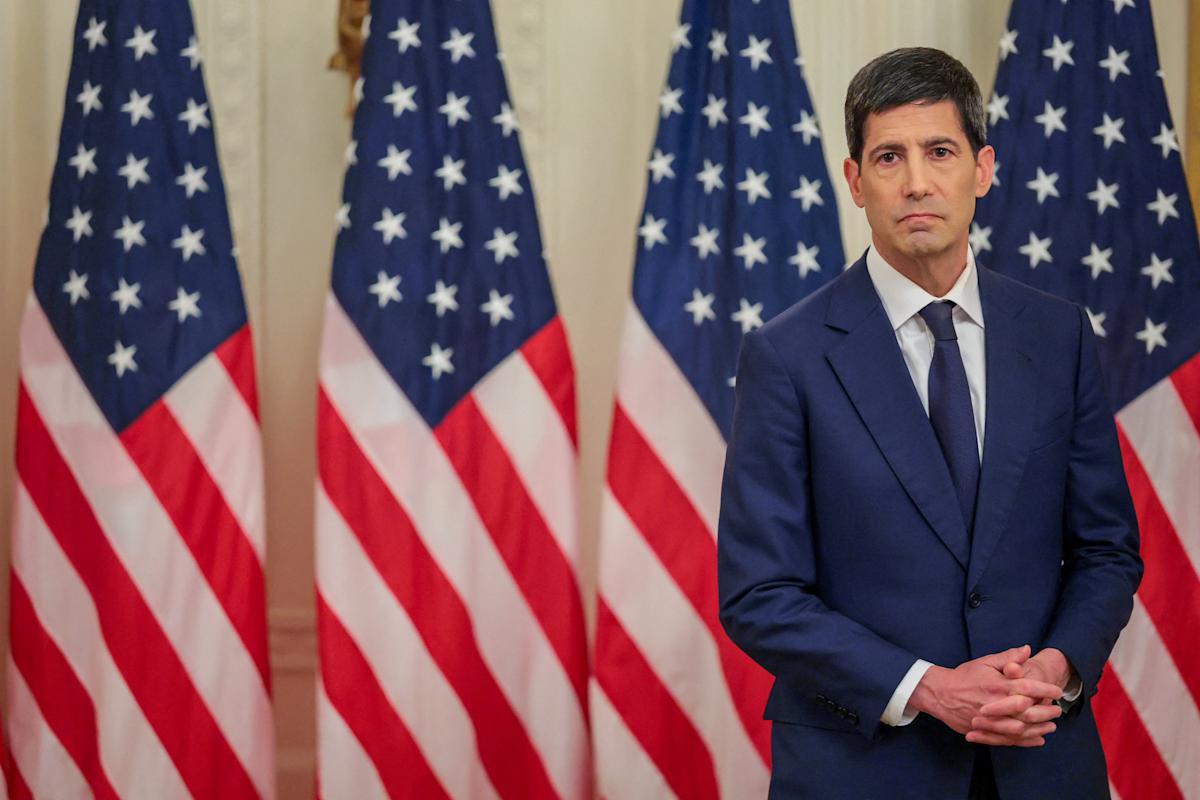
Wall Street stocks hit pause on Tuesday on a record-setting rally as hopes faded for a swift return of Hormuz oil flows and focus turned to the Federal Reserve's policy meeting. Dow Jones Industrial Average futures (YM=F) nudged up 0.1% after soaring to an all-time closing high on Monday as markets celebrated a US-Iran peace deal. Contracts on the S&P 500 (ES=F) were also up about 0.1%, while those on the tech-heavy Nasdaq 100 (NQ=F) rose 0.3%. Markets are digesting warnings that Friday's Strait of Hormuz reopening promised by the US-Iran agreement isn't likely to be easy, and it could take months for oil shipments to ramp up. Uncertainty over the deal's details, which have yet to be released, is also cooling optimism. However, US officials have said commercial traffic will be allowed to use the waterway without tolls. That provides a complicated backdrop to the Fed meeting, with recent inflation reports running hotter than expected as the war with Iran pushed energy prices higher. Its counterpart the Bank of Japan on Tuesday raised its benchmark interest rate to a 31-year high to counter those price pressures. Officials will begin their June meeting on Tuesday, ahead of Wednesday's closely watched rate decision — the first under President Trump-backed Chair Kevin Warsh. While the Fed is overwhelmingly expected to hold rates steady this time, many on Wall Street expect a shift toward hikes this year in the "dot plot" of policymakers' expectations. Meanwhile, SpaceX (SPCX) shares jumped further before the bell, pointing to a third day of post-IPO gains. The Elon Musk-led company is eyeing overtaking Amazon (AMZN) in market value to become the world's fifth-biggest company. Robinhood (HOOD) stock rose 1.6% in premarket trading on Tuesday after the company announced it plans to lay off 290 employees, or about 10% of its workforce. Yahoo Finance’s David Hollerith reports: The move is intended to "maintain a high performance culture, further accelerate product velocity, and remain lean and disciplined," according to a regulatory filing signed by CFO Shiv Verma. Robinhood will incur $20 million in severance and restructuring charges, with $8 million in related share-based compensation payments. In a memo posted on X, Robinhood CEO Vlad Tenev maintained that the financial and investing app has "never been stronger" and said that the goal of the reduction is "to maximize our talent density and ensure that our culture is defined by an absolute elite performance bar." "To achieve the massive scale of our mission, we cannot default to operating as a heavily-layered organization," Tenev said. "We must be a lean, hyper-focused team where every single individual is empowered to make a massive impact," he added Read more here. Yahoo Finance’s Jared Blikre writes in today’s Chart of the Day: SpaceX's (SPCX) market debut turned into a record retail buying event, with individual investors buying more of the stock on day one than they did in Coinbase (COIN), Uber (UBER), Arm (ARM), or Airbnb (ABNB), according to data from Vanda Research tracking major IPOs since 2018. Retail investors bought a net $117.6 million of SpaceX on Friday, topping Coinbase's $92 million in its April 2021 debut. That confirmed what Vanda's pre-IPO retail-flow data had already hinted: Retail traders were not just watching SpaceX. They were making room for it. … “SpaceX has officially entered the big leagues for retail investors," Vanda wrote. The firm said that outside of Nvidia (NVDA), retail investors have rarely bought more than $100 million of any "Magnificent Seven" stock on a single day this year. Read more here. US investors will have all eyes focused on Wednesday's Federal Reserve meeting — Kevin Warsh's first as chair. But the Fed is only one move in a busy stretch that sees four of the world's major central banks deliver policy decisions in less than three days. Yahoo Finance’s Jake Conley writes: The concentration of central bank decisions comes at a moment when policymakers around the world are confronting the classic question of an energy shock: Whether to address concerns over inflation or growth. For much of the past several years before the war, central banks confronted a steady picture: Inflation was easing, economic growth remained resilient, and policymakers could focus on calibrating the pace of policy normalization. Yet 2025 and 2026 both brought major shocks. … "The two global macro forces — the cyclical and energy shocks — may be countervailing on growth but they are amplifying on inflation," JPMorgan strategist Alex Gallin wrote in a recent note. "This has prompted a sharp shift in policy discussion and, in some cases, in action." The result is a policy backdrop that looks increasingly uncomfortable for central bankers. While growth concerns might ordinarily argue for lower rates, renewed inflation pressures are making it difficult for policymakers to signal easier policy. Read more here. Shares of SpaceX (SPCX) rose more than 10% in premarket trading on Tuesday, extending their post-IPO rally. The move sets Elon Musk's company up to overtake Amazon (AMZN) in market value and to become the world's fifth‑largest company, just days after the stock began trading on Friday. Reuters reports: The stock was last up 10.4% at $212.50, a jump of more than 57% above its $135 IPO price and giving the company a market capitalization of nearly $2.8 trillion if gains hold. Amazon's valuation, meanwhile, stands at $2.66 trillion. "We can say with certainty that this valuation makes absolutely no sense today. People are buying SpaceX in the expectation that others will buy too and push the price higher — that's speculation," said Ipek Ozkardeskaya, senior market analyst at Swissquote Bank. The company reported sales of $18.67 billion last year and a net loss of $4.94 billion after merging with money-losing xAI — in contrast to many of Wall Street's big technology companies that have posted bumper numbers. SpaceX options activity is set to begin as soon as Tuesday, with early activity expected to be heavy, volatile and likely expensive. Read more here. The Bank of Japan raised interest rates to a 31-year high on Tuesday, marking another landmark step in normalising monetary policy as it focused on taming price pressures from the energy shock caused by the Iran war. Reuters reports:In a widely expected move, the BOJ decided to raise its short-term policy rate to 1% from 0.75%, taking borrowing costs to levels unseen since 1995. In a statement announcing the decision, the BOJ said the risk of Japan's economy deteriorating sharply from the Middle East conflict has diminished due to progress made in procuring alternative energy supplies. The hike was the first since December and aligns the BOJ with other central banks shifting towards tighter policy to combat inflation, including the European Central Bank. Deputy Governor Shinichi Uchida acknowledged the recent U.S.-Iranian peace deal, which he described as a "welcome move", but noted persistent inflationary risks. "Compared with the previous meeting, the risk of a sharp deterioration in the economy has diminished. On the other hand, price rises are broadening and there is a risk underlying inflation may deviate from our target," Uchida said in a news conference he held on behalf of Governor Kazuo Ueda, who missed the meeting for medical treatment. Read more here. Reuters reports: Asian shares mostly gained and Japan's benchmark Nikkei 225 briefly topped 70,000 for the first time Tuesday before trimming early gains after the Bank of Japan raised its key interest rate to 1%. The quarter percentage point hike took the benchmark rate to its highest level in three decades. By early afternoon, the Nikkei 225 (^N225) was up 0.6% at 69,713.05, while South Korea's Kospi moved further into record territory, gaining 2.1% to 8,721.64. The Shanghai Composite (000888.SS) gained less than 0.1% to 4,100.53. Australia's S&P/ASX 200 (^AXJO) lost 0.3% to 8,892.10 and Hong Kong's Hang Seng (^HSI) slipped 1.3% to 24,533.35. In Taiwan, the Taiex was up 0.6%, while India's Sensex picked up 0.5%. Read more here. Bloomberg reports: Oil steadied after the biggest drop in more than two weeks as traders, shippers and producers waited for details of a US-Iran deal that's intended to pave the way for the full reopening of the Strait of Hormuz. Brent (BZ=F) traded above $83 a barrel after sinking almost 5% on Monday, while West Texas Intermediate (CL=F) was near $81. The interim agreement is due to be signed by both sides in Switzerland on Friday, although Washington and Tehran have yet to release the text of the memorandum of understanding." The lack of detail has kept the market cautious. Persian Gulf energy officials said they had been inundated with inquiries from buyers about whether crude could once again move through the strait, while shipping executives and traders said they need more clarity before committing vessels to the route. Oil's drop to the lowest since early March has erased the bulk of the gains seen during the conflict, easing inflationary pressures just as policymakers at the Federal Reserve assess interest rates this week. Still, a reopening may not mean an immediate return to normal, with questions lingering over shipping safety, operating rules and whether the chokepoint — which carried about a fifth of oil supply before the war — will actually remain toll-free. Read more here. Yahoo Finance’s Pras Subramanian reports: SpaceX (SPCX) stock jumped over 19% on Monday in its first full trading day on Wall Street, giving the shares a two-day pop of 43% since the rocket company's market debut. SpaceX had offered 555.6 million shares to investors, raising a record $75 billion, but the company confirmed on Monday that it actually raised $85.7 billion after underwriters exercised their "green shoe" option to sell an additional 83,333,333 shares. The appetite for SpaceX stocks seems unabated, with some commentators now likening it to a momentum stock, though one that could be volatile. "SpaceX going public is an important watershed moment for the broader tech sector in our view as this AI Revolution and data takes this next step forward," Wedbush analyst Dan Ives wrote on Monday, predicting it will lead to more capital deployed at the companies and boost upcoming IPOs for Anthropic (ANTH.PVT) and OpenAI (OPAI.PVT). Read more here.
Comments
You must be logged in to comment.