yahoo Press
Oracle CEO Says Token Billing Model Helps Firms Control AI Costs. What That Actually Means for ORCL Stock.
Images
1 / 5
2 / 5

3 / 5
4 / 5

5 / 5
The above button links to Coinbase. Yahoo Finance is not a broker-dealer or investment adviser and does not offer securities or cryptocurrencies for sale or facilitate trading. Coinbase pays us for certain activity generated through this link. Prices displayed are informational.

Oracle (ORCL) is changing the way in which businesses pay for artificial intelligence, and the company's CEO says the new approach places customers back in control.

During Oracle's fiscal fourth-quarter 2026 earnings call on Wednesday, CEO Mike Sicilia outlined a shift toward token-based and outcome-based pricing for AI features across its software suite. The goal, he said, is simple: help customers spend smarter on artificial intelligence without the sticker shock.

Micron Stock is Now Close to Fair Value, But Shorting 2-Week Puts Yield 7.0%

SpaceX's First Full Week, FOMC and Other Key Things to Watch this Week

Adobe CFO Quits to Join a Chipmaker. You Shouldn’t Quit ADBE Stock.

Markets move fast. Keep up by reading our FREE midday Barchart Brief newsletter for exclusive charts, analysis, and headlines.

"All of this helps our customers control their costs and align their spending with the value being generated," Sicilia said on the call.

Oracle has introduced two new pricing tracks alongside its traditional software subscriptions.

The first is a token bundle model. Customers can buy bundles of tokens that work across Oracle's application suite, essentially pre-purchasing AI capacity in a straightforward, predictable package. Think of it like buying a data plan. Consumers know what they are getting and what it costs.

The second is outcome-based pricing. Instead of a flat fee, customers pay based on what the AI actually delivers. Oracle gave a few examples on the call:

An interview agent priced per candidate screened, or

A hospitality upsell tool priced as a cut of the transactions it generates.

Sicilia said Oracle has been testing outcome-based models in areas like construction, health care, and hospitality for some time. But the company is now rolling these structures out more broadly across its Fusion applications and industry-specific products.

"We are simplifying how customers consume and pay for agentic capabilities," he said. "Our new agentic pricing aligns with customer value."

In the quarter ended May 31, 33 customers pre-purchased token bundles to unlock access to advanced AI reasoning and models. Aon Services Corporation (AON) and Liberty Energy (LBRT) were among those named on the call.

Sicilia was clear that much of Oracle's AI functionality in core applications remains included at no extra charge. The token bundles are for customers who want more, specifically, access to bigger, more capable reasoning models.

Oracle's pricing pivot comes at a time when enterprise software costs are climbing in unexpected ways.

According to a January report from software management firm Zylo, new AI monetization strategies and consumption-based fee structures have become a top driver of rising software-as-a-service (SaaS) costs, surpassing even application sprawl, per CFO Dive. Organizations are getting hit with charges they didn't budget for as vendors pile AI add-ons onto existing subscription contracts.

That volatility is precisely what Oracle says it's trying to avoid. By packaging AI capacity in predictable bundles, or tying costs directly to measurable results, the company is betting customers will find it easier to justify and plan their AI budgets.

Sicilia pointed to Oracle's full-stack position as a key advantage here. Because Oracle runs the infrastructure, the database, and the applications, it can actually measure what AI is doing for a customer.

The pricing announcements came on the back of a strong earnings report. Oracle posted total revenue of $19.2 billion for its fiscal fourth quarter, up 21% year-over-year (YOY). Cloud revenue jumped 47% to $9.9 billion, driven by 93% growth in cloud infrastructure, reflecting surging demand for AI workloads.

For the full fiscal year, Oracle topped $67 billion in revenue for the first time. Remaining performance obligations, essentially future contracted revenue, hit $638 billion, up 363% YOY.

New CFO Hilary Maxson, who joined Oracle two months ago, acknowledged that gross margins will face near-term pressure as the company ramps up data center capacity. But she was upbeat about the trajectory.

"We expect margin performance in infrastructure to improve rapidly as we reach full contractual revenue levels at our data centers," she said on the call.

For fiscal year 2027, Oracle guided for total revenue growth of roughly 34% in constant currency, along with non-GAAP earnings per share of $8.05, up 18% in constant currency, excluding one-time investment gains booked in fiscal 2026.

The pricing shift gives enterprise customers more flexibility, but it also signals where enterprise software is heading more broadly.

The days of flat per-seat licensing for AI tools appear to be numbered. Vendors across the industry are working out how to charge for capabilities that don't map neatly onto headcount.

Oracle's approach, transparent token bundles plus results-linked pricing, is one of the more structured answers to that challenge so far.

For businesses already deep in Oracle's ecosystem, the message from Wednesday's call is that more AI features are coming built into existing subscriptions. But for those who want to push further, there's now a clear, if new, path to do that without signing a blank check.

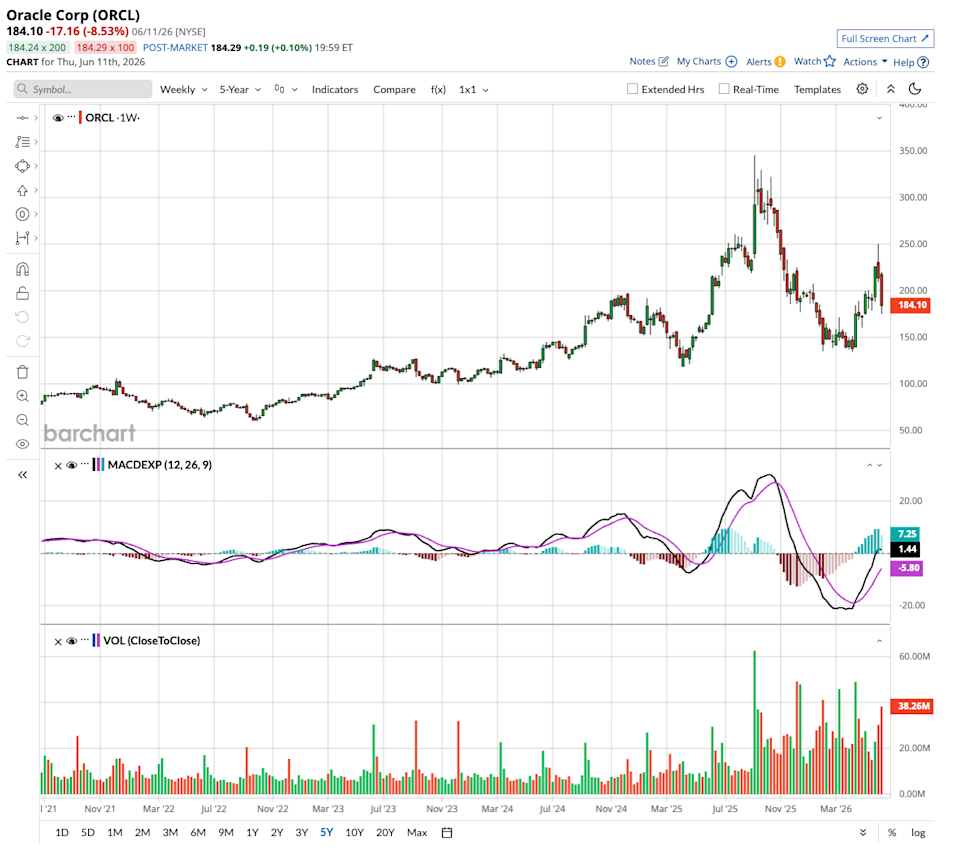
Down 46.7% from all-time highs, ORCL stock is projected to expand adjusted earnings per share from $7.63 in fiscal 2026 (ended in May) to $23.33 in fiscal 2031.

If the tech stock is priced at 22.92 times forward earnings, which is similar to its current multiple, it could nearly triple over the next four years.

Out of the 43 analysts covering Oracle stock, 33 recommend “Strong Buy”, one recommends “Moderate Buy”, eight recommend “Hold”, and one recommends “Strong Sell”. The average ORCL stock price target is $257.30, implying 39.7% upside from here.

On the date of publication, Aditya Raghunath did not have (either directly or indirectly) positions in any of the securities mentioned in this article. All information and data in this article is solely for informational purposes. This article was originally published on Barchart.com
Comments
You must be logged in to comment.