huffpost Press
Wealthy Self-Funders Fail To Advance In 2 California Primaries
Images

1 / 9

2 / 9
3 / 9

4 / 9

5 / 9

6 / 9

7 / 9

8 / 9

9 / 9
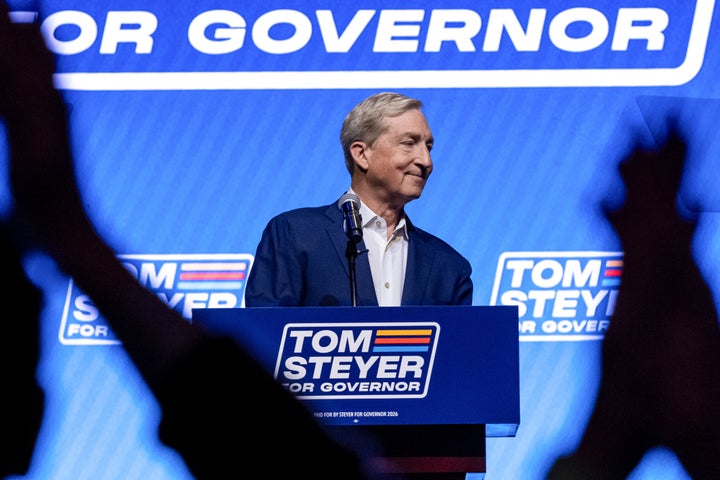
All told, billionaire environmental activist Tom Steyer spent over $215 million of his own fortune on a primary for the California governor’s seat – and ultimately fell short.

On Tuesday, The Associated Press projected that conservative commentator Steve Hilton would edge out Steyer and advance in the gubernatorial contest. The latest results, as of Thursday, show that former Health and Human Services Secretary Xavier Becerra had 28% of the vote, Hilton had 24.9% and Steyer trailed in third at 22.6%.

Similarly, Saikat Chakrabarti, a former chief of staff to Rep. Alexandria Ocasio-Cortez (D-N.Y.), came in third in the House primary for California’s 11th congressional district after putting nearly $10 million of his own funds into the race. The latest results had State Sen. Scott Wiener at 40.8%, San Francisco Supervisor Connie Chan at 29.7% and Chakrabarti with just 17.8%.

Political experts say that hefty campaign spending can boost candidates, though it also has notable limits. Funding can bolster a candidate’s name recognition, for instance, though it can’t do as much for their favorability, San Francisco State University political science professor Jason McDaniel told HuffPost.

“Campaign spending is ads, it’s staff, it’s precinct walkers, it’s all organizational stuff, data, all that,” said McDaniel.

Steyer spent $209 million on television ads, some of which introduced him to voters and laid out his progressive messaging on issues like breaking up utilities in the state. Chakrabarti, who also ran a progressive platform, focused on confronting the Democratic Party and invested heavily in voter outreach, employing over 250 paid canvassers who went door-to-door to engage local residents.

“The money could not substitute for… voters’ experience with you, previous favorable ratings, trusting,” said McDaniel.

In both races, Steyer and Chakrabarti’s opponents leaned into their backgrounds in public office and endorsements they had received to emphasize their experience and local ties. Becerra, Steyer’s chief Democratic opponent, touted his track record as California’s former attorney general, a former House lawmaker and a former Cabinet official, expertise that appealed to his supporters.

In the House race, Wiener and Chan cited endorsements from local constituencies, including Democratic officials and labor groups. Chan’s campaign also received a last-minute boost when she secured the backing of House Speaker Emerita Nancy Pelosi (D-Calif.), the incumbent in the seat.

Neither Steyer nor Chakrabarti had previously held public office, so both cast themselves as candidates eager to take on the status quo. That message resonated with a number of voters hungry for change, though it likely worked against them with people who favored their opponents’ credentials.

Steyer and Chakrabarti’s wealth and self-funding also invited scrutiny from some voters, who were wary of supporting a billionaire or centimillionaire. In both instances, their opponents accused them of attempting to buy their elections. Steyer also drew criticism for past investments in industries like fossil fuels and private prisons, which clashed with the progressive platform he had embraced.

Steyer has since said those investments “clearly didn’t align with my values” and that his former firm had divested from its stake in the private prison company. His campaign also said that the hedge fund had screened out fossil-fuel-related holdings from Steyer’s portfolio.

Both candidates criticized the support their opponents received from corporate interests and pointed to the attacks levied against them by groups affiliated with tech leaders and energy companies, respectively. Steyer said he wasn’t “conflicted by taking money from corporations,” and Chakrabarti said it was an alternative to relying on big donors and owing them favors. They also described themselves as “class traitors” who favored policies like taxing the rich.

“I think the money that they spent, they had a hard time overcoming that presumption of self-funder, you know, in a time when a lot of people in the Democratic Party are just skeptical of very rich people,” said McDaniel.

Candidates’ success can also vary depending on other factors, McDaniel said.

“If the candidates [Steyer] faced were different, if it was a different year, maybe that money is enough,” he said.

Previously, San Francisco Mayor Daniel Lurie spent heavily to self-fund his 2024 campaign as an outsider candidate. According to McDaniel, Lurie’s bid was helped by voters’ openness to an anti-incumbent message for city leadership at the time – and by one of his opponents’ campaigns struggling in the run-up to the election.

At least one other California contest involving a self-funding candidate this cycle has yet to be called. Eric Jones, a former venture capitalist who invested nearly $5 million in a progressive challenge of incumbent Rep. Mike Thompson (D-Calif.), is one of two candidates vying for the second-place spot in a primary for California’s 4th congressional district.

By entering your email and clicking Sign Up, you're agreeing to let us send you customized marketing messages about us and our advertising partners. You are also agreeing to our Terms of Service and Privacy Policy.
Comments
You must be logged in to comment.