yahoo Press
Opinion - Hegseth must stop using the government to promote his own religion
Images
1 / 6

2 / 6

3 / 6
4 / 6

5 / 6

6 / 6
The recent furor over the Pentagon’s reclassification of religious affiliations points to a deeper problem occurring in the Pentagon and the Trump administration today. That is the effort to “establish religion” in government, and particularly Christianity. But even then, it is only Christianity as defined by government officials like Secretary of Defense Pete Hegseth.

Hegseth considers himself an evangelical Christian. Evangelicals tend to be more orthodox in their Christian views than more liberal Christian churches. For example, Evangelicals stridently believe members of the Church of Jesus Christ of Latter-day Saints are not Christian. And they are critical of mainline Protestant denominations that they believe have abandoned the Gospel.

That Hegseth has those beliefs is not necessarily a problem. Top government officials often hold personal religious beliefs that they keep private or do not attempt to interject into their public duties. For example, President Joe Biden said he personally opposed abortion in line with his Catholic faith, but he did not attempt to make such views public policy.

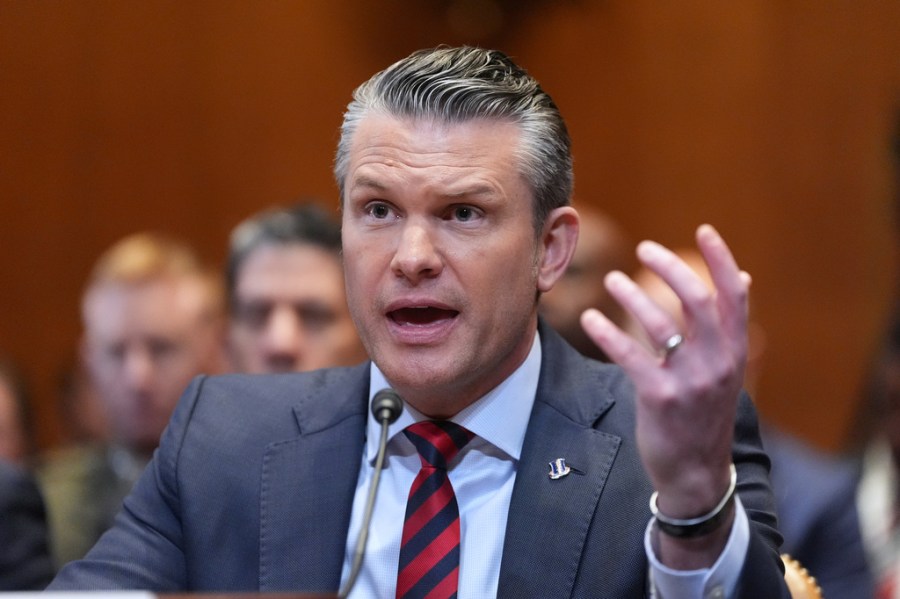
However, Hegseth has gone beyond a public official with personal religious beliefs. He has attempted to translate those beliefs into Pentagon policy and practice. He has used his government platform to promote his personal religious views.

Last year, Hegseth established a monthly religious devotional at the Pentagon, which he personally hosts. Hegseth invited his own pastor to speak at one of the sessions. At these prayer meetings, he has used Christian language to justify war. At one Pentagon prayer meeting, he read a prayer that included: “Let every round find its mark against the enemies of righteousness and our great nation.” He has specifically called on Americans to pray for the military “in the name of Jesus Christ.“

The prayer meetings are ostensibly optional for the military who work at the Pentagon. However, servicemembers report they have felt pressure to participate in the meetings. Some claim the Pentagon is keeping records of who attends.

The latest was determining which religions were Christian and which were not, and, not surprisingly, labelling the Church of Jesus Christ of Latter-day Saints as non-Christian. The Pentagon ended up backtracking after LDS criticism and reorganized the list by removing the faith designations from all faith codes.

Hegseth has diminished other religions besides his own by creating broad categorizations that minimize the distinctions among religious groups. For example, there is a significant difference between Reformed Judaism and Orthodox Judaism. But Hegseth’s list suppresses those differences with one category — Judaism. Similarly, one categorization for “Lutheran” ignores the fact that conservative Lutherans tend to belong to the Lutheran Church-Missouri Synod, whereas more progressive ones are members of Evangelical Lutheran Church in America. That may be trivial to someone like Hegseth, but paramount to a believer in either of those churches.

The Pentagon claims the new listing “will provide chaplains with clear, readily available information that will better enable them to anticipate the religious support needs of service members.” But the opposite would be true. The new list gives a chaplain less information about someone they are counseling. Chaplains typically understand the differences among faiths. But they need to have that information to counsel someone of that faith, not a broad categorization that misses key distinctions.

The most neutral means for guiding chaplains is to simply list the names of actual religious organizations, as occurred previously. The Pentagon should return to that list and drop the attempt to blur the distinctions that are real in the lives of military members. Not only will chaplains be better served, but so will the religious servicemembers they minister to.

It is not the job of the secretary of Defense to promote a particular religion or religion at all. The fact that Hegseth is doing so is a threat to religious liberty. If he will not cease injecting his personal views through his government platform, Congress needs to act to stop him.

Richard Davis is a professor emeritus of Political Science at BYU. He is the author of two books on politics and religion: “The Liberal Soul” (Greg Kofford Books) and “Faith and Politics” (Deseret Book Company and BYU Religious Studies Center).

Copyright 2026 Nexstar Media, Inc. All rights reserved. This material may not be published, broadcast, rewritten, or redistributed.

For the latest news, weather, sports, and streaming video, head to The Hill.
Comments
You must be logged in to comment.