yahoo Press
SpaceX fever is testing the chip trade: Chart of the Day
Images
1 / 7

2 / 7

3 / 7

4 / 7
5 / 7

6 / 7

7 / 7
The above button links to Coinbase. Yahoo Finance is not a broker-dealer or investment adviser and does not offer securities or cryptocurrencies for sale or facilitate trading. Coinbase pays us for certain activity generated through this link. Prices displayed are informational.

SpaceX is not public yet, but retail traders may already be making room for it.

Retail selling across single stocks just hit the heaviest level since November 2023, according to the latest note from Vanda Research, with pressure concentrated in semiconductor names including Micron (MU) and Sandisk (SNDK).

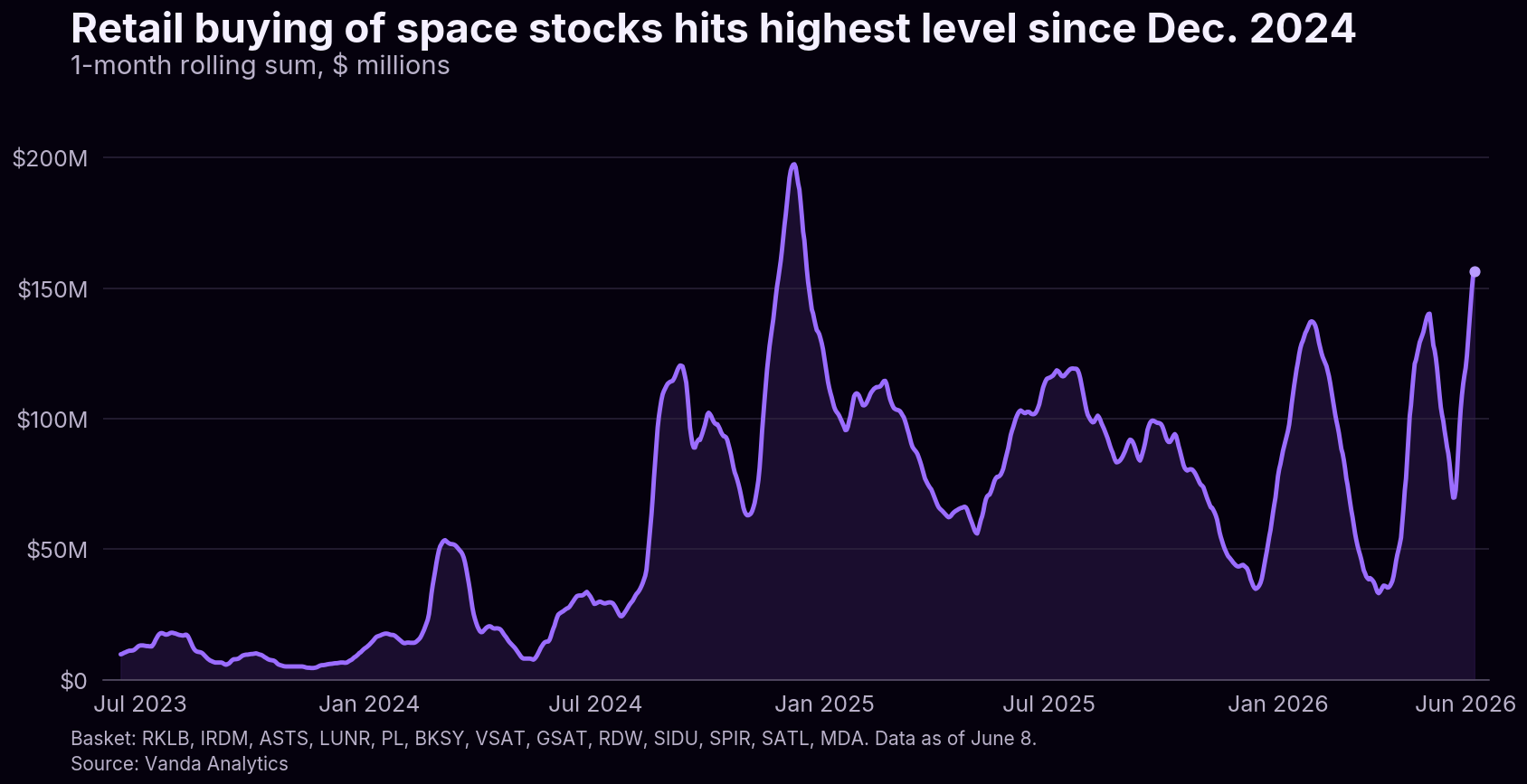
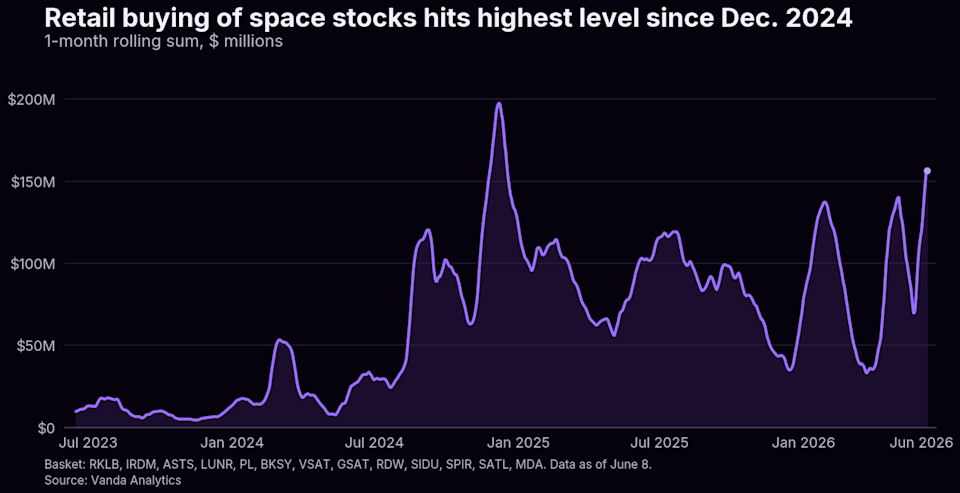
At the same time, retail buying of space stocks has reached its highest level since December 2024.

That does not mean investors are dumping chips to buy SpaceX. Broadcom (AVGO) and Marvell (MRVL) are still drawing retail buying, according to Vanda, making this less a broad semiconductor exit than a test of where retail attention goes next.

The concern is that the next wave of mega-IPOs could drain cash from the trades that have already run. That fear showed up in the tape Tuesday, when the Philadelphia Semiconductor Index (^SOX) sank nearly 9% at the lows before a late-day rally cut the loss to 1.9% by the close.

SpaceX (SPCX), OpenAI (OPAI.PVT), and Anthropic (ANTH.PVT) are expected to test public market demand while large tech companies are raising equity to fund the AI build-out. Alphabet (GOOG, GOOGL) already showed how expensive that build-out has become with its planned $80 billion stock sale.

But the size of the supply wave depends on how you measure it.

Alfonso Peccatiello, founder and CEO of the Macro Compass and founder of Palinuro Capital, recently highlighted a Goldman Sachs chart that puts the IPO rush in market context. Instead of just showing the raw dollar amount of stock being sold, the chart compares new equity issuance — stock sold through IPOs, follow-on offerings, and other share sales — with the total value of the Russell 3000 (^RUA), a broad gauge of the US stock market.

That matters because a huge dollar amount of new stock can look less threatening when scaled against the whole market. The Goldman Sachs chart asks the more important question: How big is the supply compared with the market that's expected to absorb it?

"Equity issuance as a [percent] of total market cap is still very small," Peccatiello wrote. He added that the track record of using IPO waves to call a market top is "pretty bad."

The public debut of Elon Musk's rocket and AI company is expected to make history.

He also pushed back on the idea that a stronger labor market automatically turns the Federal Reserve into a market killer. That's front and center in investors' minds after Friday's jobs report revived rate-hike fears and hit chip stocks especially hard.

Peccatiello wrote that the market's Fed hike narrative may be getting "out of hand." His point: If higher rates reflect stronger nominal growth, they do not necessarily hit risk assets the same way as a central bank suddenly slamming the brakes on the economy.

That leaves a narrower, more useful risk for investors.

The IPO wave may not be big enough to break the bull market. But it may still be big enough to pull attention away from the chip proxies retail traders already own.

Jared Blikre is the global markets and data editor for Yahoo Finance. Follow him on X at @SPYJared or email him at jaredblikre@yahooinc.com.

Click here for in-depth analysis of the latest stock market news and events moving stock prices

Read the latest financial and business news from Yahoo Finance
Comments
You must be logged in to comment.