yahoo Press
Trump praised IBM's 'legend' CEO, government floated a $1B quantum award — is the stock still a 'very nice price'?
Images
1 / 4
2 / 4

3 / 4

4 / 4
The above button links to Coinbase. Yahoo Finance is not a broker-dealer or investment adviser and does not offer securities or cryptocurrencies for sale or facilitate trading. Coinbase pays us for certain activity generated through this link. Prices displayed are informational.

Moneywise and Yahoo Finance LLC may earn commission or revenue through links in the content below.

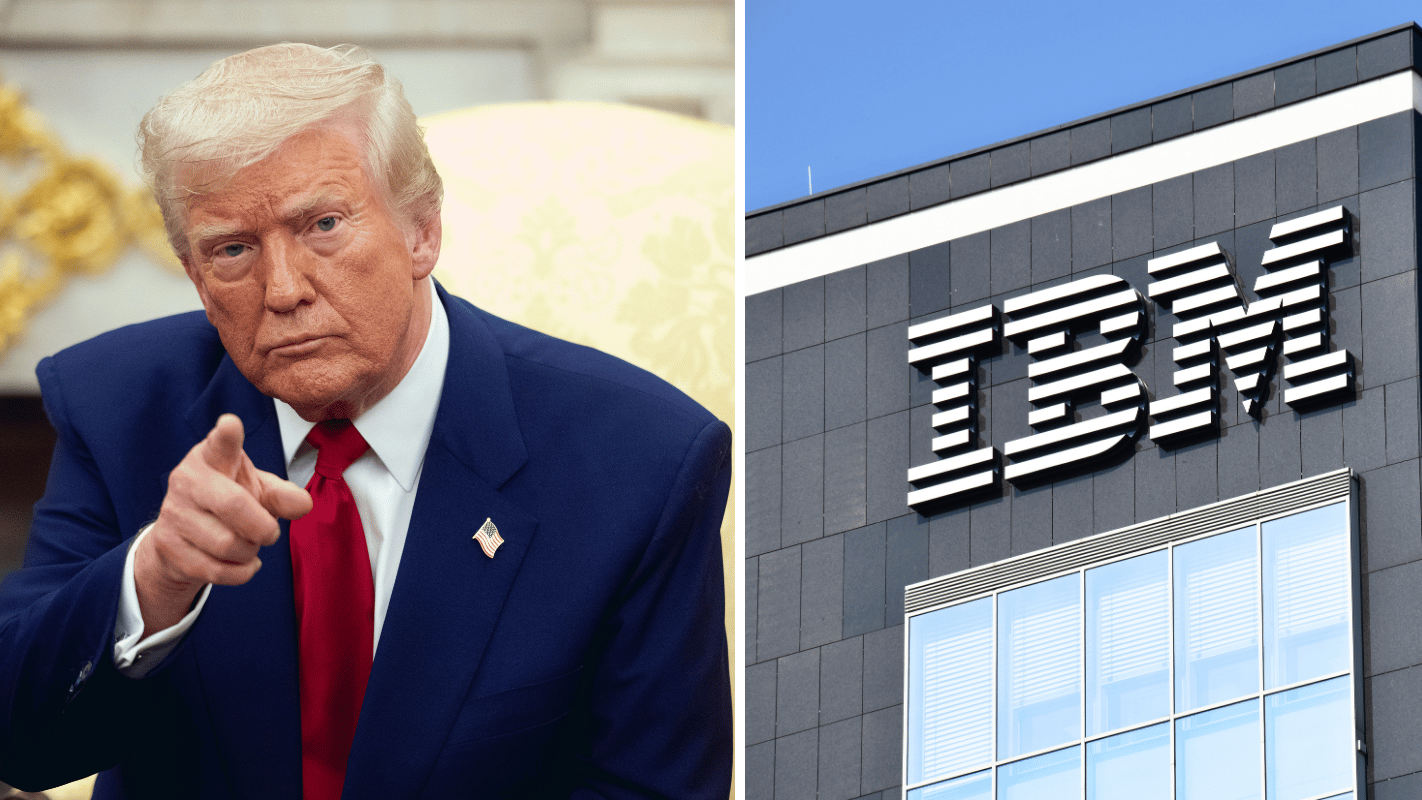
At a White House business roundtable on Dec. 10, 2025, President Donald Trump singled out IBM (NYSE:IBM) chief executive Arvind Krishna, who was in the room. He called Krishna "a legend" and credited him with taking the company's stock "from a rather low price to a very nice price," then added: "I won't say high because I'm sure you're going to say it's going to go up a lot more, right?" (1).

The clip resurfaced and spread widely in late May 2026, often stripped of that context and framed as breaking news. The reason: a newly announced IBM partnership with the government.

@placment()

On May 21, 2026, IBM and the US Department of Commerce announced a proposed $1 billion CHIPS Act award to build America's first purpose-built quantum chip foundry — a new standalone IBM company called Anderon, headquartered in Albany, New York (2).

The federal money is a proposed incentive, not cash already in hand and IBM is matching it with $1 billion of its own, plus intellectual property and workforce (3). IBM's award was the largest slice of a broader $2.01 billion package the Commerce Department spread across nine companies. GlobalFoundries (NASDAQ:GFS) is in line for $375 million, with five firms — Atom Computing, D-Wave, Infleqtion, PsiQuantum and Quantinuum — getting $100 million each, Rigetti up to $100 million and Diraq $38 million. In exchange, the government takes minority, non-controlling equity stakes rather than handing out subsidies (3).

IBM's announcement disclosed no equity stake for Anderon — unlike GlobalFoundries, which confirmed a 1% government stake in its spinoff, or Intel, whose CHIPS award the administration converted into a roughly 10% stake last year (4).

Investors responded. IBM shares closed up about 12% on May 21, the stock's biggest single-day gain since January 2025 (5). The rally extended through the following week after IBM detailed plans to invest more than $10 billion in quantum computing over five years and a separate $5 billion Red Hat cybersecurity push, carrying the stock to $297.80 by the May 29 close — a weekly gain of roughly 13% (6).

According to Trump's Q1 2026 periodic transaction report, filed with the US Office of Government Ethics on May 8, IBM appears among the holdings — not as a single headline-grabbing buy, but as part of routine, two-way trading activity (7).

The filing lists eight IBM transactions between February and March 2026: four purchases and four sales, every one in the two smallest reporting bands, from $1,001 to $50,000. Two of the purchases carry an "unsolicited" tag, meaning the trade was placed by a money manager without the filer's direction. They sit among thousands of transactions across hundreds of companies — the signature of a broad, actively managed portfolio rather than a targeted bet.

The ultra-rich use these 5 real estate strategies to build wealth while they sleep — you can start with just $100

The IRS usually taxes gold as a collectible — but this little-known strategy lets you hold physical bullion tax-free. Get your free guide from Priority Gold

Dave Ramsey warns nearly 50% of Americans are making 1 big Social Security mistake — here’s how to fix it ASAP

The trust was buying and selling IBM in the same window, including a sale in March. The White House has said Trump's assets are managed by his children and presidents are not barred from holding or trading stocks while in office, though Trump did not divest or set up a blind trust with an independent overseer. No improper timing is alleged here and the broad reporting bands make precise conclusions impossible. The trading ran in both directions.

The consensus rating sits at "buy" across roughly two dozen analysts. But the average 12-month price target near $290 sits below the recent $329.23 close. The spread is wide, running from a low of $195 to a high of $335 (8).

The bull case rests on the AI and quantum story. Wedbush analyst Dan Ives reiterated an "outperform" rating with a $320 target on May 29, naming IBM one of his top software picks as enterprise AI adoption accelerates (9).

The bears focus on valuation. UBS maintains a "sell" with a $200 target and at least one valuation model flags the stock as roughly 20% overvalued at current levels (8).

Intel's run after its own federal investment showed how government backing can reshape investor psychology faster than fundamentals justify. Whether IBM's quantum windfall translates into durable returns or is just a sentiment-driven pop is the open question.

Still, IBM may have secured a lucrative contract with the U.S. government, but even that wasn't enough to shield the stock from the latest wave of market turbulence. A widespread market selloff dragged IBM shares down more than 10% over the past five trading days.

The pain wasn't limited to IBM. Semiconductor stocks and tech giants led the decline, pushing the Nasdaq Composite to its worst single-day performance since April 2025 on June 5 (10).

Investors were rattled after a stronger-than-expected jobs report dampened hopes that the Federal Reserve would cut interest rates anytime soon. As expectations for lower borrowing costs faded, the VIX — often referred to as Wall Street's "fear gauge" — climbed to its highest level in two months.

The market's rebound since Friday's selloff serves as a reminder of just how quickly sentiment can change. Rather than reacting to every headline, consider focusing on strategies designed to weather volatility over the long run.

Market selloffs often create opportunities — but they can also expose weaknesses that investors may have overlooked during better times. That's what makes volatile markets so challenging. A stock that falls 20% could either be a bargain hiding in plain sight or a company facing serious long-term problems.

For those trying to separate temporary panic from genuine risk, expert guidance can be invaluable. That’s where platforms like Moby come in.

Their team of former hedge fund analysts and experts spend hundreds of hours each week sifting through financial news and data to provide you with breaking stock recommendations.

And if you sign up for Moby Premium you get one free top-stock.

Moby’s success speaks for itself. The platform’s stock picks have outperformed the S&P 500 index by about 11.9% over the past four years.

Even better, Moby offers a 30-day money-back guarantee so you can see if the service is right for you.

Picking the right investments is only part of the equation. Keeping more of your returns can be just as important. While volatility can be unsettling, markets don't always move in the direction investors expect. And whether your portfolio is rising or falling, investment fees continue to chip away at returns.

Discount brokers like SoFi let you buy stocks, ETFs and more with no commission fees and no account minimums — helping you minimize your investment costs.

The platform is designed for both beginners and seasoned investors, with real-time investing news, curated content and the data you need to make smart decisions about the stocks that matter most to you.

Plus, for a limited time you can get up to $1,000 in stock when you fund a new account.

When markets are swinging wildly, it's tempting to jump in and out of investments based on the latest trend or headline. But trying to time the market is notoriously difficult — even for experts.

Even legendary investor Warren Buffett has cautioned against market timing.

"We haven't the faintest idea what the stock market is gonna do when it opens on Monday — we never have," Warren Buffett said during 2022 Berkshire Hathaway Annual Shareholders Meeting, adding, "We haven't ever timed anything” (11).

Instead, Buffett has long advocated for regularly investing in broad-market index funds and allowing time and compounding to do the heavy lifting. Automating contributions can make this process even easier while helping investors benefit from dollar-cost averaging during periods of volatility.

Platforms like Acorns make it easier than ever to invest in index ETFs with your spare change from everyday purchases.

The best part? You can automate this process by linking your cards and Acorns will round up each purchase to the nearest dollar, investing the difference — your spare change — into a diversified portfolio.

With Acorns, you can invest in an S&P 500 ETF with as little as $5 — and, if you sign up today with a recurring investment, Acorns will add a $20 bonus to help you begin your investment journey.

Another way to strengthen your portfolio during uncertain times is by not putting all your eggs in one basket. Alternative assets can provide another layer of diversification, helping reduce dependence on the performance of traditional financial markets.

One asset class that has historically moved independently from the stock market is fine art. For decades, however, investing in blue-chip art was reserved for the ultra-wealthy.

Now, with Masterworks, you can buy fractional shares in multimillion-dollar works by icons like Banksy, Picasso and Basquiat. While art can be illiquid and typically requires a long-term hold, it offers unique portfolio diversification.

Masterworks has sold 25 artworks so far, yielding net annualized returns like 14.6%, 17.6% and 17.8% among assets held for longer than a year.

Moneywise readers can get priority access to diversify with art: Skip the waitlist here

Past performance is not indicative of future returns. Investing involves risk. See important Regulation A disclosures at Masterworks.com/cd.

- With files from Rudro Chakrabarti.

Read More: Thanks to Jeff Bezos, you can become a landlord for $100 — without the headache of actually being one

We rely only on vetted sources and credible third-party reporting. For details, see our editorial ethics and guidelines.

Senate Democrats (1); IBM News (2); National Institute of Standards and Technology (3); Tom's Hardware (4); CNBC (5), (11); Stock Analysis (6),(8); Office of Government Ethics (7); GuruFocus (9); CNN (10)

This article provides information only and should not be construed as advice. It is provided without warranty of any kind.
Comments
You must be logged in to comment.