yahoo Press
Stock market today: Dow, S&P 500, Nasdaq slide as CPI report lands, US-Iran truce teeters
Images
1 / 4

2 / 4

3 / 4

4 / 4
US stocks moved sharply lower on Wednesday after consumer inflation soared to its highest level in three years and renewed US-Iran military clashes cast doubt on the odds for peace talks.

The Nasdaq Composite (^IXIC) and Dow Jones Industrial Average (^DJI) both slid by roughly 1.2% as Tuesday's sell-off in tech stocks deepened, while the S&P 500 (^GSPC) dropped a slightly lesser 0.9%.

The focus Wednesday was on May's CPI report, which showed consumer prices rose at the fastest rate since May 2023. The 4.2% annual rise in CPI inflation was in line with expectations; however, the hot reading may boost bets that the Federal Reserve will hike interest rates this year.

Energy prices remained the biggest driver of inflation, amid the protracted war with Iran. Tensions between the US and Iran ramped back up, with the two sides trading strikes overnight after the downing of an Apache helicopter. President Trump said on Wednesday that Iran has "taken too long" to negotiate and would have to "pay the price." Oil prices gained after Trump's post on social media.

The tech sector is taking another bruising as the rotation out of the AI trade continues, as concerns around OpenAI (OPAI.PVT) and Anthropic's (ANTH.PVT) mega-IPOs build. Eyes are now on Oracle (ORCL) results due after market close, as the company counts OpenAI as a customer. Details of its cloud business are in focus, amid fluctuations in the AI trade.

The main event of the week lands on Friday, with the expected IPO of Elon Musk's SpaceX (SPCX). Its debut is expected to mark the largest public offering in history.

The Bank of Canada voted to maintain its target interest rate at 2.25% for the fifth time in a row on Wednesday, citing widespread instability from US trade relations and the Iran war.

The Middle East conflict has sent global energy prices rising, putting pressure on the Canadian economy, the council said. At the same time, a continuous wave of new trade negotiations and tariff proposals from the US has increased uncertainty in the Canadian market and business sector.

While there is limited evidence of higher energy prices due to the war in Iran, per the Governing Council, Canadian CPI inflation rose to 2.8% in April, while GDP fell by 0.1% in the first quarter, underperforming expectations.

"Economic activity in Canada has been weak and uncertainty about US trade policy persists. The conflict in the Middle East is ongoing and oil prices remain elevated," the Governing Council wrote in a release announcing the hold.

The rate-hold from the Bank of Canada kicks of a series of rate-setting decisions from the world's major central banks.

The European Central Bank is widely expected to raise rates by 25 basis points, to 2.25%, in its upcoming meeting on June 10 and 11; while the Bank of Japan is expected to issue a similar quarter-point hike in July to bring the nation's target interest rate to 1%, the highest level in roughly thirty years.

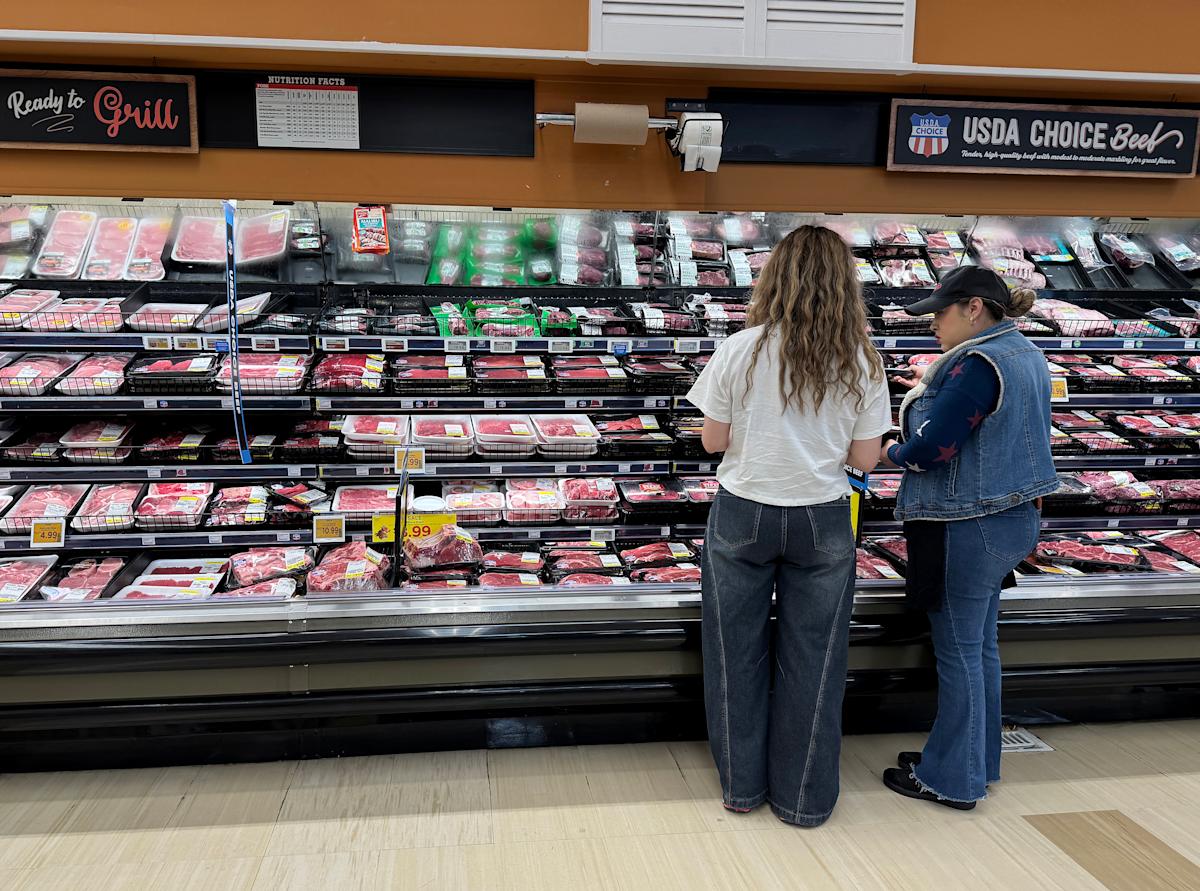
Beef prices were at record highs, and overall food prices were up 4.2% over the previous year in May, this morning’s CPI data release showed.

Here’s a look at some other categories that have seen big price jumps:

US stocks slid at the open on Wednesday after May's CPI report showed prices increased at the fastest rate since 2023, while renewed conflict in the Middle East sent oil prices climbing once more.

The Nasdaq Composite (^IXIC) led losses, down 0.8%. The S&P 500 (^GSPC) and Dow Jones Industrial Average (^DJI) both lost roughly 0.6%.

Headlining Wednesday morning was May's CPI report, which showed consumer prices advancing at the fastest rate since May 2023, up 4.2% year over year. On a core basis, prices rose 2.9% year over year, putting increased pressure on Federal Reserve Chairman Kevin Warsh to not cut rates.

A flare-up of conflict in the Middle East sent oil prices climbing once more, as President Trump said on social media that Iran has "taken too long" to negotiate and would have to "pay the price."

In the corporate world, Oracle (ORCL) is set to report its earnings results, providing investors with a key read on the state of AI demand.

Energy prices continued to surge upward in May, according to data from the Bureau of Labor Statistics' May CPI report on Wednesday, as the war in Iran continues to pressure the global oil market.

On the top line, energy prices overall advanced 23.5% year-on-year in May, a marked jump from the 17.9% increase in April.

That headline increase was driven by energy commodities, which include oil derivatives such as fuel oil, propane, and gasoline. The category advanced by 40.6% year-on-year, with prices on fuel oil and gasoline rising 58.9% and 40.9%, respectively.

Tempering the top-line jump in energy was energy services, which includes electricity prices and utility gas service. Electricity prices rose 5.9% year-on-year, while utility gas rose 3%, good for a 5.3% jump in energy services over last May.

Futures on Brent crude (BZ=F) and US WTI crude (CL=F) hovered around $93 per barrel and $90 per barrel, respectively, on Wednesday, after cooling from the near-$100 mark of the last two months for the two contracts.

Consumer prices rose 4.2% in May from a year ago, according to data released by the Bureau of Labor Statistics on Tuesday morning, marking the first time the annual metric has reached 4% in three years.

The annual inflation measure met economists’ expectations of 4.2% and rose from April's 3.8% reading. On a monthly basis, headline inflation rose 0.5%, also in line with economists’ expectations.

The "core" Consumer Price Index, which excludes the volatile food and energy categories, rose by 0.2% from the previous month and 2.9% over the previous year.

The monthly core reading was below economists' expectations of 0.3% month over month and in line with expectations of 2.9% year over year. The readings for core inflation also fell below April's 0.4% monthly rise and 2.8% yearly increase.

Stocks were poised to open lower as oil prices rose on the latest escalation in the war in the Middle East. On Wednesday morning, after the US and Iran clashed overnight, President Trump criticized the Iranian regime for dragging out negotiations and said they will "have to pay the price."

"They've taken too long to negotiate a deal that would have been great for them, now they will have to pay the price!!!" Trump stated on Truth Social.

Brent oil prices (BZ=F) rose nearly 2% to $93 per barrel, while WTI hovered just below $90 per barrel. Dow futures were down 0.9%, while futures on the S&P 500 fell 1% and those on the Nasdaq tumbled 1.5%.

Trump's comments come after the US launched a series of airstrikes within Iran on Tuesday, targeting "air defense, ground control stations, and surveillance radar sites," US Central Command said. Iran acknowledged strikes around the city of Bandar Abbas and Qeshm Island inside the Strait of Hormuz, but gave no details on the damage.

"The operation was a proportional response to recent attacks on U.S. forces and international commercial ships transiting regional waters," Central Command said, referencing the downed US Army helicopter that the US has attributed to an Iranian drone.

Jordan, Bahrain, and Kuwait all acknowledged attacks within their borders in the hours after the US airstrikes, per Reuters, further threatening to destabilize the delicate peace negotiations between Washington and Tehran. Iran claimed the strikes on the three Gulf nations.

SpaceX is not public yet, but retail traders may already be making room for it, writes Yahoo Finance’s Jared Blikre

He reports:

Retail selling across single stocks just hit the heaviest level since November 2023, according to the latest note from Vanda Research, with pressure concentrated in semiconductor names including Micron (MU) and Sandisk (SNDK).

At the same time, retail buying of space stocks has reached its highest level since December 2024.

That does not mean investors are dumping chips to buy SpaceX. Broadcom (AVGO) and Marvell (MRVL) are still drawing retail buying, according to Vanda, making this less a broad semiconductor exit than a test of where retail attention goes next.

The concern is that the next wave of mega-IPOs could drain cash from the trades that have already run. That fear showed up in the tape Tuesday, when the Philadelphia Semiconductor Index (^SOX) sank nearly 9% at the lows before a late-day rally cut the loss to 1.9% by the close.

Read more here.

Oracle (ORCL) is set to post results for its most recent quarter against a background of faltering faith in the AI trade underpinning hopes for the Silicon Valley veteran.

Yahoo Finance’s Daniel Howley lays out what to watch:

Oracle will report its fourth quarter earnings after the bell on Wednesday, amid recent AI trade fluctuations and as Anthropic (ANTH.PVT) and OpenAI (OPAI.PVT) set up their initial public offerings.

The cloud services and infrastructure provider counts OpenAI among its most important customers.

The Sam Altman-helmed AI startup signed a $300 billion, five-year deal with Oracle in 2025, which serves as the linchpin of its AI efforts.

For the fourth quarter, Oracle is expected to report earnings per share (EPS) of $1.97 on revenue of $19 billion, according to a Bloomberg analyst consensus.

Read more here.

Bloomberg reports:

Gold (GC=F) extended a decline after the US launched strikes against Iran in retaliation for the downing of a military helicopter, jeopardizing efforts to end the war that's roiled global markets and raised inflation risks.

Bullion fell as much as 2.1% to around $4,173 an ounce on Wednesday, having slid 1.6% in the previous session. American forces struck Iranian sites near the Strait of Hormuz after President Donald Trump blamed Tehran for shooting down a US helicopter off the coast of Oman. Iran's Mehr news agency reported that several explosions were heard on Qeshm Island and along the country's southern coast.

The latest clashes threaten a fragile ceasefire and risk extending the near-total closure of Hormuz, a vital transit point for energy shipments from the Middle East to global markets. Iranian Foreign Minister Abbas Araghchi said in a post on X that the country "will leave no attack or threat unanswered" and the Islamic Republic later launched a drone strike on the US Fifth Fleet in Bahrain, state-run IRIB News reported.

Gold is about a fifth below where it was trading before the Iran war broke out at the end of February. The metal's recent decline through its 200-day moving average — a widely watched measure of long-term momentum — has triggered additional selling as it's seen as an important level watched by institutional investors.

Read more here.

Bloomberg reports:

Oil rebounded after the US launched fresh strikes against Iran following the downing of an American helicopter, posing a new threat to a fragile truce that's been tested by recent attacks in the Middle East.

Brent (BZ=F) crude climbed as much as 2% to trade above $93 a barrel, while West Texas Intermediate (CL=F) rallied to $90. Both benchmarks slumped in the previous session. The "self-defense strikes" on Iran were conducted under President Donald Trump's direction in response to an Apache helicopter being shot down off Oman, US Central Command said in a brief statement.

"The mission is a proportional response to unjustified Iranian aggression," Centcom said on X. Iran's state-run IRIB reported that Qeshm Island in the Strait of Hormuz had been struck, with at least six explosions, along with strikes in the Jask region near the narrow waterway.

The fresh US strikes imperil the stability of a shaky ceasefire in the region and negotiations for a more lasting accord between the warring parties. Trump has repeatedly said that peace talks are on track, after a flare-up earlier in the week saw Israel and Iran exchange attacks.

Read more here.
Comments
You must be logged in to comment.