yahoo Press
Live From Wealth Management EDGE: Focus on AI, Growth and UHNW Wealth Transfer
Images
1 / 7
2 / 7

3 / 7
4 / 7
5 / 7

6 / 7

7 / 7
You can find original article here WealthManagement. Subscribe to our free daily WealthManagement newsletters.

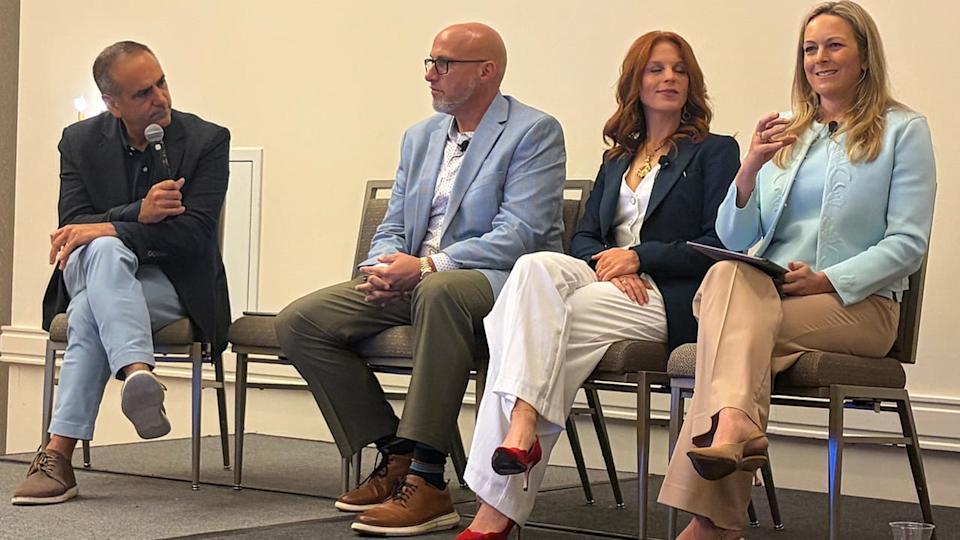
RIA leaders speaking on a panel at the UHNW Summit at Wealth Management EDGE said there is a pressing need for financial advisors to engage with their clients’ second-generation family members, rather than just pay lip service to the idea.

Cameron Rogers, partner at Angeles Wealth Management, said financial advisors can benefit by engaging clients’ second-generation family members early. She said advisors need to realize that families are getting more complex in their makeup, and issues of inheritance and support may veer more toward “therapy.”

“Yes, it’s about investments, and yes, it’s about growth of principal, but it’s as much about managing these conversations,” she said.

Tiffany Tocco, business development risk advisor at Starkweather & Shepley Insurance, said advisors need to stop using complex investment terms and acronyms with younger generations. Instead, she recommended financial advisors seek to “educate the next generation in terms they can understand and relate to.”

She also said advisors should stop asking whether the next generation wants to work with them more through technology, and just assume that they do.

“They don’t want to hear that you are working to offer technology options—they expect you to be using them,” she said.

Jason Borek, chief growth officer, The Pinnacle Group, said he sees among advisors “a little bit of an engagement problem.”

“The question I think most advisors are going to ask is, ‘Are we wanting to engage through the lens of preparation, or are we wanting to engage through the lens of a family crisis?’,” he said. “If this conversation hasn’t happened, you’re already too late if an advisor is stepping into the room with the next generation during a crisis.”

Borek said that the “firms that are getting it right” have committed to working with the next generation and have set up a system to support it, including hiring next-generation advisors.

Large firms aren’t the only beneficiaries of advancing artificial intelligence. In fact, according to Adam Moseley, Charles Schwab’s director of artificial intelligence consulting, small firms may have a tactical advantage as they “have far less red tape to work through.”

During a discussion at the AI Assembly Summit at Wealth Management EDGE, Moseley and other AI industry experts expanded on how AI-enabled firms will change over the next 12-24 months.

According to Mark Swan, the CEO and co-founder of Nevis, the industry is seeing a shift from systems to agents, meaning AI tools will no longer be considered a supplement to advisor tasks and will move further toward completing tasks “end-to-end.” While firms typically spend about 30% on operations, Swan expected big reductions, whether through cost savings or scale.

Allworth Financial Chief Marketing Officer Brad Boekestein noted that during that firm’s recent recapitalization (the third since its founding, led by Integrum Holdings), AI was the top focus. According to Boekestein, potential investors wanted to know whether AI would make firms’ current models more efficient or change them “altogether.”

“It’s to be determined, and it’s probably what every industry is struggling with,” he said. “There are pockets of folks who think it’s only going to be an efficiency shift, and I’m not sure.”

Mazi Bahadori, CCO and executive vice president of operations at Altruist, argued that there are more artificial intelligence solutions out there in wealth management than there are problems.

Almost every company raising venture capital funding has an AI mandate, and these companies are raising “stupid sums of money” to build things that will become commoditized and that you can build yourself using tools like Claude.

As a result, advisors are constantly getting sold on stuff that doesn’t really add much value.

“They look really cool; they look really flashy,” he said.

The best way to address this is to identify what problem you’re trying to solve in your advisory business.

Zoe Financial CEO and founder Andres Garcia-Amaya wants firms to ask themselves where they are “on the AI pyramid.”

During an opening session at the AI Assembly Summit at Wealth Management EDGE, Garcia-Amaya said that most firms have reached the base of the pyramid, which he deemed “search and discovery,” which he described as “essentially replacing Google Search” (it could also include doing basic tasks like improving copy and checking for errors).

Firms are trying to build their ability to use AI to develop “repeatable” skills that automate common tasks within the organization, saving hours per week. Garcia-Amaya surmised that this was the stage where many wealth-focused firms “want to become efficient.”

The final step of the pyramid is “agentic,” though Garcia-Amaya stressed that there were very few companies worldwide operating on agentic strategies and tools. However, he stressed that there was only one way to reach the tip of the pyramid.

“You need to get there by building skills and tasks,” he said. “It gives you a visual understanding of the promise of AI.”

According to Garcia-Amaya, you can build skills in your organization that can attract clients, and that firms are “sitting on an amazing amount of information on what your ideal client is.”

—Patrick Donachie

Heather Pelant, a managing director and wealth advisor at Cresset, said the wealth management industry is grappling with whether, and to what extent, advice is broadening beyond investment management and financial planning.

“Are we amidst a short-term demographic shift as the great wealth transfer happens, and the next generation comes online, or are we amid a fundamental redesign of our industry?” she asked during the UHNW Summit, kicking off the Wealth Management EDGE conference.

Pelant made the case for the latter, saying this change is being driven by three key areas: the increased complexity of portfolios and investment products, shifting client expectations toward broader life advice and guidance, and the impact of technology for both advisors and clients.

“The aperture for wealth management is getting wider and deeper at the same time,” Pelant said. “I think that the goals are not necessarily about maximizing return, but we are also supposed to be having a hand in ‘what does multigenerational stewardship look like, how does capital align to what is of most importance to me and my family? What does governance look like?’ ... And I don’t think this is happening in five years. I think it’s happening now.”

—Alex Ortolani

Client and prospect relationships go through a lifecycle, from attraction through retaining a client and having them give you referrals. But there are points along that lifecycle where it stops working because growth breaks down.

Robert Sofia, CEO of Snappy Kraken, outlined the five most common places where growth breaks down. Mishandling leads is the first place. He said 68% of advisors are competing for the same leads, so you’ve got to work fast. And 78% of clients choose the first responder.

The second area is working with the wrong leads. Leads require different handling, and advisors need a place to see all lead sources and track those leads.

Third, growth can break if there’s no strategic, short-term follow-up. The vast majority of leads aren’t ready right away, but advisors need to stay visible without becoming noise. Advisors can build trust by staying relevant. “You can’t have one generic path for everyone, because humans aren’t generic,” Sofia said.

Fourth, there can sometimes be a lack of long-term follow-up. “Long-term nurture drives more engagement, which leads to more clients,” he said.

And finally, growth can break if there’s no behavior-based handoff to advisors. When advisors get leads, it’s hard to know where to focus their energy. But firms can help by providing qualified, high-intense leads. That will result in higher conversion rates.

—Diana Britton
Comments
You must be logged in to comment.