yahoo Press
The Liquidity Vacuum: Why Friday’s Stock Market Selloff Was a Technical Glitch
Images
1 / 6
2 / 6

3 / 6
4 / 6
5 / 6

6 / 6
The above button links to Coinbase. Yahoo Finance is not a broker-dealer or investment adviser and does not offer securities or cryptocurrencies for sale or facilitate trading. Coinbase pays us for certain activity generated through this link. Prices displayed are informational.

Market selloffs are almost always blamed on macroeconomics. The labor market, inflation, and Fed rates are the usual culprits. However, sometimes the mechanics behind price movements depend heavily on temporary technical factors. Let’s break down Friday’s drop, not through a lens of fear, but through the mechanics of cash flow.

First, I want to be clear: Alphabet (GOOG) (GOOGL) is not to blame for the market drop. It was simply a convergence of circumstances. Last year, the company reported a net income of $132 billion, and its trailing-12-month (TTM) profit is a staggering $160 billion.

Ahead of Oracle Earnings, Here's What Barchart Data Says Comes Next for ORCL Stock

Billionaire Jeff Bezos Says America Needs to ‘Fix It at the Root’ Like Amazon Does Instead of Picking Villains — Bottom 50% Should Pay ‘Zero’ Taxes

JPMorgan Just Dramatically Reversed Course on Tesla Because TSLA Stock Has Massive Physical AI Potential

Our exclusive Barchart Brief newsletter is your FREE midday guide to what's moving stocks, sectors, and investor sentiment - delivered right when you need the info most. Subscribe today!

But as I see it, the company’s plans for data center infrastructure are so massive that even this amount of cash isn't enough. Therefore, last Thursday and Friday, the company issued additional shares to keep its expansion on track and raise extra capital from the market.

Judging by Friday’s trading results, the market struggled to digest this offering. Let’s look at the math. On June 4, the market absorbed about $18 billion in Alphabet Class A and C shares. On June 5, an additional $16.75 billion in mandatory convertible preferred stock hit the market. On top of that, Berkshire Hathaway (BRK.A) (BRK.B) participated in the offering for $10 billion.

On its face, there is nothing inherently wrong with this. However, for the financial system itself, this sudden extraction of liquidity over such a short period clearly played a cruel trick. In total, over those two days, about $34.75 billion in pure cash was pulled out of circulation.

For the global financial system, $35 billion is a drop in the ocean. Banks, repos, and Treasury bills — they all function normally. But for the order book, it is critical. When a brokerage firm or market maker sends these billions toward Google's bank accounts, their own account balances deplete instantly. Yes, they have massive assets, and yes, they can order liquidity or raise cash through interbank instruments, but this process doesn't work like an instant teleportation. In the banking system, "ordering" cash is a process that physically cannot be completed until the following day.

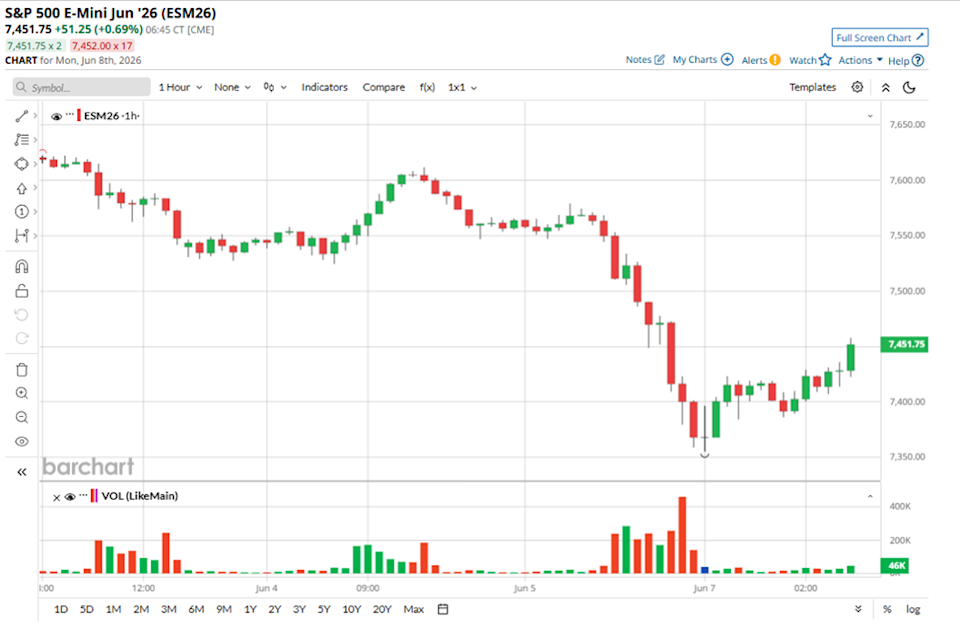
Ultimately, here is how the Friday picture played out, in my view: The labor market statistics were released. Traders instantly interpreted them as negative due to interest-rate risks, and standard selling began. On any normal day, a deep order book would have easily absorbed this volume, and prices would have simply dipped slightly. However, this past Friday, the order books were physically empty.

Liquidity had been funneled into the Google deal, so there were far fewer buy orders than usual. Prices moved sharply downward, driven by sales that would have been called a banal correction on any other day. A chain reaction was triggered instantly once stop-loss orders were hit. I believe there was simply no one left to buy the dip. There was a critical shortage of live cash in trading systems at that moment.

This can be referred to as a technical crash. The market "overreacted" precisely because it lacked a sufficient liquidity buffer to absorb the shock.

The situation will normalize. Repos, capital inflows, and arbitrage will bring liquidity back into the system. Order books will fill up with volume again, and the market will start trading based on fundamentals rather than "liquidity holes."

On the date of publication, Mikhail Fedorov did not have (either directly or indirectly) positions in any of the securities mentioned in this article. All information and data in this article is solely for informational purposes. This article was originally published on Barchart.com
Comments
You must be logged in to comment.