yahoo Press
The AI bubble looks fit to burst, Bank of America director says. Here’s your road map for riding out a crash
Images
1 / 4
2 / 4

3 / 4

4 / 4
Amid a fire hose of financial forecasts and guidance from endless talking heads, CEOs, social media personalities and others, more and more industry watchers are pointing to telltale signs that the stock market’s bull run can’t last much longer.

One of these is Michael Hartnett, managing director and chief investment strategist at the Bank of America’s research arm. He issued some guidance to clients this past week that’s very telling of his blunt prognosis for the current AI frenzy: prepare for the bubble to burst.

Robert Kiyosaki says this 1 asset will surge 400% in a year and begs investors not to miss this ‘explosion’

Prime US real estate was a rich person's game — then something changed. Now everyday Americans are getting a piece of the action for as little as $100

Millionaires under 43 are reshaping investing — just 25% of their portfolios are in stocks. Here’s where their money is going

Hartnett — who coined the term The Magnificent Seven (1) for the seven largest tech stocks — hasn’t written Substack diatribes or given tons of interviews, as industry gurus like Michael Burry, Jamie Dimon and others (2) have. But his “post-bubble roadmap” offers a stark picture. His research report, The Flow Show, is not available publicly (3), but excerpts have been published (4).

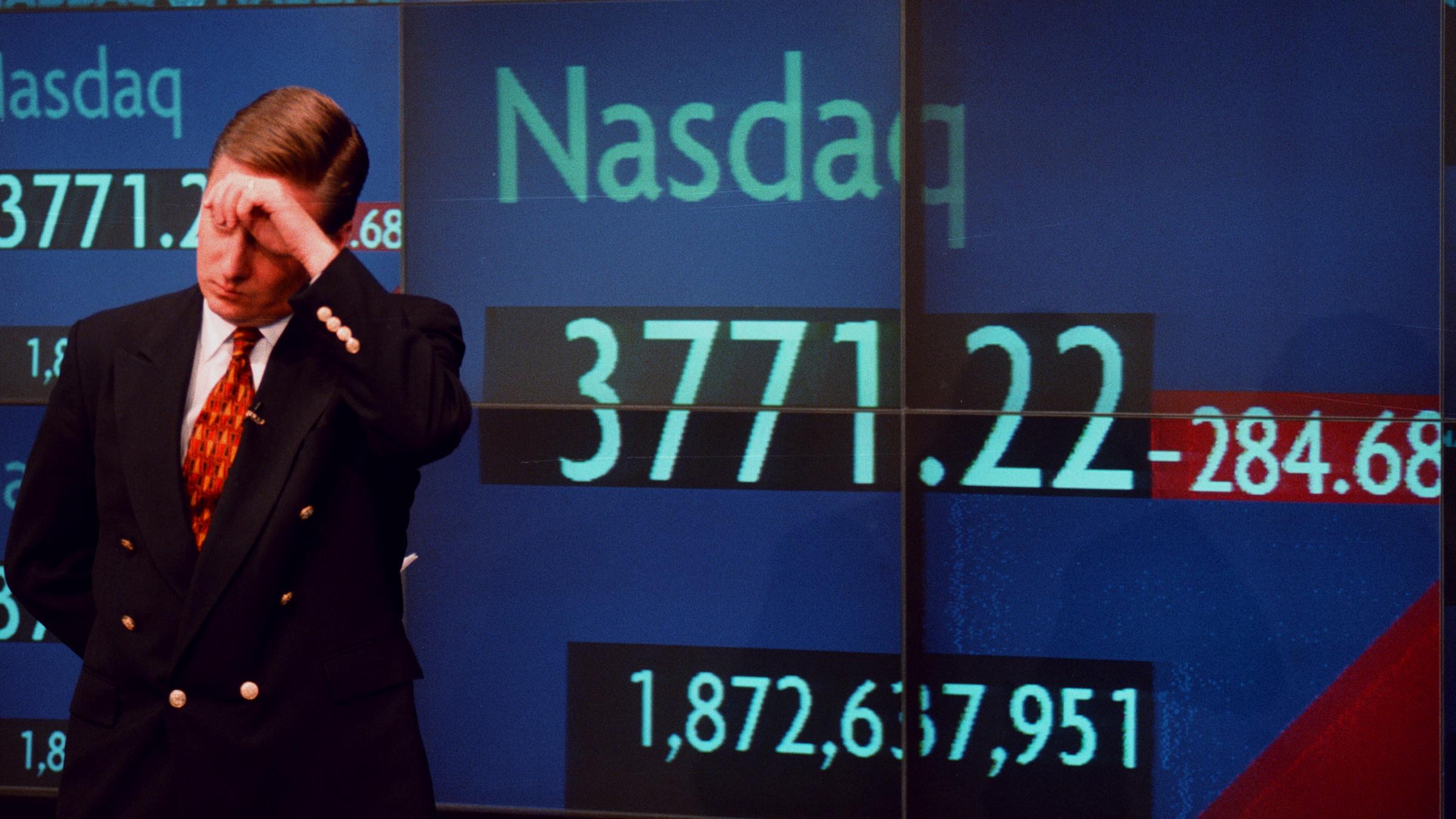
On Friday, yet another unignorable, potentially calamitous pattern emerged in the S&P 500 that pricked the ears of Hartnett and others. While the index hit another record closing high (5), it was only 21 stocks that led it there — just one more than the 20 that propelled the dot-com bubble to its peak before everything came crashing down in 2000.

Other key red flags behind recent performance include what Hartnett called “speculative” and “exponential price action;” overvaluation of firms that have yet to produce earnings relative to their stock price; a high bull & bear indicator; extreme imbalance and over-concentration, with only 10 stocks comprising two-fifths of the index’s power; and the fact that the vast majority of S&P components (upwards of 330) are now sitting at 20-40% below their previous highs.

All of this and more has driven Hartnett and his team to issue some simple advice that he believes will prove necessary in the near future. To mitigate the damage of a potential correction, they suggest the tried-and-true strategy of leaning into bonds — a historically reliable, but perhaps boring area of the market that isn’t high-flying right now.

“Post-bubble investor roadmap since 1929 is long bonds, and long combo of defensives and/or sectors which dramatically underperformed in the last months of the bubble,” the memo states.

Hartnett recommends relying on comparatively underperforming segments like consumer goods, mining, materials, health care and similar equities alongside bonds. According to his analysis, they’ll likely be leaders after the AI bubble, based on what’s happened in past crashes. (Famously, during some of the worst days of the 2008 stock market crash, the recession-proof Campbell Soup was the only S&P 500 stock to rise (6)).

When it’s time to pivot and diversify is a trickier question, given the overall environment of economic uncertainty. A lot is still riding on the results of the military action in Iran, forthcoming interest rate changes, major tech IPOs and other events. It’s also worth saying that even after major shocks, historical trends show the stock market does eventually recover. Those who are able to ride out extended downturns often fare better.

As “Big Short” investor Michael Burry said late last year (7), “There is no way to time or predict” the end of the bubble, which could still persist for some months.

Read More: Taxes are going to change under Trump’s ‘big beautiful bill’ — 4 reasons you can’t afford to waste time

In recent weeks, pundit sentiment has been unsettling for anyone who has heavily invested in AI equities.

Retired chief investment strategist Jim Paulsen has written numerous columns about a concerningly “extreme” bifurcation between new-era and old-era stocks, with the former “racing ahead almost in isolation.” Meanwhile, Burry, who predicted the subprime mortgage crisis in 2008, has underscored time and time again how much the present moment feels like the Y2K-era dot-com bubble.

“The market has jumped the shark … the end of this is nigh,” he wrote on his blog in May, pointing to the 784% surge in the Nasdaq 100’s top 10 over one year, which outpaced the 622% increase preceding the 1999-2000 recession.

Burry has also eagerly reminded the public how overstated tech earnings have been for years, with billions poured into infrastructure with little real return on investment, soaring valuation multiples (8) and concerningly high price-to-earnings ratios (9) that Hartnett likewise flagged in his recent message. These are all signs investors look for to indicate stocks are overvalued.

In the words of Mad Money’s Jim Cramer, the market has been “punishing anything not connected to tech or to the data center” — punished equities that may soon see a triumphant return in a new cycle.

Millions of US drivers renew their car insurance without shopping around. Your insurer loves that. This 2-minute check could save you 15% or more

Dave Ramsey warns nearly 50% of Americans are making 1 big Social Security mistake — here’s how to fix it ASAP

Thanks to Jeff Bezos, you can now become a landlord for as little as $100 — and no, you don't have to deal with tenants or fix freezers. Here's how

Stop the leak: 4 costs Americans (still) overpay for every single month. How many are sabotaging your budget?

Join 250,000+ readers and get Moneywise’s best stories and exclusive interviews first — clear insights curated and delivered weekly. Subscribe now.

We rely only on vetted sources and credible third-party reporting. For details, see our ethics and guidelines.

Reuters (1), (5); Bloomberg (2); Bank of America (3); CNBC (4); The Denver Post (6); Business Insider (7); Morgan Stanley (8); Investopedia (9)

This article originally appeared on Moneywise.com under the title: The AI bubble looks fit to burst, Bank of America director says. Here’s your road map for riding out a crash

This article provides information only and should not be construed as advice. It is provided without warranty of any kind.
Comments
You must be logged in to comment.