yahoo Press
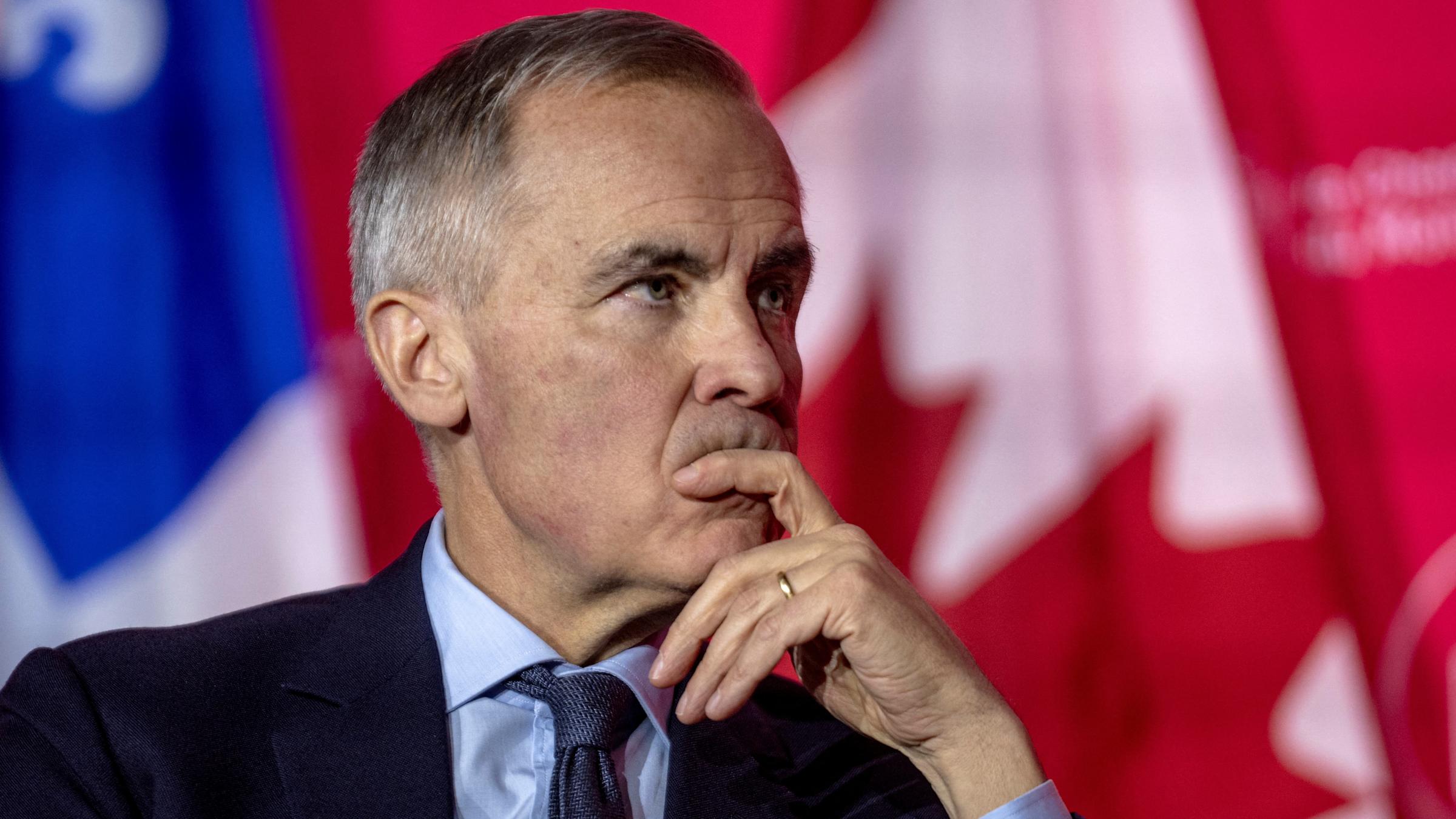
Mark Carney now says Canada can help 'make America great again' — a reversal from defiance as Canada’s economy shrinks
Images
1 / 5
2 / 5

3 / 5

4 / 5
5 / 5
Moneywise and Yahoo Finance LLC may earn commission or revenue through links in the content below.

While the friction between the U.S. and Canada might seem to be cooling, veteran investors, scarred by past tariff skirmishes (1), are well aware that cross-border alliances can turn on a dime.

Carney once argued (2) that Canada’s deep economic integration with the U.S. had created vulnerabilities and called for “middle powers” to unite and work together. Speaking at the Economic Club (3) of New York in late May, he struck a different tone, declaring that a “Canada Strong” would help “make America great again.”

Here’s how to get rich from rising US property values with as little as $100 — and without the stress of angry tenants

Dave Ramsey warns nearly 50% of Americans are making 1 big Social Security mistake — here’s how to fix it ASAP

Goldman Sachs used to hoard prime real estate deals for the ultrarich. Two ex-analysts just opened the door for $250

These comments land at a critical moment for North American trade. Looming over the market is the July 1 deadline, the day the United States, Canada and Mexico must decide whether to renew the United States-Mexico-Canada Agreement (USMCA) for another 16 years.

The USMCA (4) currently guarantees $1.8 trillion in trilateral, tariff-free trade as of 2022. But according to the CSIS’s March 2026 brief (5), USMCA Review 2026: Six Scenarios for North America’s Future, the upcoming assessment has cast a “cloud of sustained uncertainty that discourages long-term investment bets.”

Carney has a more optimistic perspective, despite the trade tensions that defined 2025.

“We know that while Canada and the United States have had our differences over the centuries, we have always worked and eventually work through them because we share values and our common interests run deep,” Carney said.

North America’s manufacturing relies on highly connected supply chains (6), with some items crossing borders up to eight times (7) before hitting shelves. Trade disputes break that chain, and the resulting border friction cuts domestic production capacity.

This means that even just anticipating a tariff can immediately drive inflation. Higher costs then squeeze corporate profits, forcing central banks to pause interest rate hikes and creating unpredictable volatility across North American financial markets.

While investors can’t control trade negotiations, they can take steps to make their portfolios more resilient if volatility returns.

According to ICBA Chief Economist Jock Finlayson, writing as a Senior Fellow at the Fraser Institute (8), Canada’s recent efforts to diversify have resulted only in a modest pullback from American markets. He described the process as “sticky.”

Plus, on May 29, CTV News (9) reported on the shrinkage of the Canadian economy, citing StatCan data (10) showing a stall from Q1 2026 following a 0.2% decline in Q4 2025.

Canada sends roughly three-quarters of its exports to the United States (11), making America by far its largest trading partner. Carney emphasized the advantages of enhanced North American integration, despite his administration’s earlier focus on bolstering trade links with Asia and Europe and pursuing greater economic autonomy.

“It’s still the case that 85% of our trade goes across tariff-free,” Carney said. “Everyone benefits from that.”

The U.S., Canada and Mexico collectively represent one of the largest trading blocs in the world. Under USMCA, most goods move across borders without tariffs, helping businesses keep costs lower and supply chains operating efficiently.

Carney highlighted just how integrated the economies have become, noting that Canada is America’s largest export customer and that roughly 70% of Canadian exports are used as inputs for American-made products, including cars, homes, aircraft and machinery.

He also pointed to Canada’s role in supplying critical resources to the U.S. economy, arguing that Canadian aluminum exports alone are equivalent to the energy output of “10 Hoover Dams.”

If trade negotiations deteriorate, businesses could face higher costs, consumers could see higher prices, and investors could experience greater market volatility.

Investors have seen this story before. Previous rounds of tariff disputes triggered market volatility across manufacturing, industrial and agricultural sectors as companies struggled to adapt to shifting trade policies. For example, the 2018-2019 tariff dispute (12) over the initial implementation of Section 232 led the U.S. to impose a 25% tariff on steel and a 10% tariff on aluminum, triggering a surge in worldwide tariffs.

That doesn’t necessarily mean you should make drastic changes. In fact, periods of uncertainty are a great time to review long-term investment strategies.

Read More: Here’s the average income of Americans by age in 2026. Are you falling behind?

Trade negotiations, elections and geopolitical disputes can create short-term volatility. Still, long-term investors have historically been rewarded for staying invested through market cycles rather than trying to time them.

That’s where regular investing can make a difference. Putting in a little bit at a time consistently plays into dollar cost averaging, which means you tend to capture both dips and spikes in the market, with the former helping to mitigate the effects of the latter. But for many, taking the time to invest regularly is just another obligation on an already long list of obligations.

With Acorns, investors can automatically invest spare change from everyday purchases into a diversified portfolio of exchange-traded funds managed by leading investment firms such as Vanguard and BlackRock.

How it works is simple: Just link your debit and credit cards, then Acorns will round up each purchase to the dollar. For example, if you purchase a coffee for $3.50, Acorns can round the transaction up to $4 before the caffeine rush hits and automatically invest the remaining 50 cents. Over time, those small contributions can accumulate alongside regular deposits.

Small amounts can really add up. An investor who contributes $100 per month and earns an average annual return of 8% could accumulate roughly $136,000 over 30 years — despite investing only $36,000 of their own money. The difference comes from compound growth working over time.

And if you sign up today, you can get a $20 bonus investment — provided you set up a small monthly deposit to boost your saving power.

While staying steadily invested is often the right play, what you invest in also matters. Stocks have generated strong long-term returns, and the S&P is currently at its highest run in history (13), but some investors also allocate a portion of their portfolios to assets that don’t move in lockstep with the markets.

Gold, in particular, can be an attractive asset during periods of market volatility. When inflation rears its ugly head, gold holds its value.

That’s because it isn’t directly tied to a company’s earnings or a single country’s economic performance. Gold is often called a ‘hedge’ or ‘safe-haven’ (14) against market turbulence for that reason.

Priority Gold is an industry leader in precious metals, offering physical delivery of gold and silver. Plus, they have an A+ rating from the Better Business Bureau and a 5-star rating from Trust Link.

If you’d like to convert an existing IRA into a gold IRA, Priority Gold offers 100% free rollover, as well as free shipping and free storage for up to five years. Qualifying purchases can also receive up to $10,000 in free silver.

To learn more about how Priority Gold can help you reduce inflation’s impact on your nest egg, download their free 2026 gold investor bundle. Just remember, for most investors, gold is one part of a well-diversified strategy — not a one-to-one asset replacement strategy.

Trade policy is just one of many factors that can affect financial markets. Interest rates, inflation, corporate earnings and economic growth often play an even larger role in determining long-term investment outcomes.

This is especially critical for those with a portfolio of $250,000 or more. Losing your nest egg due to poor management could set you back a decade, easily.

In these cases, working with a financial advisor can help reduce costly oversights. Platforms like WiserAdvisor can connect you with vetted professionals who specialize in this kind of planning.

How it works:

Share your goals: You provide a few details about your savings, retirement timeline and your investment portfolio

Get matched for free: WiserAdvisor scours its network to match you with up to three vetted, reputable advisors who fit your specific needs

Consult for free: You can set up a no-obligation consultation with your matches to see who is the best fit for your long-term goals

Note: WiserAdvisor is a matching service and does not provide financial advice directly. All matched advisors are third parties, and specific financial results are not guaranteed.

For investors concerned about what comes next in North American trade relations, the most productive response may not be trying to predict the outcome of negotiations. Instead, it may be ensuring that their portfolio is diversified enough to handle whatever happens next.

10 minutes could get you up to $2M in life insurance coverage with no medical exams. Check your rate and secure instant coverage from your couch with Ethos

Thanks to Jeff Bezos, you can now become a landlord for as little as $100 — and no, you don't have to deal with tenants or fix freezers. Here's how

Vanguard’s outlook on U.S. stocks is raising alarm bells for retirees. Here’s why and how to protect yourself

Robert Kiyosaki says this 1 asset will surge 400% in a year and begs investors not to miss this ‘explosion’

Join 250,000+ readers and get Moneywise’s best stories and exclusive interviews first — clear insights curated and delivered weekly. Subscribe now.

We rely only on vetted sources and credible third-party reporting. For details, see our editorial ethics and guidelines.

Lexology (1); World Economic Forum (2); CBC News/ YouTube (3); Office of the United States Trade Representative (4), (11); Center for Strategic and International Studies (5); Brookings Institution (6); Canadian Veterinary Medical Association (7); Fraser Institute (8); CTV News (9); Statistics Canada (10); Choices Magazine (12); BNN Bloomberg (13); MDPI (14)

This article provides information only and should not be construed as advice. It is provided without warranty of any kind.
Comments
You must be logged in to comment.