yahoo Press
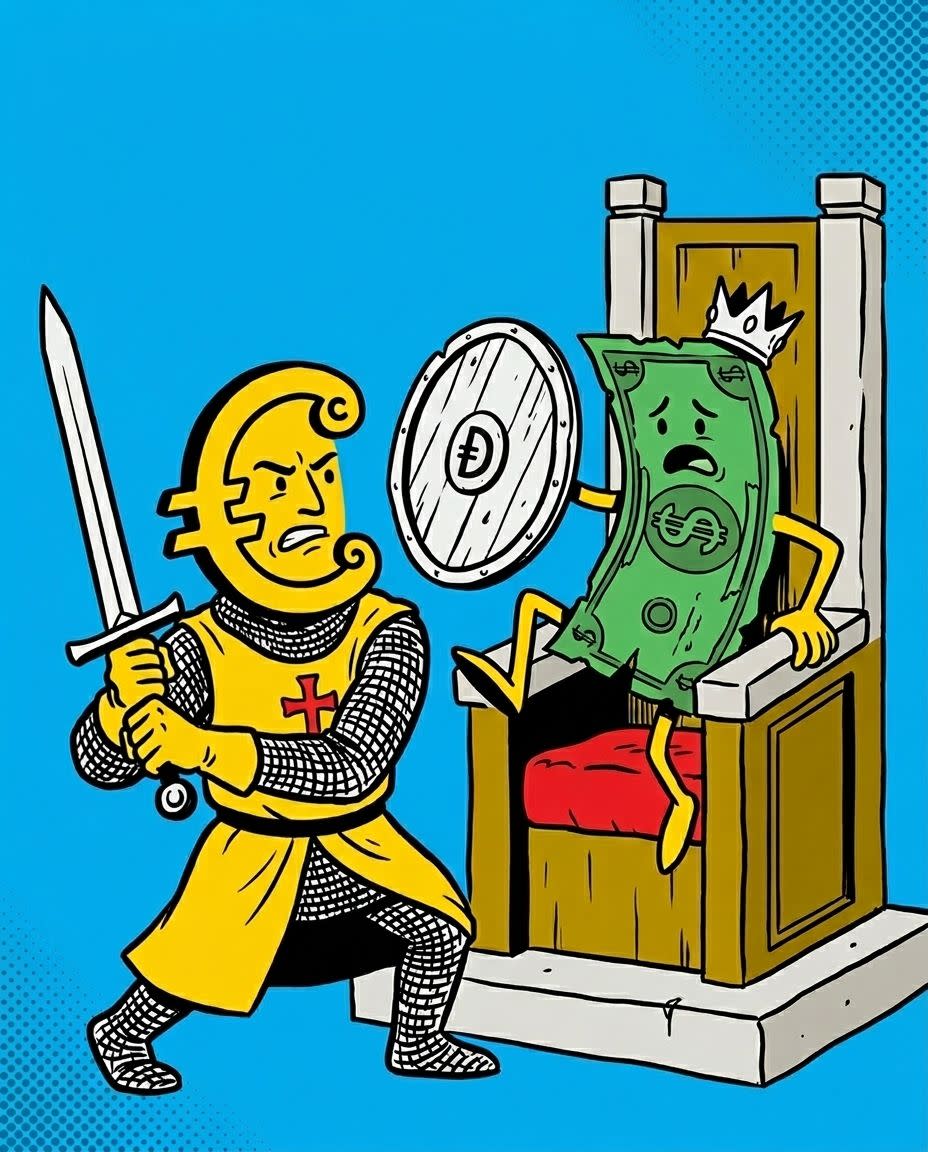
The Euro Stages an Accidental Coup Against the Almighty Dollar
Images
1 / 5
2 / 5

3 / 5

4 / 5
5 / 5
The above button links to Coinbase. Yahoo Finance is not a broker-dealer or investment adviser and does not offer securities or cryptocurrencies for sale or facilitate trading. Coinbase pays us for certain activity generated through this link. Prices displayed are informational.

Our analysts just identified a stock with the potential to be the next Nvidia. Tell us how you invest and we'll show you why it's our #1 pick. Tap here.

The euro has locked in its strongest international footprint in a decade, but the European Central Bank is far from satisfied. According to the ECB’s freshly released annual report, global issuance of euro-denominated debt skyrocketed 30% to hit an all-time record of nearly €1 trillion ($1.1 trillion) in 2025.

Yet, in a high-profile media blitz on Tuesday, ECB Executive Board member Piero Cipollone warned that this expansion occurred "largely by circumstance rather than by design." With China aggressively invoicing trade in the renminbi and Washington weaponizing private stablecoins to entrench the greenback, Frankfurt is demanding that EU legislators immediately fund a unified capital market to turn the euro into a proactive geopolitical weapon.

The data released by the ECB on Tuesday outlined a dramatic, silent reshuffling of international capital markets. Driven by an explicit search for stability amidst systemic financial volatility in the United States and protectionist trade policies from the Trump Administration, institutional investors flooded into European assets. Total worldwide issuance of euro-denominated loans and bonds surged past previous thresholds, establishing a commanding 41% dominant share in the global green and sustainable bond market, effectively unseating the U.S. dollar, which tumbled to 32%.

Furthermore, central bank reserve portfolios demonstrated a structural diversification away from traditional U.S. Treasuries, which slid to 22%. While the euro's baseline share of global official reserves held steady at 20%, gold allocations jumped to 27%. Christine Lagarde noted that during multiple geopolitical stress episodes, the single currency served as a primary safe-haven asset for global funds, helping the euro's aggregate international index print a steady 1.5 percentage point advance over its historical mid-2010s baseline.

Despite these spectacular numbers, Cipollone used the official ECB blog to issue a stern reality check to European policymakers. He pointed out that while Europe has coasted on its reputation for upholding the rule of law, its global competitors are executing highly aggressive, state-backed monetary roadmaps. China has successfully expanded its global trade financing share to 8%, surpassing the euro, while more than 20% of French imports from Beijing are now invoiced in renminbi. Cipollone warned that Europe can no longer afford to be a passive observer while the international monetary system fractures.

This institutional friction between the central bank and EU politicians highlights a deeper structural flaw: the euro is currently punching well below its true economic weight. Europe remains the most open major economy on earth, shipping close to €4 trillion in exports last year, yet its global currency share remains structurally capped because its domestic financial markets are deeply fragmented across national borders.

One stock. Nvidia-level potential. 30M+ investors trust Moby to find it first. Get the pick. Tap here.

To break this glass ceiling, the ECB is initiating an aggressive, independent technological front, accelerating its timeline to issue tokenized central bank money for wholesale institutional settlement. This digital transformation is designed as a direct preemptive strike against Washington's stablecoin strategy. Under the recently passed GENIU.S. Act, the U.S. Treasury has fully embraced dollar-pegged private instruments like Tether and Circle to build massive demand for US government debt and further entrench the dollar's network effects across cross-border digital rails.

The structural divergence between the two continents could not be more stark. While U.S. Treasury Secretary Scott Bessent has explicitly taken a retail digital dollar off the table to protect consumer privacy, ECB Executive Board member Isabel Schnabel clarified in Seoul that a public digital euro is an absolute geopolitical necessity to neutralize the threat of American-dominated digital monopolies.

However, the ECB can only build the technological plumbing; the actual economic muscle must be delivered by EU legislators. Both Lagarde and EU Economy Commissioner Valdis Dombrovskis are leveraging these record debt figures to pressure member capitals to finalize the long-delayed Capital Markets Union. Without a deep, liquid, and unified pool of joint European safe assets to directly rival U.S. Treasuries, institutional asset managers will continue to treat the euro as a temporary tactical refuge during American market selloffs, rather than a permanent structural replacement.

On the monetary policy front, this record-breaking inflow framework is granting the ECB's hawkish wing massive breathing room. With Eurozone services inflation proving sticky, market analysts expect the central bank to deliver a 25 basis point "insurance" rate hike to 2.25% at its June 11 meeting. Because the Eurozone's underlying financial fundamentals are shielded by a net cash balance sheet, the single currency can comfortably sustain higher rates without triggering the systemic credit freezes that continue to rattle the heavily leveraged U.S. regional banking sector.

The immediate operational milestone lands in September, when the ECB will officially commence live issuance of its tokenized wholesale settlement infrastructure. This pilot will give commercial banks their first true look at automated, blockchain-based euro liquidity delivery, setting the stage for a wider retail digital euro rollout scheduled for mid-2027.

Politically, the focus shifts to the upcoming European Council summit, where Dombrovskis intends to utilize the €1 trillion debt milestone to force a definitive legislative vote on the savings and investments union framework. If the text passes, it will unlock a wave of pan-European corporate consolidation, providing the deep market architecture required to turn the euro from an accidental safe haven into an unshakeable global monetary anchor.
Comments
You must be logged in to comment.