yahoo Press
Russia Ships Most Oil Since 2022 as Drones Strike Refineries
Images
1 / 12
2 / 12

3 / 12

4 / 12
5 / 12
6 / 12
7 / 12
8 / 12
9 / 12
10 / 12
11 / 12
12 / 12
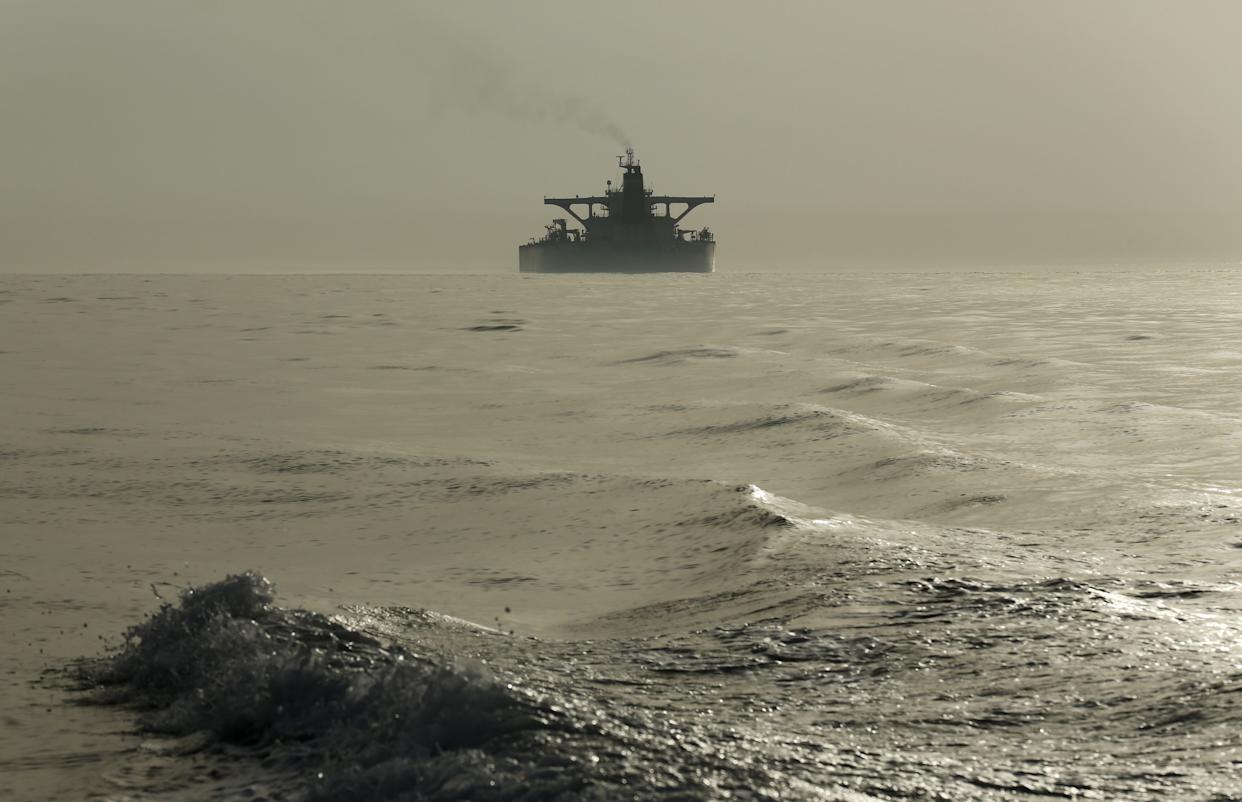
(Bloomberg) -- Russia is exporting the most crude since its invasion of Ukraine back in 2022 as Kyiv's record attacks on its neighbor's oil refineries force more barrels into the global market.

Most Read from Bloomberg

Russia Finance Officials Tell Putin War Spending Is Unaffordable

Canada Dips Into Technical Recession for First Time Since 2020

Alphabet to Raise $80 Billion in Equity for AI Spending

Andrew Left Found Guilty in Case That Spooked Short Sellers

US Says Deals With Iran for Safe Hormuz Transit Are Prohibited

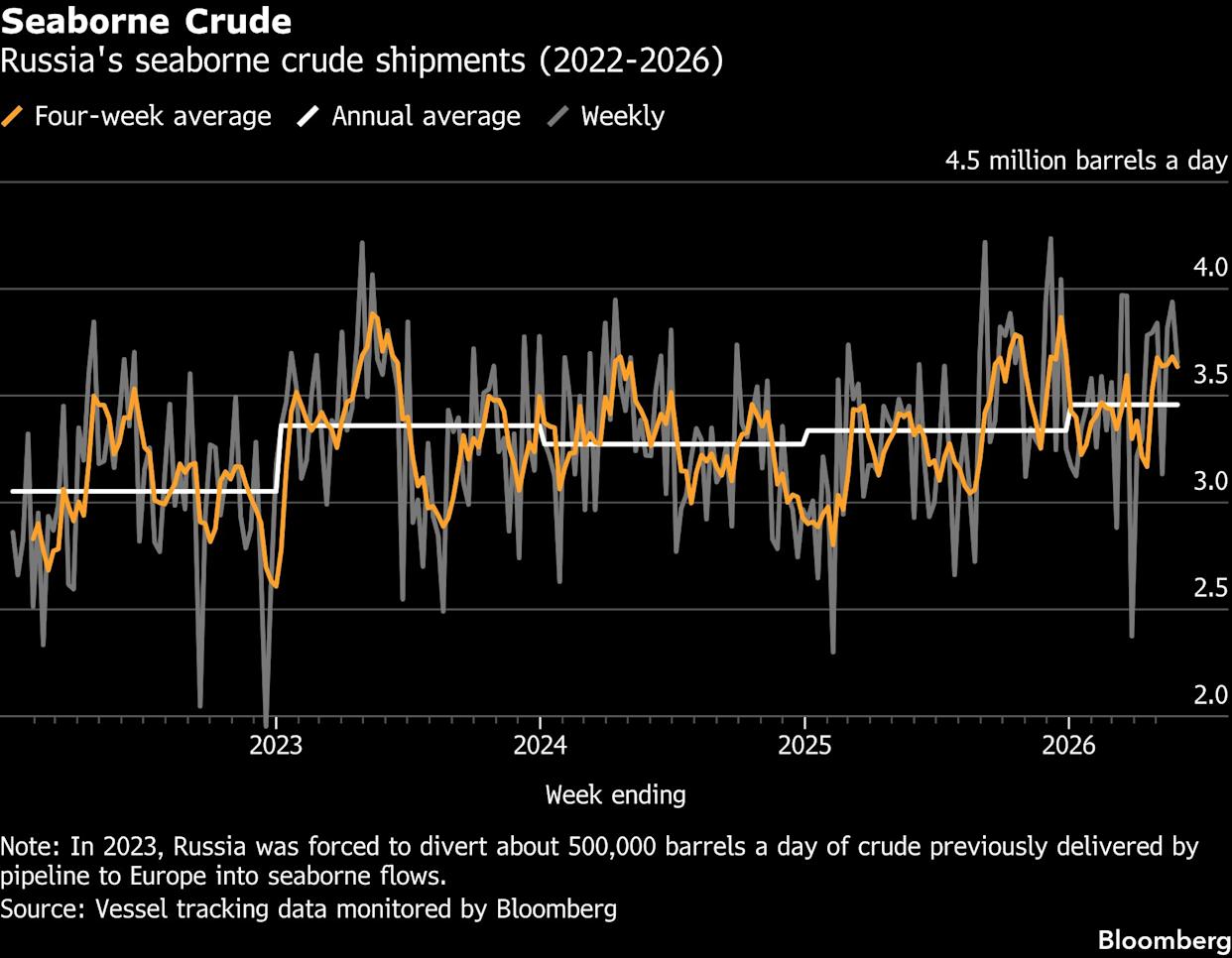
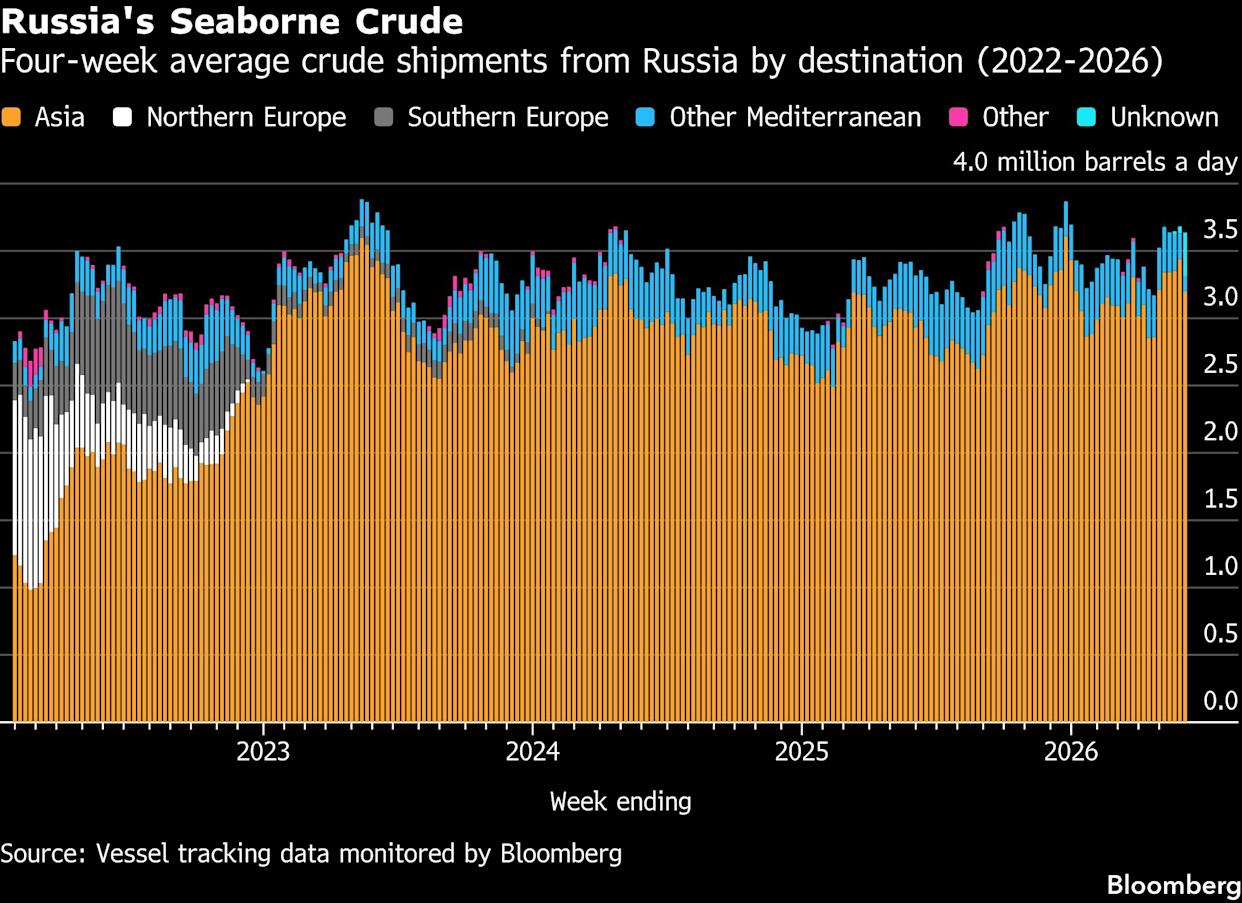
Moscow’s year-to-date shipments are running at 3.46 million barrels a day, about 120,000 barrels a day higher than 2025, and exceed the annual averages for each year since Moscow’s troops marched into Ukraine in February 2022.

Flows have recovered from an earlier slump caused by strikes on key export facilities on the Black Sea and Baltic, as Kyiv switches its focus back to Russia’s refineries and oil pumping stations. Attacks on refineries set a record in May, sending processing to a 16-year low and prompting Moscow to ban jet fuel exports on top of earlier halted foreign sales of gasoline. The renewed targeting of processing plants likely boosts the amount of crude available for shipping overseas.

Four-week average crude shipments were 3.64 million barrels a day in the period to May 31, little changed from the revised 3.68 million in the 28 days to May 24, tanker-movements data compiled by Bloomberg show. And with global oil prices boosted by the war in Iran and the effective closure of the Strait of Hormuz, the value of Moscow’s shipments in recent weeks has exceeded even the levels seen in the first months of the Ukraine invasion.

Moscow has found a ready market for its higher flows after the US and Israel launched attacks on Iran at the end of February, prompting Tehran to effectively close the Strait of Hormuz. That’s halted about 15 million barrels a day of crude flows from the Persian Gulf, with only about one-third of that diverted to other routes, leaving refiners scrambling for alternatives and the price of Russian crude soaring alongside global benchmarks. US President Donald Trump aided the Kremlin by waiving sanctions on its shipments, making it easier for Indian processors, in particular, to boost purchases.

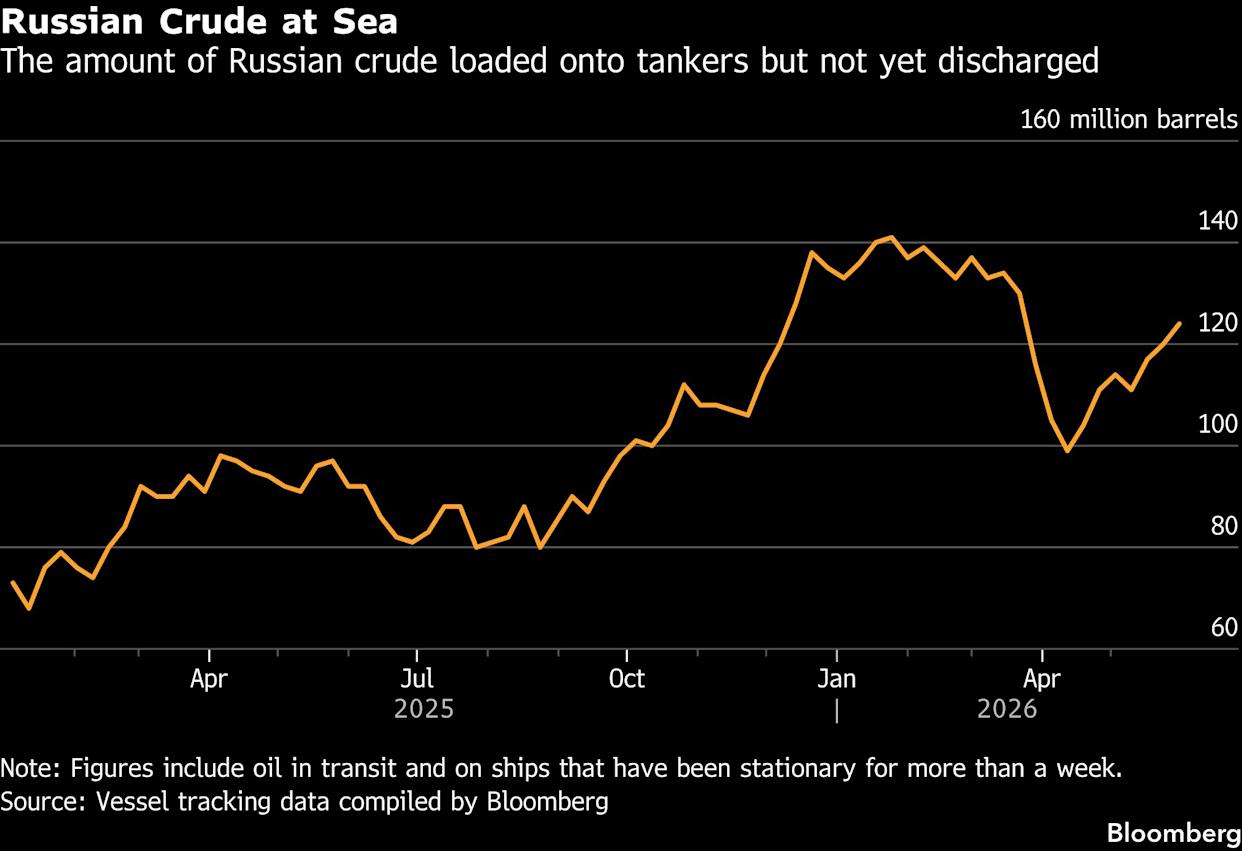
With Russia’s daily shipments in the past four weeks running about 300,000 barrels higher than during the first quarter, the amount of its oil at sea continues to edge higher, reaching 124 million barrels on Sunday, up by about 25% from a mid-April low. Almost all of that is now on ships in transit, rather than idling at sea, tanker-tracking data show.

India emerged as a lifeline for Russian oil exports after Moscow’s invasion of Ukraine led European buyers to shun those barrels. Purchases of Russian crude by the south Asian nation soared to as much as 2 million barrels a day from almost none previously, before dropping back to half that level as the US began to tighten sanctions on buyers of the Kremlin’s oil.

But that changed again after President Trump launched air strikes on Iran at the end of February, leading Tehran to retaliate by effectively closing the Strait of Hormuz to shipping, shutting off the flow of oil and gas from the Persian Gulf. Surging oil prices led the US to ease restrictions on buying Russian oil, boosting purchases by India’s processors. Deliveries in May averaged about 1.76 million barrels a day, 63% higher than they were in February.

Crude Shipments

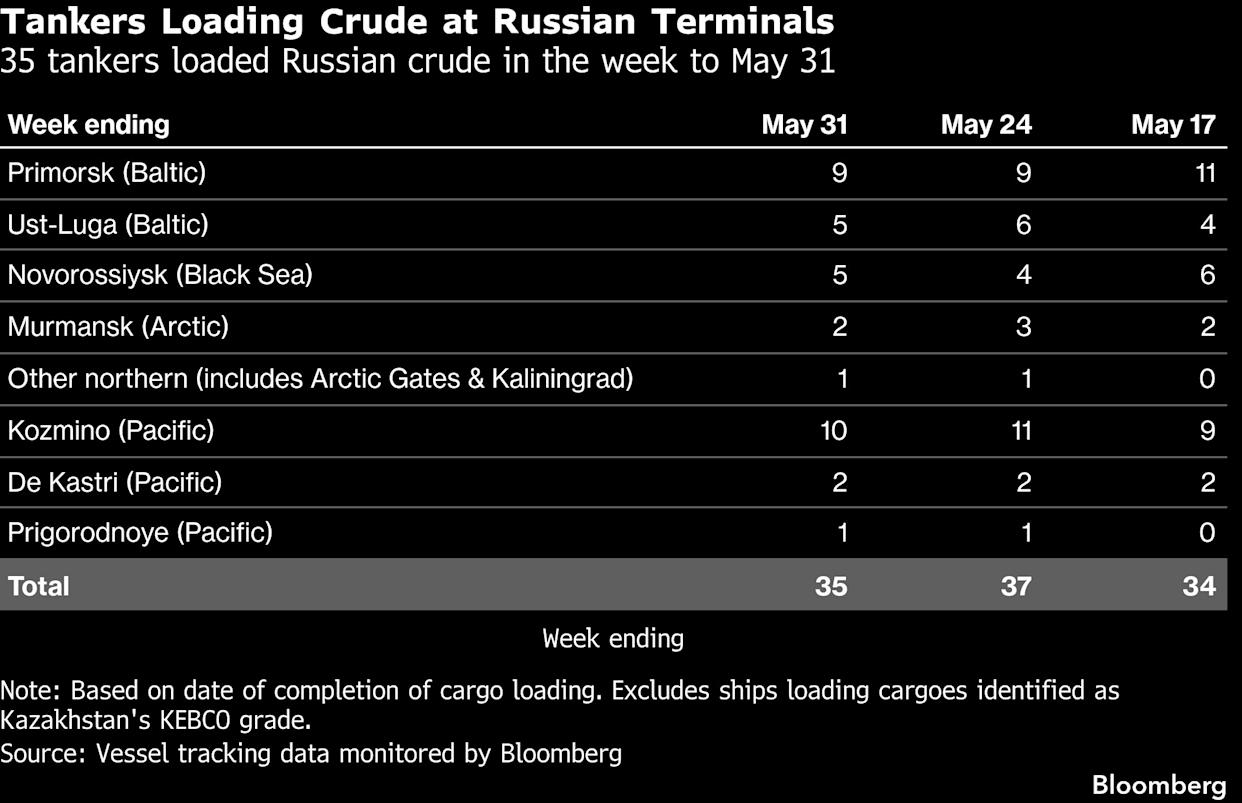
A total of 35 tankers loaded 25.58 million barrels of Russian crude in the week to May 31, vessel-tracking data and port-agent reports show. The volume compared with a revised 27.57 million barrels on 37 ships the previous week.

On a daily average basis, shipments in the week to May 31 slipped to 3.65 million barrels a day from a revised 3.94 million the previous week.

The flows can be volatile, affected by weather, maintenance work, sanctions and the timing of shipments.

There were three shipments of Kazakhstan’s Kebco grade from Novorossiysk during the week.

Export Value

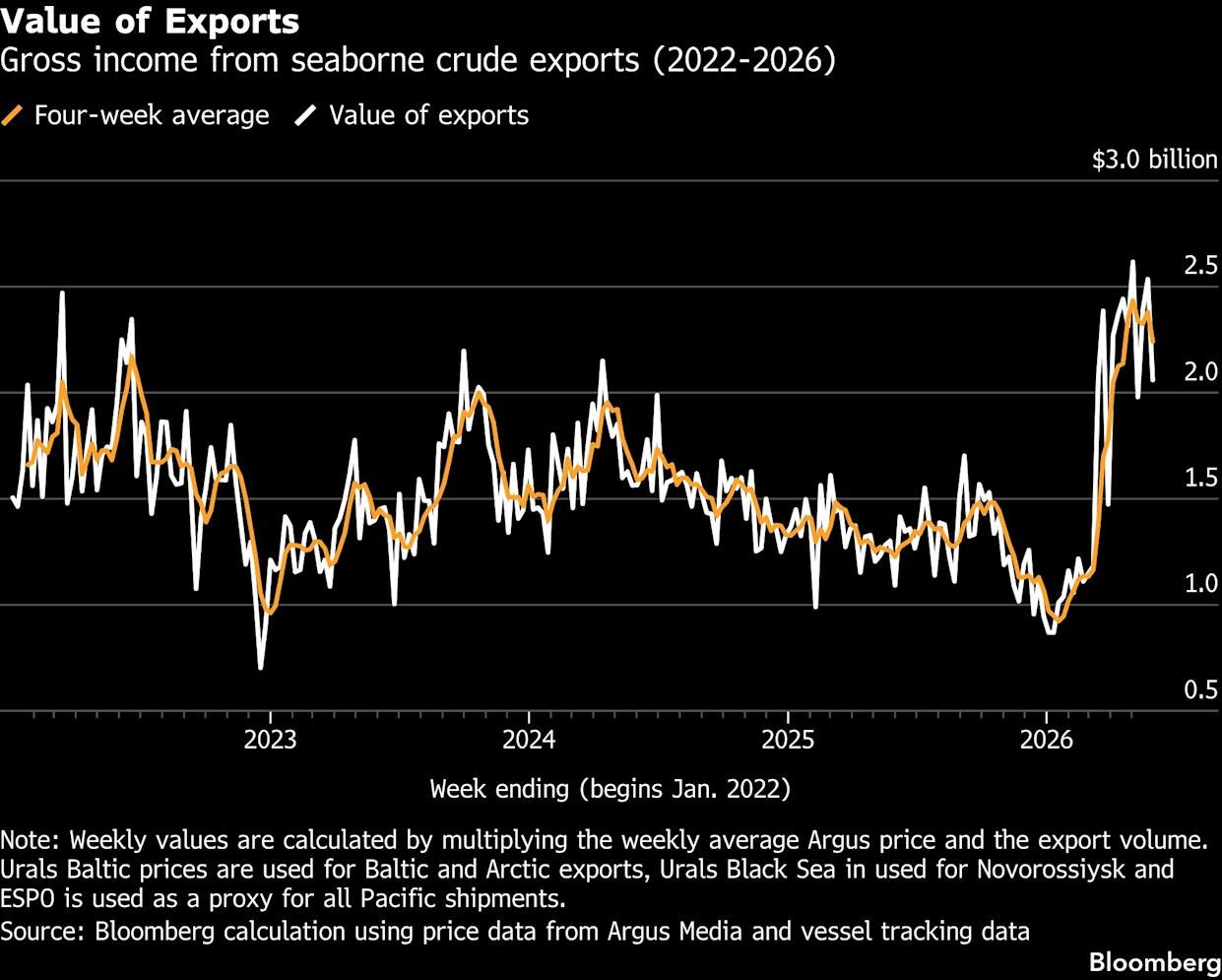
On a four-week average basis, the gross value of Moscow’s exports slipped to $2.24 billion a week in the 28 days to May 31 from a revised $2.38 billion in the period to May 24, with lower Urals prices compounding the effect of a small dip in flows. Using this measure, the value of exports remains at levels not seen since the early days of Moscow’s war in Ukraine.

On a four-week-average basis, the export prices of Russia’s Urals loaded in the Baltic were down by about $4.80 to $84.87 a barrel, while a $4.60 drop took Black Sea prices to $83.56 a barrel. The price of Pacific ESPO crude fell by $3.30 to average $94.37 a barrel. Delivered prices in India fell for a sixth week, down by $6.10 to $108.73 a barrel, the lowest since March. All prices are according to numbers from Argus Media.

On a weekly basis, the value of exports averaged about $2.06 billion in the 7 days to May 31, down by $470 million from the previous week’s figure.

Flows by Destination

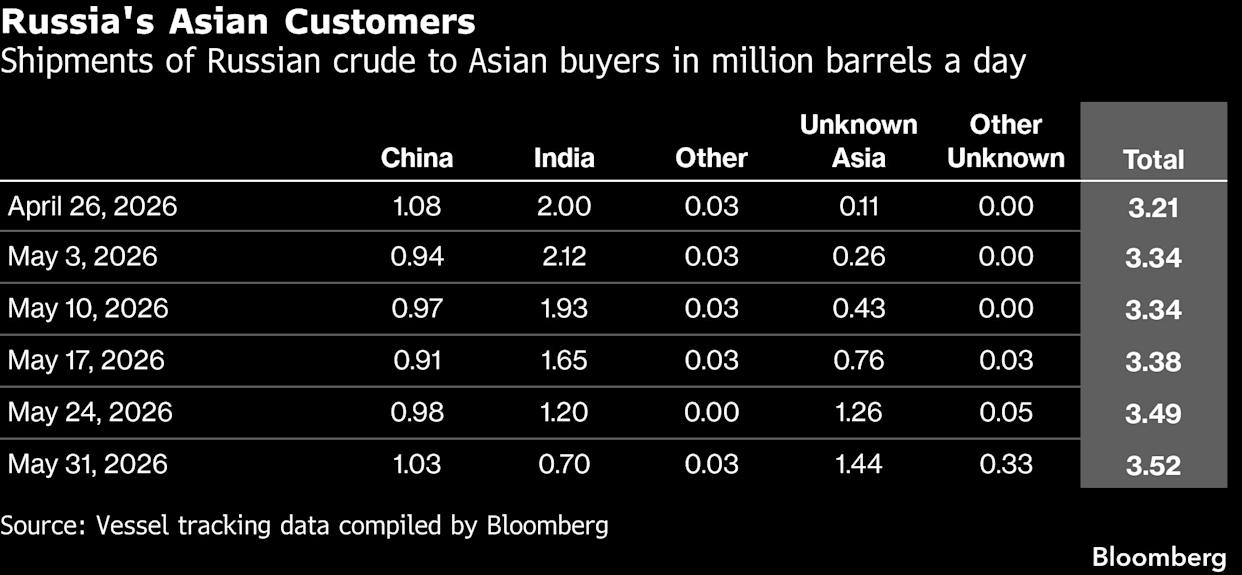
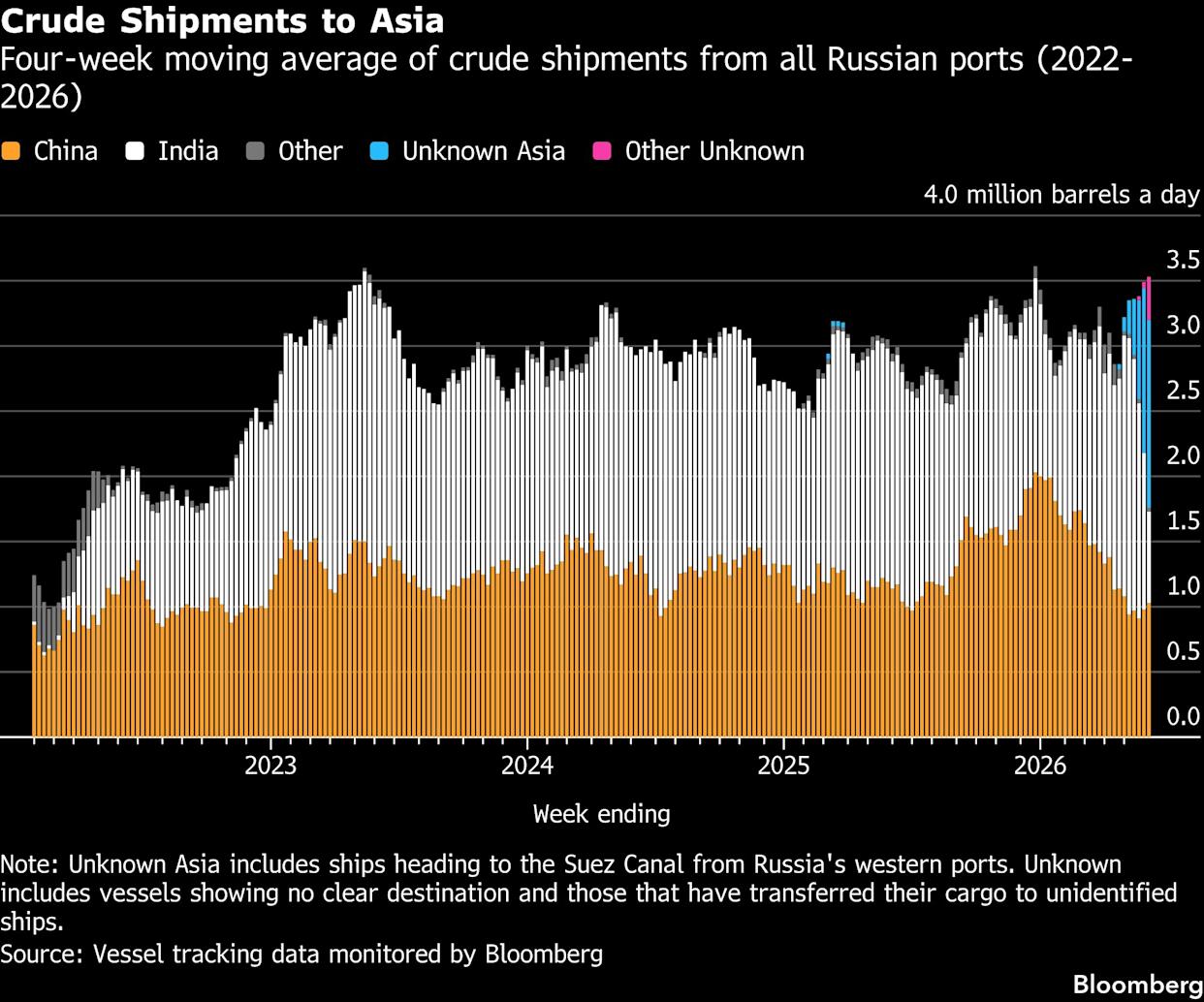
Observed shipments to Russia’s Asian customers, including those showing no final destination, rose to 3.52 million barrels a day in the 28 days to May 31, up from a revised 3.49 million in the period to May 24.

While the amount of Russian crude on tankers showing destinations in China and India combined continues to show sharp declines in the most recent weeks, the volume on vessels yet to show a final destination has soared, allowing for much of that pattern to be reversed in time. Tankers frequently show interim destinations, such as Suez or Port Sudan, until they are well across the Arabian Sea, while some never show a final calling point, even after mooring to discharge.

Flows on tankers signaling Chinese ports stood at 1.03 million barrels a day in the four weeks to May 31, up from a revised 980,000 barrels a day for the period to May 24. About 700,000 barrels a day was on tankers destined for India, down from a revised 1.2 million barrels a day in the earlier period.

But there is the equivalent of 1.77 million barrels a day on vessels yet to show a final destination. Of that, about 1.44 million barrels a day is on ships from Russia’s western ports showing their destination as Port Said or the Suez Canal, or those from Pacific ports with no clear delivery point, and a further 330,000 barrels a day is on tankers yet to signal any destination.

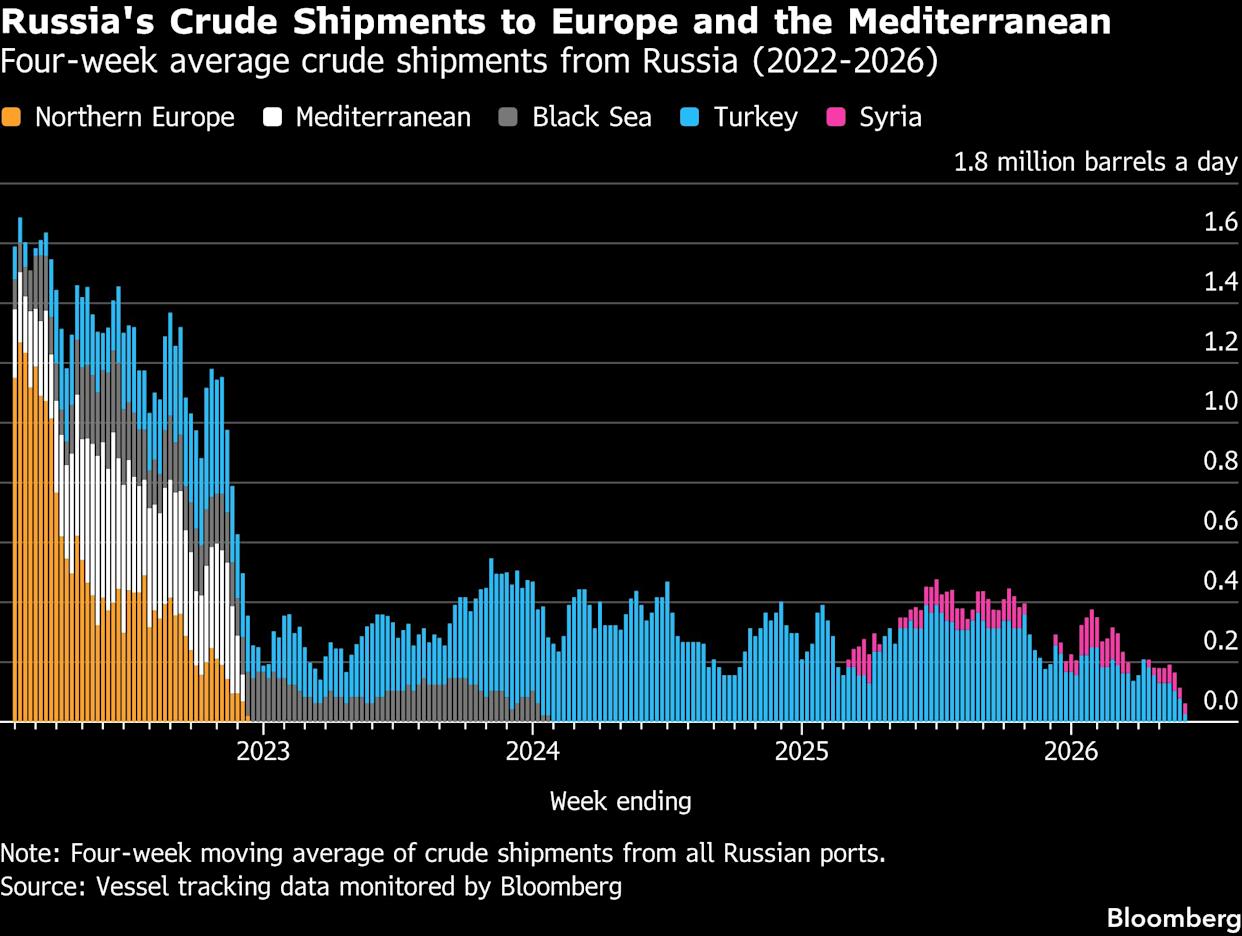
Flows to Turkey in the four weeks to May 31 fell to about 30,000 barrels a day, the lowest since the invasion of Ukraine.

Four-week flows to Syria were unchanged at 40,000 barrels a day, with one Arctic-loading tanker heading to the East Mediterranean nation. Tankers hauling Russian crude to Syria rarely signal their destination and usually disappear from automated tracking systems when they’re south of Crete, making it difficult to estimate flows in advance of ships arriving off the port of Baniyas, where they can often be picked up on satellite photos.

NOTES

This story forms part of a weekly series tracking shipments of crude from Russian export terminals and the gross value of those flows. The next update will be on Tuesday, June 16.

All figures exclude cargoes identified as Kazakhstan’s KEBCO grade. Those are shipments made by KazTransoil JSC that transit Russia for export through Novorossiysk and Ust-Luga and are not subject to European Union sanctions or a price cap. The Kazakh barrels are blended with crude of Russian origin to create a uniform export stream. Since Russia’s invasion of Ukraine, Kazakhstan has rebranded its cargoes to distinguish them from those shipped by Russian companies.

Bloomberg classifies ship-to-ship transfers as clandestine if automated position signals appear to be switched off or falsified — a tactic known as spoofing — to hide the two vessels involved coming together to make the cargo switch.

Vessel-tracking data are cross-checked against port-agent reports as well as flows and ship movements reported by other information providers including Kpler and Vortexa Ltd. and satellite imagery covering Russian ports.

If you are reading this story on the Bloomberg terminal, click for a link to a PDF file of four-week average flows from Russia to key destinations.

--With assistance from Sherry Su.

Most Read from Bloomberg Businessweek

Valve, the Anticorporate Hero of the Games Industry, Has Its Antitrust Moment

What It Takes to Get a Job at Anthropic

Whole Foods’ CEO Wants to Put a Banana in Your Amazon Box

It’s Such a Mess Shopping for Reasonably Priced Menswear

Grocery Shoppers Are In For a Summer of Pain

©2026 Bloomberg L.P.
Comments
You must be logged in to comment.