yahoo Press
Tech stocks today: Tech stocks tumble following Broadcom, CrowdStrike earnings
Images
1 / 9

2 / 9

3 / 9

4 / 9

5 / 9

6 / 9

7 / 9

8 / 9

9 / 9
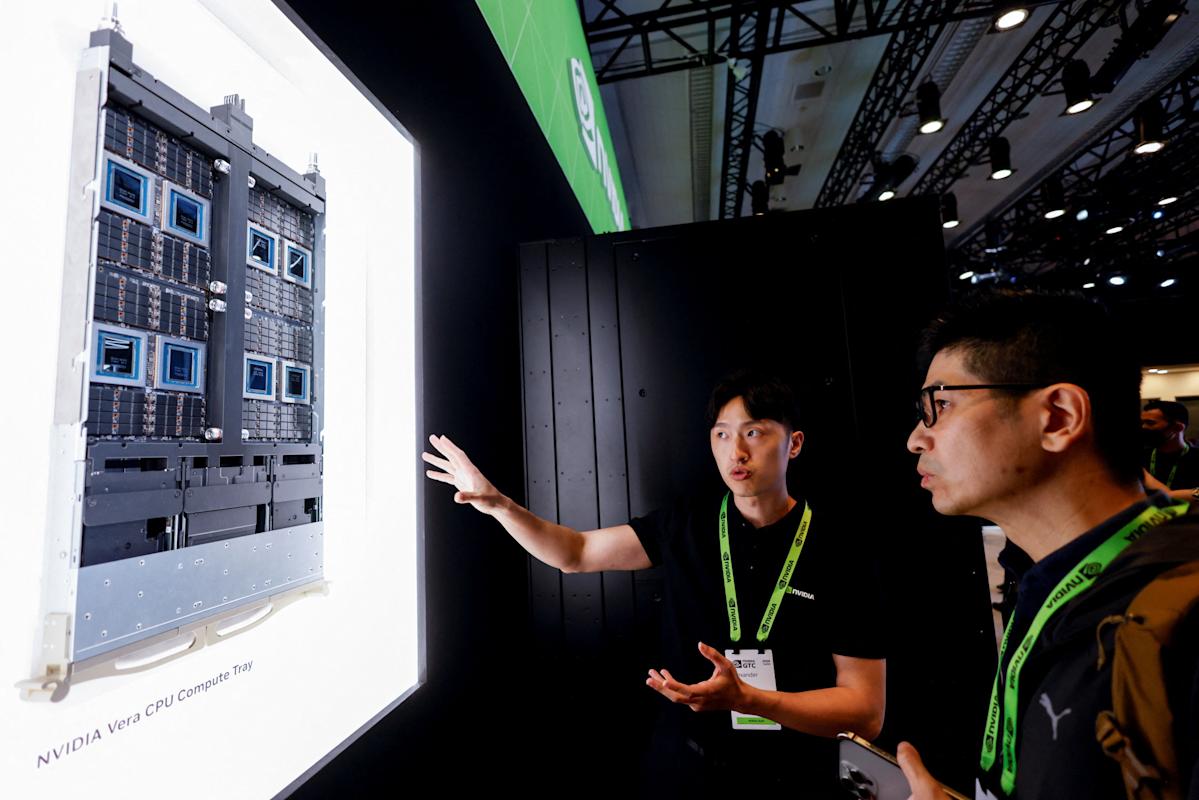
The above button links to Coinbase. Yahoo Finance is not a broker-dealer or investment adviser and does not offer securities or cryptocurrencies for sale or facilitate trading. Coinbase pays us for certain activity generated through this link. Prices displayed are informational. Tech stocks fell on Thursday morning as doubts grew about an extended ceasefire agreement between the US and Iran and as investors weighed quarterly results from chipmaker Broadcom (AVGO) and cybersecurity play CrowdStrike (CRWD). Shares of AI chip winners, including Marvell (MRVL), Nvidia (NVDA), and AMD (AMD), fell in premarket trading after Broadcom did not raise its AI semiconductor sales forecast for 2026. Earlier in the week, Alphabet stock (GOOG, GOOGL) was in focus after the tech giant said it plans to raise $80 billion by selling stock, including by offering Warren Buffett's Berkshire Hathaway (BRK-B, BRK-A) $10 billion in shares. Alphabet said it will use the proceeds to pay for its artificial intelligence build-out. Meanwhile, Nvidia CEO Jensen Huang continued to exert influence over markets at Computex Taipei. On Monday, software stocks got a lift after Huang said in a keynote address that he believes AI will increase demand for software companies, pushing back against a prevailing view this year that software makers will become obsolete in the age of AI. PC makers also surged after Nvidia unveiled a new processor — the RTX Spark — for Windows laptops. In the private markets, Anthropic (ANTH.PVT) filed confidential paperwork with the Securities and Exchange Commission to go public, beating rival OpenAI (OPAI.PVT) to the punch. Last week, Anthropic announced that it had completed its Series H funding round, valuing the company at $965 billion, making the Claude Code creator the most valuable AI startup in the world. Investors continue to assess what the looming mega IPOs from Anthropic, OpenAI, and SpaceX (SPAX.PVT) mean for the booming AI and tech trade. SpaceX (SPAX.PVT) may be a generational business. History says IPO day can still be a terrible entry point. Across more than 9,000 operating-company initial public offerings from 1975 to 2021, 60% of returns finished flat or lower three years after the first close, while only 16% more than doubled. The average return was positive — but only because a small group of moonshots pulled it higher. The data comes from Jay Ritter's IPO research at the University of Florida, which tracks traditional companies going public — not SPACs, REITs, closed-end funds, or ADRs. In other words, this is closer to the IPO market most investors imagine when they hear about a big private company finally listing its stock. In a filing on Wednesday, SpaceX (SPAX.PVT) confirmed it’s seeking to raise $75 billion from its initial public offering, a record amount for any IPO. Yahoo Finance’s Pras Subramanian reports: In the filing, the company said it would offer 555,555,555 shares at $135 each, raising $75 billion. That would amount to 4.2% of the entire float, with the remaining 95.8% held by CEO Elon Musk and other insiders. SpaceX authorized the underwriters to sell additional shares if needed, bringing the total raised to $85.7 billion. At that share price, it would give SpaceX a hypothetical market cap of around $1.785 trillion. SpaceX plans to use the proceeds for purposes "including the expansion of our AI compute infrastructure, enhancements to our launch infrastructure and launch vehicles, increases in the scale and capacity of our satellite constellations, and any remaining amounts for general corporate purposes." Read more here. Alphabet’s (GOOG, GOOGL) planned $80 billion stock sale puts a new price tag on the AI race: Even Google’s cash machine is tapping Wall Street to keep up. Investors noticed. Alphabet stock fell 3.9% Monday, its worst day in two months, as Wall Street digested what the deal says about the rising cost of AI. For years, Alphabet spent more buying back its own stock than it spent on capital expenditures — the buildings, data centers, servers, and equipment that keep Google running. Now AI has blown up that budget. Alphabet expects capital expenditures to roughly double this year as it races to build more computing power for AI. That pushes spending on infrastructure far above the cash Alphabet has been sending back to stockholders through stock buybacks and dividends. Read more here. Yahoo Finance’s Brian Sozzi reports: The market has finally woken up to the reality that in order to get the most out of the artificial intelligence boom, you have to have the infrastructure in place to pull it all together. And that has networking leader Cisco (CSCO) back in favor on the stock charts. “Infrastructure is definitely cool,” Cisco CEO Chuck Robbins said on Yahoo Finance’s Opening Bid (video above) from the company’s Cisco Live conference. “Everything that's happened over the years has always required high-performance infrastructure,” Robbins added. “I think to some extent, along the way, we forgot about it because it just works. But building the silicon, building the optics, all the underlying technology that allows the global economy to operate candidly on a daily basis, as long as everything's working, people don't think about it very much. I think now with these massive build-outs to train the models to provide inferencing, telecom providers building out their infrastructure to support the traffic flows, enterprises modernizing their infrastructure to be prepared and to deal with concerns over some of these emerging models, secure infrastructure is very important right now.” Read more here. Meta (META) will soon begin selling access to an AI agent in a new monetization path for the tech giant increasingly pushing into AI. As of Wednesday, companies will now be charged for access to the “Meta Business Agent,” Bloomberg reported, citing a company spokesperson. The agent’s primary role focuses on communication with a business’s customers on Meta’s communications platforms WhatsApp, Messenger, and Instagram. Meta shares rose 3.4% on the news. In the future, the agent will be able to complete tasks such as managing users’ calendars and putting together market research, Bloomberg reported. Smaller businesses will have to pay for a subscription to use the agent, while larger businesses will pay Meta for the token costs powering the service. A similar service has been offered before, but it was free of charge, Bloomberg reported. Yahoo Finance’s Brian Sozzi reports: The artificial intelligence spending for Big Tech has only just begun. Goldman Sachs strategist Amanda Lynam has put some fresh numbers on hyperscaler capex spending on AI, and it’s eye-popping. Goldman now expects a combined $5.3 trillion of capex spending for the four largest hyperscalers — Meta (META), Microsoft (MSFT), Amazon (AMZN), and Alphabet (GOOGL) — from fiscal year 2025 to fiscal year 2030. Prior to the start of first quarter earnings, this figure stood at $4.5 trillion. The baseline aggregate capex estimate stands at $7.6 trillion between 2026 and 2031, across compute, data centers, and power. Google, Amazon, Microsoft, and Meta alone collectively plan to allocate $725 billion to capital expenditures in 2026 — up a staggering 77% from last year’s already record-breaking $410 billion. Amazon is projecting $200 billion in capital expenditures, Alphabet is targeting $175 billion to $185 billion, Meta is guiding $115 billion to $135 billion, and Microsoft is tracking toward $190 billion for the calendar year. Read more here. The cybersecurity industry is racing to ensure powerful new AI models like Anthropic’s (ANTH.PVT) Mythos don’t create a flood of cyberattacks. To address at least a part of that, Cisco (CSCO) on Tuesday debuted its new Live Protect platform. A kind of stopgap cybersecurity measure for networking systems, Live Protect allows cybersecurity professionals to deploy targeted “shields” against specific exploits to prevent attackers from breaking into victims’ networks. In traditional settings, cybersecurity workers might have to update a network system a few times a year. But Mythos changed that. Anthropic unveiled Claude Mythos Preview last month, sending shockwaves through the tech industry. According to the company, the AI model was wildly adept at hacking software, despite not being designed to do so. Read more here. Microsoft (MSFT) on Tuesday unveiled a collection of seven AI models developed by its Microsoft AI Superintelligence Team as part of the company’s annual Build Conference. The models, which include the company’s first reasoning model, MAI-Thinking-1, come as Microsoft looks to further diversify its AI capabilities and lean less on OpenAI’s (OPAI.PVT) models. According to Microsoft, MAI-Thinking-1 is a midsize AI model designed for high efficiency and low-token cost. The company said independent raters preferred MAI-Thinking-1 to Anthropic’s (ANTH.PVT) Claude Sonnet Opus 4.6, its midrange model, and that MAI-Thinking–1 matched Opus 4.6’s coding ability, albeit in a benchmark. In addition to MAI-Thinking-1, Microsoft debuted its MAI-Image-2.5 image-generating model, MAI-Transcribe-1.5, MAI-Voice-2, and MAI-Code-1. While Microsoft was an early investor in OpenAI and remains one of its most prominent backers, the relationship between the two companies has become strained over the years. Read more here. Microsoft (MSFT) is turning to AI to help protect users from attacks and hacks, leveraging a new class of models that can find and exploit software flaws faster than any person could on their own. Part of that includes the company’s new Microsoft Security multimodal agentic scanning harness, or MDASH. The platform, which Microsoft said is in an expanded preview, uses AI agents to scan for software vulnerabilities that hackers can exploit. Speed is a key component of cybersecurity. The faster a company can detect a software flaw, the sooner it can fix the flaw before hackers can exploit it. “AI brings a lot of superpowers to defenders, but also AI in the hands of cyber attackers is a very powerful tool,” Vasu Jakkal, corporate vice president of security at Microsoft, told Yahoo Finance. “The time between vulnerability discovery to exploitation essentially collapses … and if we don’t build on this technology with context for defenders, that is going to continue to be a very asymmetric cyber war across the industry,” she added. Amazon (AMZN) plans to offer Prime customers megadeals earlier than usual this year as higher fuel costs strain shoppers’ budgets. The e-commerce giant announced its annual Prime Day event will kick off on June 23 and run through June 26. The sales event is typically held in July. The last time Amazon held its global savings event in June was in 2021. The company said that after taking into account the World Cup and the 250th anniversary of American independence, the week in June felt right. “Stating it bluntly, more savings now is better than more savings later, and so we're not … shying away from the fact that … having the event sooner means people can save more money sooner,” Jamil Ghani, vice president of Prime, told Yahoo Finance. Read more here. Alphabet (GOOG, GOOGL) stock edged 2% lower in premarket trading after the company announced late Monday that it plans to sell $80 billion in stock to help pay for its artificial intelligence build-out. In a statement, the company said it will offer $30 billion in underwritten public offerings and $40 billion directly to Class A common shareholders and Class C capital shareholders over time, beginning in the third quarter of this year. The remaining $10 billion was sold to Berkshire Hathaway, the global holding company founded by Warren Buffett and that is now led by Greg Abel. Alphabet said the proceeds will be used “for general corporate purposes, including capital expenditures to scale AI infrastructure and global compute.” “The company is experiencing strong demand for its AI solutions and services from enterprises and consumers, at levels that are exceeding the company’s available supply,” it added. “By scaling its investments, the company seeks to expand its foundational infrastructure to support the significant growth opportunity ahead.” Alphabet plans to spend $180 billion to $190 billion in capital expenditures in 2026, and capex is expected to “significantly increase” from that level in 2027. Marvell Technology (MRVL) stock surged 21% in premarket trading on Tuesday after Nvidia CEO Jensen Huang called the chipmaker the next "trillion-dollar company." Reuters reports: Huang and Marvell CEO Matt Murphy were speaking at the Computex week in Taipei on Tuesday. Marvell's market capitalization, as of last close, was just short of $192 billion, far below the one-trillion mark that Huang touted. Earlier this year, Nvidia invested $2 billion in Marvell, as part of its efforts to make it easier for customers to use the custom artificial intelligence chips that the smaller company designs with Nvidia's networking gear and central processors. Marvell last week forecast that its custom chips business would surpass $10 billion in revenue in fiscal 2029, as cloud companies expand AI data centers. Read more here. Reuters reports: Hewlett Packard Enterprise posted record second quarter results on Monday, prompting the company to accelerate its long-term financial goals by two years, as expansion of AI data centers boosts demand for its servers and networking products. Shares of the company rose 30% in extended trading after HPE also appointed Elliott Investment Management partner Christopher Hsu to its board in connection with their cooperation agreement. Read more here. Software stocks swung higher on Monday after Nvidia CEO Jensen Huang pushed back against fears of software company obsolescence during his keynote address at an event ahead of the Computex Taipei chip summit. “A lot of people have said, you know, … agentic AI is coming, therefore all of the software companies are going to go out of business. I said it's exactly the opposite because there are going to be so many agents, the world is no longer limited by the number of people, therefore those agents are going to use more tools than ever,” Huang said. “This is actually an incredible time to be a software company, but the software has to be presented to the agent in a way that the agent can use it,” he added. Earlier today, Yahoo Finance’s Brian Sozzi pointed out that the iShares North American Tech-Software ETF (IGV) closed above its 200-day moving average on Friday for the first time since Jan. 7. Software stocks posted strong gains on Monday, with shares of Salesforce (CRM), ServiceNow (NOW), and Snowflake (SNOW) rising 9%. Anthropic (ANTH.PVT) on Monday said that it filed confidential paperwork with the Securities and Exchange Commission to go public, beating rival OpenAI (OPAI.PVT) to the punch. The company said the number of shares it will offer and the stock’s price haven’t been set yet. “This gives us the option to go public after the SEC completes its review,” Anthropic said in a statement. “The proposed initial public offering will depend on market conditions and other factors.” The announcement comes just days after Anthropic said it raised $65 billion in its latest funding round at a valuation of $965 billion, pushing it past OpenAI, which was last valued at $852 billion in March. Read more here. Nvidia (NVDA) is taking aim at Intel (INTC) and AMD (AMD) with the debut of its RTX Spark superchip for Windows laptops. The processor, which includes a Blackwell GPU and Grace CPU, will power laptops from manufacturers including ASUS, Dell (DELL), HP (HPQ), and Microsoft (MSFT) when it lands this fall. Unveiled during Nvidia’s GTC Taipei event, the RTX Spark, which is also coming to small desktops, is meant for customers running AI applications, content creators, and, importantly, gamers. According to the company, the RTX Spark will pack upward of 128GB of memory, a massive amount for any laptop. Memory serves as a kind of temporary holding area for data the CPU needs to access quickly. Generally, the more memory, the better the overall performance Most laptops generally pack 16GB of memory, though higher-end systems, like a top-of-the-line MacBook Pro, can be outfitted with 128GB. But to get that configuration, you’ll have to shell out a whopping $5,099. Nvidia hasn’t announced pricing for laptops running its new chip, but it did note that the first systems will target the premium market. However, it will also offer less powerful versions of the RTX Spark with less memory for use in lower-priced notebooks. Read more here. Nvidia CEO Jensen Huang took the stage in Taipei on June 1 to kick of the Computex annual semiconductor trade show to highlight the company’s products, AI factories, and more. “Everything has changed,” Huang said. “So the first idea is that useful AI has arrived. AI is now a profit generator. AI is now a GDP generator. Behind it is a whole new kind of computing pattern, not just a large language model, but an agent. Today, almost everything we're going to talk about is going to be based on this.” Huang touted how Nvidia has evolved from being a GPU company to an AI infrastructure company and highlighted the next-generation Vera Rubin AI platform, calling the system “the most ambitious endeavor in the history of our company.” Watch Huang’s full keynote address below or on YouTube: The world’s chip giants are descending on Taiwan for the annual Computex Taipei conference this week. The gathering, which runs from June 2 through June 5, will likely feature a number of product announcements and industry updates from the likes of AMD (AMD), Intel (INTC), Nvidia (NVDA), and Qualcomm (QCOM). Nvidia kicked things off with its own GTC Taipei beginning June 1 with a keynote from CEO Jensen Huang. The executive has been in Taiwan for the past several days, meeting with corporate partners and hosting an event for Nvidia’s future headquarters in the country called Nvidia Constellation, which will be home to some 4,000 workers. In a statement, Huang noted that the company has dramatically increased spending in the island nation, saying Nvidia will spend upwards of $150 billion a year in Taiwan, up from $10 billion to $15 billion just four years ago, Reuters reported. Read more here for what to expect from Computex Taipei.
Comments
You must be logged in to comment.