huffpost Press
Trump Keeps Putting This 1 Photo Everywhere — And It's More Intentional Than You'd Think
Images
1 / 9

2 / 9
3 / 9
4 / 9
5 / 9
6 / 9
7 / 9
8 / 9

9 / 9
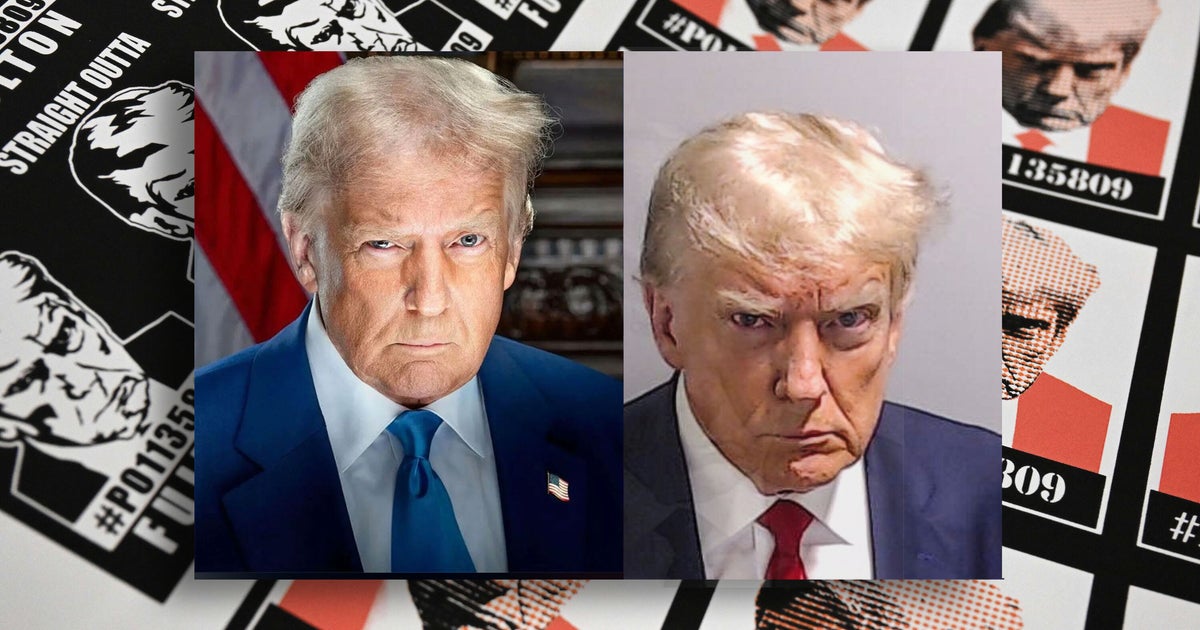
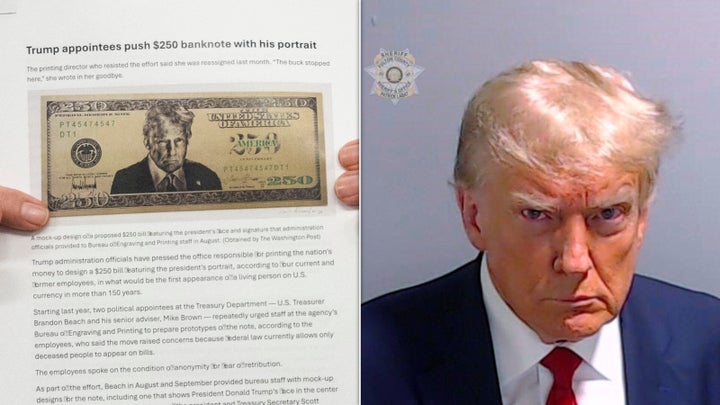
President Donald Trump’s stern, furrowed-brow portrait — which has previously been referred to as a re-creation of his mug shot — has made quite a few appearances throughout his presidency. And now, it appears it could be slapped on a $250 bill commemorating the 250th anniversary of the United States. (You’ve also probably seen it on a limited release commemorative passport and National Parks passes.)

There are a few questions, legally, as to whether that dream of his can become a reality, given that it has been illegal to have portraits of living people on American currency since 1866.

But the second-term portrait has become difficult to glaze over — becoming a full-fledged cultural artifact in its own right that tells its own story, according to experts in body language and communication who spoke with HuffPost.

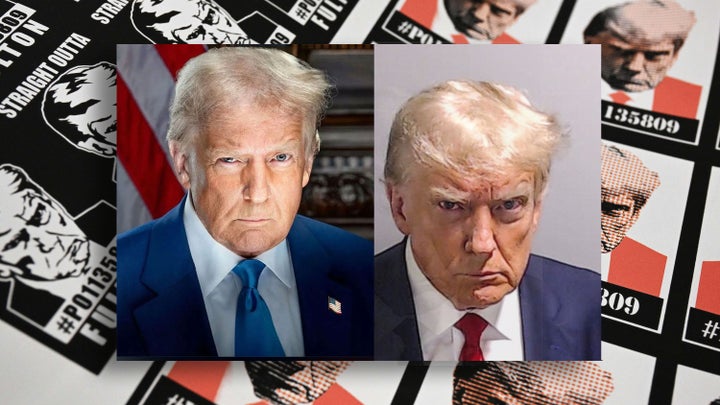
OK, so you aren’t imagining it — the official inaugural portrait of Trump taken ahead of his second term really does look like his mug shot from his 2023 arrest in Fulton County, Georgia, related to attempts to overturn the 2020 election in the state.

While most people tend to shy away from having their mug shot brought up in just about any capacity — with many normal, non-famous people spending years and many, many dollars trying to keep their mug shots from ruining their lives — that has decidedly not been the story for Trump and his team in the years following the release of the shot.

Instead, Trump’s camp has worked to reclaim the original mug shot (though they technically do not own it) and reframe the story around it, both for profit via merchandise and donations from his supporters and to “further the narrative that he is the target of politically motivated investigations,” as Chad Hankinson, a political science expert at Virginia Tech, previously told Virginia Tech News when the shot was officially released in 2023.

There are some slight differences between the portraits, as communication and body language expert Beth Dawson told HuffPost.

“The eyes in the mug shot picture are slightly narrowed and that shows intimidation rather than anger,” Dawson said. “It’s actually what I like to call the ‘charging bull’ position as he has his chin slightly tucked, head angled down and eyes looking up from beneath the brow,” creating an effect where the brows look like horns. “We unconsciously associate this posture with readiness, challenge and confrontation.”

In the presidential portrait, however, Dawson notes that there’s “a slight difference” in how his brows are positioned. While his brows are more symmetrical in the mug shot, the official portrait features one brow “slightly raised,” which Dawson said is “a more quizzical and questioning stance.”

“This says that he is in a higher-status role psychologically. He is no longer being judged; he is doing the judging,” she said, noting that the similarities absolutely feel like they were deployed “intentionally.”

And, it turns out, the resemblance was intentional, according to White House photographer Daniel Torok, who confirmed on X shortly after the official portrait’s release that the mug shot (made a part of Trump’s campaign and merch branding leading up to the 2024 election) was a major inspiration for the image.

"People are instinctively seeing a story here whether they are supporters or critics. The supporters are seeing the 'outsider' who fought the system and won and the critics are seeing the criminal.”

For Dawson, this synergy between the two photos is notable and works to demonstrate some recurring tensions in Trump’s larger narrative. The mug shot is a “reactive” instance of him being “documented, processed and judged by an institution,” and the official inaugural follow-up reminds you that the same man is in power (again).

“The underlying message is that the man in the mug shot is president. And this is such a strong message, as a mug shot is often associated with loss of status, loss of control and public shame,” Dawson told HuffPost. “[In the official portrait,] the same man is saying, ‘I hold the power, I am the institution,’ and the story is that he has come far and survived and his supporters are responding to that.”

The symbolic nature of these photos together, Dawson said, is especially powerful, as “people are instinctively seeing a story here whether they are supporters or critics.”

“The supporters are seeing the ‘outsider’ who fought the system and won and the critics are seeing the criminal,” she added.

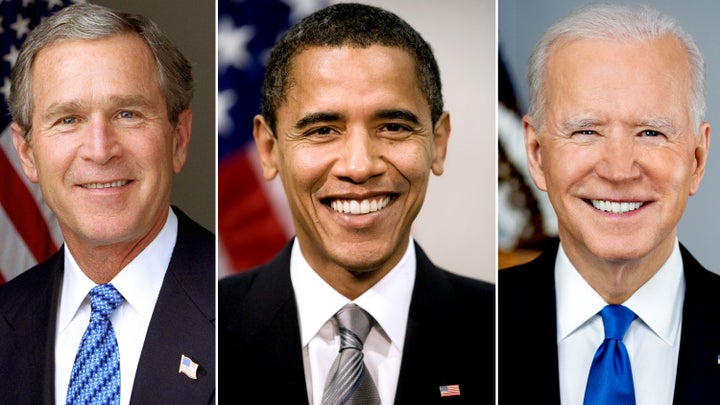
“Official presidential portraits are normally designed to communicate a careful balance of authority and accessibility,” Adrianne Carter, an international body language and communication expert, told HuffPost. “They tend to reassure, unify and project stability.”

Carter notes that Trump’s first-term portrait “followed that convention more closely,” featuring a large smile with “raised cheeks” and eye contact that “conveyed warmth, confidence and approachability.”

“Whether people supported him politically or not, the image was recognizably presidential in a traditional sense,” she said. “This new portrait takes a very different approach.”

The second-term portrait, which we now know to be inspired by the mug shot, features “lowered brows, narrowed eyes, compressed lips and intense direct gaze,” which, Carter noted, “create a much more dominant and confrontational impression.”

“Rather than inviting the viewer in, the image appears to challenge the viewer. It projects strength over warmth and resolve over reassurance,” she said. “The first portrait appeared to ask for trust. The second portrait appears to assume it. The first invited people in. The second announces that it has arrived.”

Likewise, even choosing to use these portraits in the ways the Trump administration has proposed — on park passes and currency — is another departure from norms. And it makes sense if seeing it out in the wild in these official capacities makes you feel a certain kind of way, Dawson adds.

“Using the ‘mug shot’ presidential portrait in official capacities crystallizes the ‘fighter’ narrative of Donald Trump and leans into his political brand, which has often been built around confrontation: fighting the media, political opponents, institutions, etc.,” Dawson said. “The mug shot presidential photo visually encapsulates the fighter narrative in one image.”

For a presidential photograph, especially, it captures “one of the paradoxes of Trump’s political identity,” Dawson said, “that he has been both president and outsider.”

“The mug shot helps keep up that outsider image,” she said.

Carter is quick to note that the shift away from the more disarming norm is a “significant” one “because images communicate values long before words are processed.”

“In many ways, this portrait appears less concerned with being liked and more concerned with being respected, or perhaps feared,” she said. “The visual message is not ‘trust me’ but ‘take me seriously.’”

Both Carter and Dawson note that Trump’s supporters, those who are part of the MAGA in-group, are likely to experience the photos very differently from those who do not identify that way.

“For Trump’s supporters, that expression is likely to reinforce the qualities they already admire. Many of his supporters see him as a fighter, someone willing to confront institutions, opponents and criticism head-on,” Carter said. “Through that lens, the portrait can be interpreted as determined, resilient and unapologetic. The absence of a smile may even enhance perceptions of authenticity because it signals seriousness rather than performance, although it’s very much a performance photo.”

Meanwhile, those “outside his political in-group” might see it differently.

“Dominance displays are inherently polarizing. What one person interprets as strength, another may interpret as hostility. What one person sees as resolve, another may see as aggression,” Carter noted, referring to the image as a “psychological Rorschach test” in its own way.

“One of the most interesting parts of this presidential portrait is that it allows opposing audiences to project entirely different meanings onto the same face,” Dawson said. “Supporters see courage and defiance, and critics see arrogance and intimidation. Yet, both groups are responding to the same nonverbal cues: the direct gaze, lowered brows, compressed lips, lowered head and refusal to display submission.”

“That ambiguity is one reason the photograph causes a buzz. The strongest political symbols are often those that can carry multiple meanings while remaining instantly recognizable,” Dawson continued. “For supporters, that can reinforce authenticity and the ‘hero’ image. For critics, it can create concerns about his behavior.”

“Either way, the image strengthens the perception that he exists in constant tension with institutions,” she said.

By entering your email and clicking Sign Up, you're agreeing to let us send you customized marketing messages about us and our advertising partners. You are also agreeing to our Terms of Service and Privacy Policy.
Comments
You must be logged in to comment.