huffpost Press
This 1 Thing About James Talarico Just Made Scott Jennings Melt Down — And It Drives Conservatives Crazy
Images

1 / 8

2 / 8
3 / 8
4 / 8

5 / 8

6 / 8

7 / 8

8 / 8
Conservatives have a new attack line against Texas Democratic Senate nominee Rep. James Talarico: He’s vegan. There’s just one problem — he’s not.

Ken Paxton, the Trump-endorsed Texas attorney general, who beat longtime GOP Sen. John Cornyn for the Republican nomination on Tuesday night, told supporters that Talarico is “a threat to our very way of life and values” because “he’s a vegan who thinks God is nonbinary.” Days prior, Paxton dubbed his opponent “Tofu Talarico” while speaking in San Antonio.

After the win, conservative political strategist Scott Jennings spoke with CNN’s Kaitlin Collins and said, “I’m thinking about the differences between Talarico and literally every Texan. Don’t know any Texans who believe in six genders other than Talarico, don’t know any Texans who say it’s immoral to eat meat other than Talarico, don’t know any Texans who walk around saying things, ‘You know, god is nonbinary.’”

The repeated six-gender comment comes from Talarico’s comment during a 2021 state legislative debate when he said, “Modern science obviously recognizes that there are many more than two biological sexes. In fact, there are six.” That same year, Talarico also said, “God is both masculine and feminine and everything in between. God is nonbinary,” when advocating for transgender youth in sports.

Talarico’s campaign did not respond to HuffPost’s request for comment as of publishing. But in an interview with “The MeidasTouch Podcast” Tuesday night, Talarico said, “I’m an eighth-generation Texan. I’ve been eating barbecue since before Ken Paxton’s first indictment. And if all they have on me is lying about me being a vegan, I feel pretty good about our chances this November.”

But even if Talarico were vegan, “there is no reason that veganism and other pro-animal causes need to be tied up with leftist politics,” Josh Milburn, a senior lecturer in political philosophy at Loughborough University, told HuffPost. Milburn’s research focuses on animal ethics, the philosophy of food and political theory.

“My worry is that in all this effort to tie veganism to this or that political position, or to treat ‘vegan’ as a kind of slur against one’s political opponents, the real losers will be animals,” Milburn said.

It goes deeper than Jennings’ and Paxton’s comments. On Wednesday, President Donald Trump wrote on Truth Social that Talarico “is a Vegan who dislikes meat, not exactly a good way to be if you’re wanting to win an Election in Texas.” The White House did not respond to HuffPost’s request for comment as of publishing.

Despite Talarico’s team saying he’s not vegan, Republican National Committee Chairman Joe Gruters said on Newsmax on Wednesday morning that Texas will stay red because “‘Tala-freak-o’ is a creep and he thinks — he’s a vegan, he thinks God is nonbinary, he wants to mutilate children, he wants to put boys in girls’ locker rooms — people are done with that.”

Talarico has not publicly said anything about veganism, but it’s been speculated that GOP officials leaned into a resurfaced 2022 speech Talarico gave during a fundraiser for laws against animal abuse.

“We have heard, I think heard more and more, issues of animal welfare. I think, not just because it’s the right thing to do, and the moral thing to do, but also … necessary to fight climate change. It is now existential that we try to reduce our meat consumption, and that we try to respect animals,” Talarico said. “I am proud to say that our campaign has officially become a non-meat campaign. We are only buying vegan products from our local vegan businesses.”

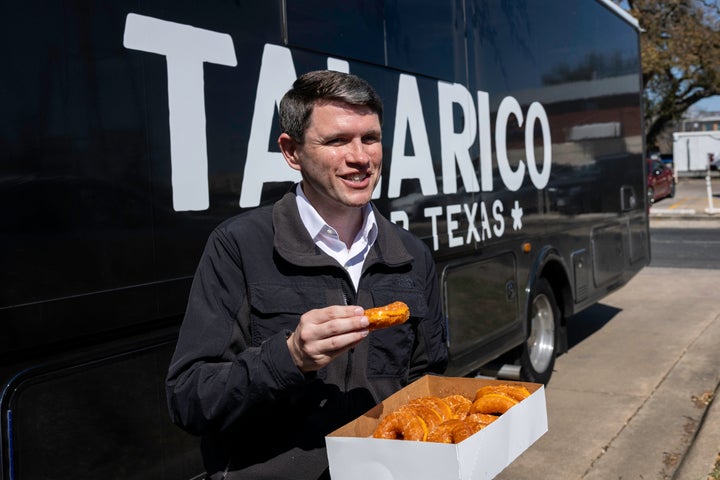
Talarico also visited a taco shop in Austin with former President Barack Obama on May 12 and ordered a breakfast taco made with potatoes, egg and cheese — without any meat. (Veganism, however, is a diet that excludes all animal products, including dairy, eggs and honey, in addition to meat.) In response to claims that he is vegan, Talarico’s team posted a photo of him in a Texas flag shirt eating meat on May 18.

There is research that suggests a lot of vegans are left-leaning politically, and a lot of left-leaning people are vegans. Still, the relationship is “often overblown into a convenient trope,” Emilia A. Leese, an author exploring the intersections of ethics and food, told HuffPost.

“From its founding, veganism carried within it a radical ethical demand: that society reorder its most basic habits of consumption,” Leese said. “The discomfort veganism generates isn’t just about beans versus brisket. It’s about what happens when someone refuses to participate in a system everyone else has agreed not to question. That refusal will always read as political, and in a polarized era, it will reliably be read as ‘left.’”

A 2020 study found that more individuals who identified as Democrats or unaffiliated were more likely to report being vegan or following a vegetarian diet, compared with individuals who identified as Republicans. However, unaffiliated respondents were just as likely as Republicans to say they have a red-meat-intensive diet.

“There is a growing body of research on the psychology of meat eating that offers some possible explanations, suggesting that conservatives, on the whole, may be less open to alternative ways of living, or may be, on the whole, more invested in the kinds of moral hierarchies that veganism challenges,” Milburn said.

There is no precise point in history when veganism became associated with liberalism, Leese argued.

“People have lived as vegans or proto-vegans since ancient times, from the Pythagoreans in the 6th century B.C.E. to the saints and dissidents of the medieval era,” she said. In the East, far older traditions had already codified nonviolent, plant-based living as spiritual and ethical imperatives: Jain monks and nuns have practiced extreme nonviolence for over 2,000 years.”

Even though Talarico isn’t vegan, Leese emphasized why this diet or mentality could be significant in Texas specifically.

“Barbecue isn’t just food there; it’s a ritual of belonging, a symbol of regional pride, and for some, a proxy for authenticity and strength,” she said. “A vegan governor, by contrast, becomes a walking critique of the status quo.”

“Texas doesn’t like vegans,” Trump told reporters on Air Force One on May 15. “I mean, this guy is bad news with his mask from relatively recently. And he’s a vegan. He’s a vegan. All of a sudden, he’s not a vegan.”

Overall, meat has become a symbol of conservative American identity. In January, Secretary of Health and Human Services Robert F. Kennedy Jr. announced the USDA’s new food pyramid, which emphasized meat protein at the top.

This is not the first time conservatives have leaned into dietary choices to try to dismiss liberal candidates. In 2021, conservatives ran with a false news story that then-President Joe Biden was going to ration red meat, leading to multiple representatives and governors posting threats against Biden, claiming he was attacking residents’ “way of life” in certain states.

When Rep. Alexandria Ocasio-Cortez (D-N.Y.) introduced the Green New Deal in 2019, numerous conservatives — including the president — falsely claimed that the plan would ban meat and ice cream across the U.S. (The proposal did not pass in the Senate.)

During the 2019 presidential primaries, candidate Pete Buttigieg spoke on climate change and told CNN, “From using a straw to eating a burger, am I part of the problem? In a certain way, yes, but the most exciting thing is that we can all be part of the solution.” In response, conservative groups like the Indiana Republican Party kept posting photos of Buttigieg using straws and eating meat, accusing him of being a hypocrite.

By entering your email and clicking Sign Up, you're agreeing to let us send you customized marketing messages about us and our advertising partners. You are also agreeing to our Terms of Service and Privacy Policy.
Comments
You must be logged in to comment.