huffpost Press
NY Times Analysis Reveals A Startlingly Unusual Element Of Trump's Cabinet Meetings
Images
1 / 8
2 / 8
3 / 8
4 / 8

5 / 8
6 / 8
7 / 8

8 / 8
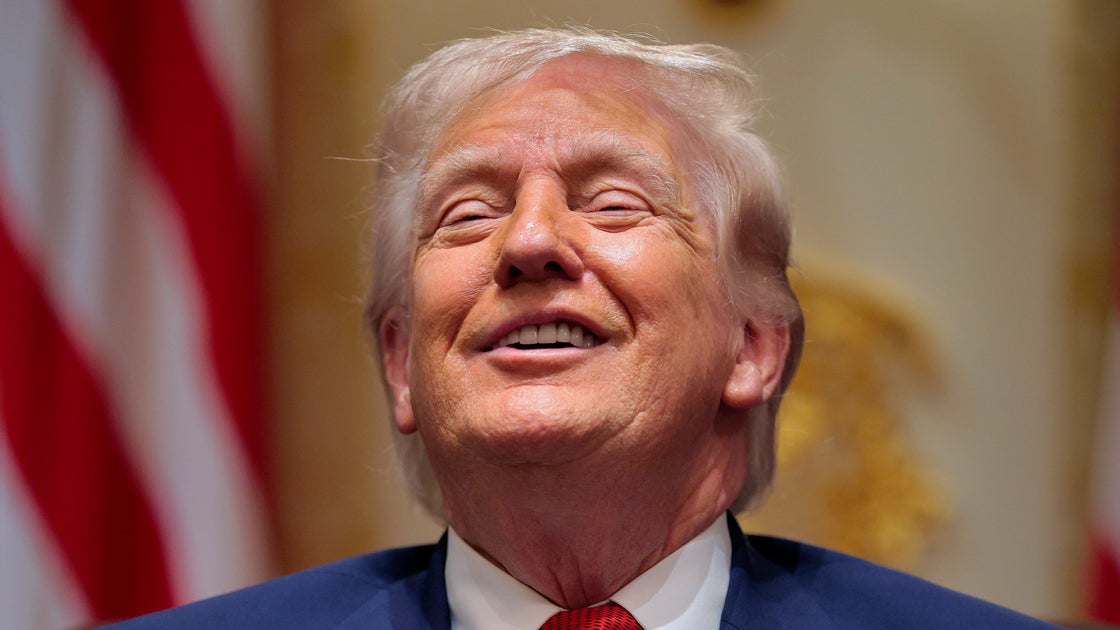
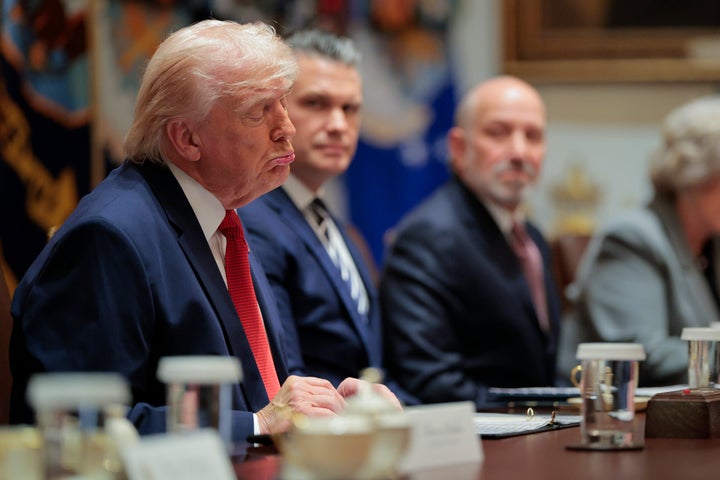
Officials in President Trump’s Cabinet meetings spend at least 1 out of every 6 sentences praising him, according to a New York Times analysis published Monday — a level of public flattery that experts say is historically unusual.

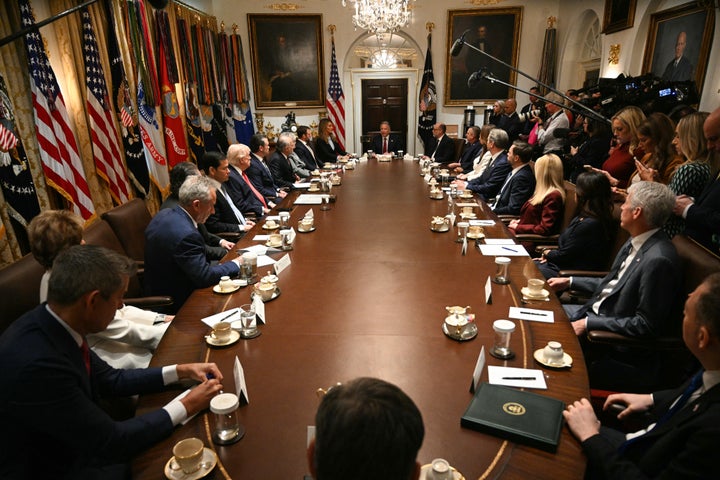
The New York Times compared televised Cabinet meetings from Trump’s first term — between July 2017 and May 2020 — to those in his second term over the past year and a half, and found that officials occasionally pushed back on Trump’s decisions and stances during his first term.

Some of the Cabinet officials’ statements echo what Trump has said publicly about himself, including the president’s claims that the Russian war in Ukraine and the conflict between Israel and Gaza “would not have happened” if he had been president. Both Defense Secretary Pete Hegseth and Secretary of State Marco Rubio offered similar assurances during these recorded Cabinet meetings, according to The New York Times.

“What happened in Afghanistan; what happened in Ukraine, a war that never would have occurred; what happened on Oct. 7 in Israel never would have happened under President Trump,” Hegseth said in the Jan. 29 Cabinet meeting.

Almost a year earlier, during the March 24, 2025, cabinet meeting, Rubio, referring to the Russian war in Ukraine, said, “This is a war that’s gone on for three years, as you’ve pointed out — that, as you’ve rightly pointed out, would have never happened had you been president.”

The praise also contrasts with national polls, which hit their lowest point for his second term last week.

As far as the public knows, this environment is rather unusual for a president, Jacob Neiheisel, an associate professor in the Department of Political Science at the University at Buffalo, told HuffPost. Much of Neiheisel’s research focuses on the effects of leader communication on the mass public.

“There are anecdotes that we can point to other presidents who expressed displeasure with dissent in those kinds of settings, but I cannot recall any presidency that has been marked by this much … fawning,” Neiheisel said. “It certainly feels different.”

But there isn’t concrete evidence to suggest this is a dangerous or problematic decision, Neiheisel argued.

“It depends on what model of leadership and decision-making you believe personally to be best,” he said. Neiheisel pointed out that former President Abraham Lincoln went in the opposite direction and intentionally surrounded himself with people who disagreed with him to “challenge him,” which Lincoln believed was “necessary” in decision-making.

“If, on the other hand, you believe [in] a kind of unified unitary executive … Then sure, having a bunch of people around you who basically just nod along in agreement is going to lend itself to faster decisions being made. It’s going to lend itself to more consistent ones with the president’s viewpoint,” he said. But, “there are obviously some downsides to that, too.”

“President Trump has assembled the most talented Cabinet in history,” White House spokeswoman Allison Schuster told HuffPost. “Unlike previous administrations, the President has opened nearly all of his Cabinet meetings to the press, allowing his talented team to highlight the exhaustive list of accomplishments they have delivered on behalf of the American people.”

The president will hold the next Cabinet meeting on Wednesday at the White House. It will be a rare closed-door meeting focused on foreign policy.

This “flattery,” as The New York Times called it, is not what former presidents have heard in their Cabinet meetings.

“Flattery and blind loyalty may be good for a president’s ego, but they rarely produce the candid advice that leads to sound policy decisions,” Chris Lu, who served as White House Cabinet secretary under former President Barack Obama and is now a professor at the University of Virginia Miller Center, told HuffPost. “A president should want advisers who are willing to tell him what he needs to hear, not just what he wants to hear.”

The Cabinet’s role is to advise the president on matters related to each member’s office, according to the Constitution and as established over time by statutes and traditions. The members essentially serve as counsel to the president and raise matters concerning their respective departments for discussion.

Historically, presidents rarely televised Cabinet meetings — former president Dwight D. Eisenhower was the first president to televise his Cabinet meeting about Western Europe on Oct. 25, 1954. When administrations did invite camera crews in, it was only for the opening remarks. Trump has made a practice of inviting cameras into the room for the full duration of meetings.

“There’s something really nice about just, you know, the openness of what we’re doing,” Trump said after a televised Cabinet meeting on Aug. 26, 2025. “It’s government.”

Conservative commentators have argued that this emphasis on presidential loyalty benefits Americans. Vice President JD Vance told Vanity Fair in December 2025 that the first Trump administration was filled with people who wanted to control or influence Trump, and now he is surrounded by people who support him — a unifying image.

Neiheisel sees it from a different perspective. “There might have been a time when a unified front would have been unifying for the country as a whole, or for the electorate. I just don’t know that there is anything right now that makes that possible,” he said. “I just don’t think the conditions are there.”

The decision to televise these full Cabinet meetings is also significant, Neiheisel argues.

“I think it is a move toward transparency … The transcripts are out there; anyone can go see them if they want,” he said. However, in reference to the downside of the Sunshine Reforms from the 1970s, “transparency isn’t always the best for decision-making.”

This raises the question of whether live cameras pressure Cabinet members into feeling like they have to perform for the public, rather than speaking about the matters and issues behind closed doors.

“We have a parallel here where you’re not going to get sincere deliberation if everyone’s worried about how this works,” Neiheisel said.

The combination of “prioritizing loyalty” and rehiring first-term Trump officials may have reduced some of the infighting and eliminated many ideological disagreements, both of which were prevalent during Trump’s first term, according to a Brookings analysis reported in January. The creation of a staff that is very responsive to the president and “homogeneity” could be why there was less A-Team turnover this term compared to Trump’s first. (Trump had a 92% turnover rate in his first term, compared to Biden’s 72% turnover rate; Trump’s second-term turnover rate is currently at 29%.)

“Trump’s team placed a premium on loyalty above all else in evaluating staff for his second administration,” the Brookings report says. “The intense emphasis on loyalty likely fueled increased staff stability, as demonstrated by a lower turnover rate among senior staff members.”

Dannagal Young, a professor of communication and political science at the University of Delaware, told HuffPost that a likely implication of this kind of group homogeneity and praise could be an impact on a leader’s ability to carefully process information.

“Positive emotions tell us that everything is great, so we don’t need to think too hard,” Young said. “Some scholars have suggested that this is, in part, why heterogeneous groups — in which people have differing opinions — generate higher quality ideas, innovations and solutions. They are literally thinking more and more creatively because the mild negative emotion that comes from disagreement is actually good for cognitive activity.”

This is not the first time these Cabinet meeting discussions have raised concern. New York Times reporter Maggie Haberman told CNN in August 2025 that she had heard the prevalence of compliments during these Cabinet meetings was “an endurance test of who could praise President Trump more.”

“Generally, what you heard was a competition for who could tell President Trump that he had saved the country more, and they started trying to one-up each other,” Haberman said. “The lead point was to praise him.”

According to Young, constant praise actually can reduce a person’s motivation to solve problems.

“It also biases the information pool from which you are drawing ideas [by] fooling you into thinking that you have a full census of information even though you don’t,” she said. “There is ample evidence that such homogeneous environments produce poorer quality solutions.”

Trump’s demand for loyalty is something he’s also been open about for years. During his first term, he told former FBI Director James Comey, “I need loyalty. I expect loyalty.”

By entering your email and clicking Sign Up, you're agreeing to let us send you customized marketing messages about us and our advertising partners. You are also agreeing to our Terms of Service and Privacy Policy.
Comments
You must be logged in to comment.