yahoo Press
‘Holy cow!’: Andrew Yang warns ‘American way’ being destroyed — says powerful force will ‘decimate’ millions of US jobs
Images
1 / 5
2 / 5

3 / 5

4 / 5
5 / 5
Moneywise and Yahoo Finance LLC may earn commission or revenue through links in the content below.

For generations, the American promise has been simple: go to school, build skills, land a good job and climb the economic ladder. But according to Andrew Yang, the very foundation of that way of life is now starting to fracture.

The former Democratic presidential candidate and founder of Noble Mobile appeared on CNBC’s Squawk Box recently, where he warned that artificial intelligence could soon upend millions of jobs — and that the disruption may be arriving faster than even he expected.

Here’s how to get rich from rising US property values with as little as $100 — and without the stress of angry tenants

Dave Ramsey warns nearly 50% of Americans are making 1 big Social Security mistake — here’s how to fix it ASAP

Goldman Sachs used to hoard prime real estate deals for the ultrarich. Two ex-analysts just opened the door for $250

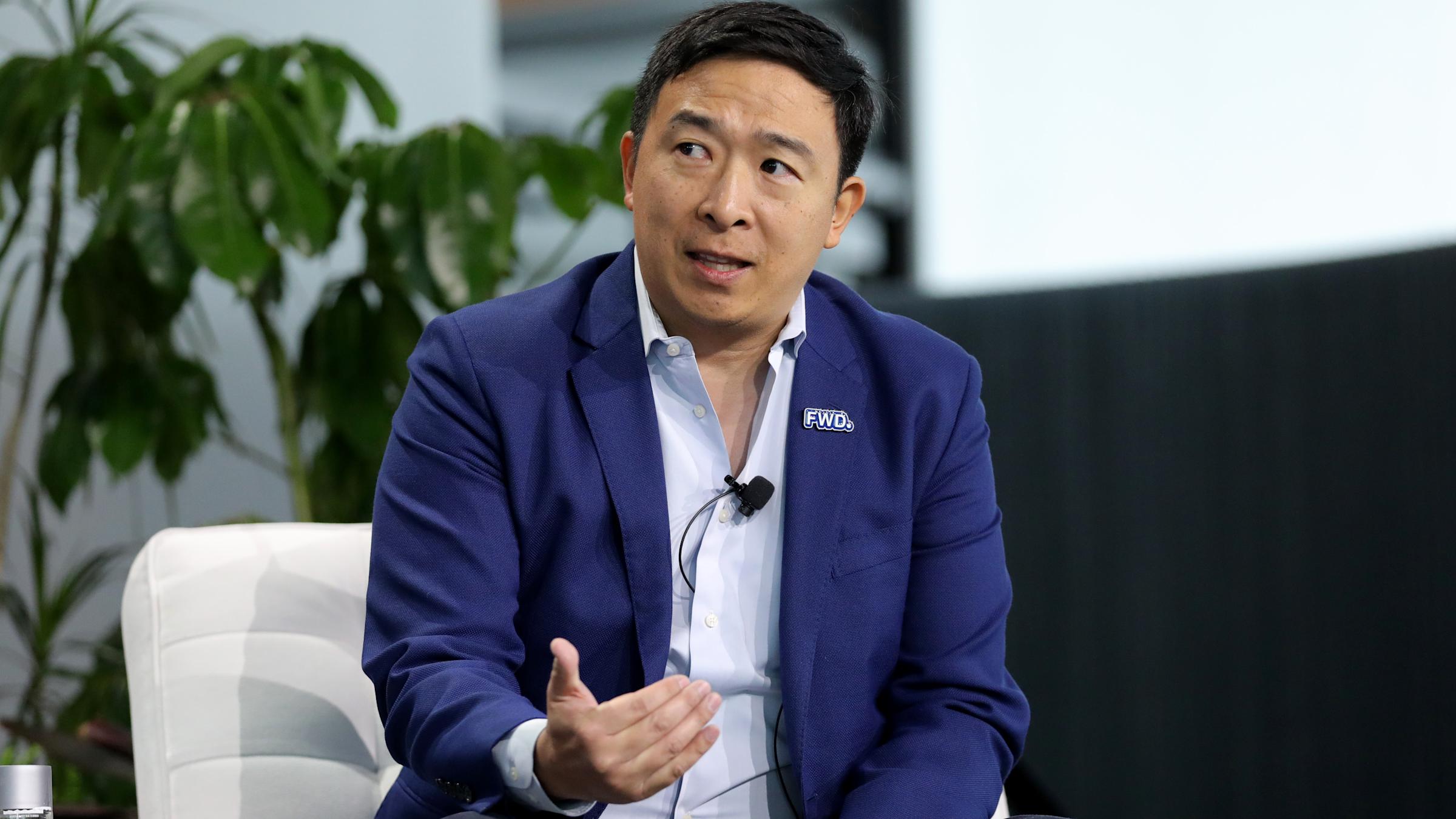
“I just came from an AI conference out west, and holy cow!” Yang said (1). “They said to me that what we’re going to see in the next six months outstrips what we’ve seen in the last 10 years, because the rate of change is on a hockey stick and heading up.”

Yang said one company selling autonomous coding tools to large enterprises had seen its revenue jump 100-fold in the past 12 months.

“If that continues, it’s going to eat a lot of the tech budgets from major corporates that used to go to humans,” he said.

That, according to Yang, is already showing up in the labor market — especially for young workers who were once told that coding was one of the safest career paths in America.

“You’re seeing the employment of recent computer science graduates fall off a cliff from a lot of programs,” Yang said. “If you rewind, what, four years ago, what would we tell young people for a secure career? Learn to code. And now the opposite of that is true.”

Yang pointed to a warning from Anthropic CEO Dario Amodei, who has said AI could wipe out up to half of all entry-level white-collar jobs and push unemployment up to 20% within the next one to five years.

Yang said he believes Amodei, noting, “The easiest people to fire are the people you haven’t hired yet.”

He also warned that the fallout could stretch well beyond the tech sector. Yang said the backlash will intensify as more parents watch their college-educated children struggle to find stable work.

“The backlash is going to get more and more pronounced as people wake up and have their kids coming back from college … and living in the basement,” he said, adding that “the implicit social contract of the American way is being fractured.”

And according to Yang, the transition will not be painless.

“There is zero chance that this transition is not going to be rough for millions of people,” he said, adding, “Like rough with a capital R, an exclamation point and a giant underline.”

Yang said some occupations could be hit especially hard.

“There are still over 2 million Americans who work at call centers right now, and we know AI is going to decimate that job,” he said.

The bigger shock, though, could come if automation hits truck driving.

“If you get to truck driving, then all bets are off, because this is the number one job in 28 states,” Yang said. “You’re talking about millions of middle-aged men, for the most part, 10% to 15% of whom are military veterans. A lot of them are gun owners. So if you get to that occupation, then you’re going to see, in my opinion, riots in the streets.”

According to the latest Bureau of Labor Statistics (2) data, there are 2,062,040 heavy and Tractor-Trailer Truck Drivers and 983,300 light truck drivers in the U.S. Taken together, that’s over 3 million Americans who could be impacted. True to Yang’s point, many of them do skew older, with a median age of 46, according to the most recent comprehensive census data (3) available.

When asked how far away this disruption could be, Yang said his timeline had changed after attending the AI conference.

“I might have said a certain time frame,” he said. “After this AI conference, it’s in the next 12 months. The whole industry right now is bracing for impact, and they see it more clearly.”

According to Goldman Sachs (4), AI is already reducing U.S. employment by around 16,000 jobs per month. Meanwhile, Verizon CEO Dan Schulman (5) predicts that AI could push U.S. unemployment as high as 30% within two to five years.

For everyday Americans, the question is no longer whether technology will change the job market. It is how to prepare if the disruption hits faster than expected.

Read More: Here’s the average income of Americans by age in 2026. Are you falling behind?

If Yang is right that millions of workers will face a “rough” transition, one of the most practical steps households can take is to build a financial cushion.

An emergency fund can help cover essentials if income is interrupted, hours are reduced or a job search takes longer than expected. It can also prevent you from relying on credit cards or loans during tough times, helping you maintain financial stability and peace of mind.

So, how large should your financial cushion be?

Personal finance expert Dave Ramsey suggests having an emergency fund that can cover three to six months’ worth of living expenses.

Of course, this amount may vary based on individual circumstances, such as job stability and personal financial obligations. You can start by setting aside a small portion of each paycheck until you reach your goal. Some financial experts, like Suze Orman, recommend an even more ambitious three to five years of funds, specifically to weather a prolonged market downturn.

To get started, a high-yield account like a Wealthfront Cash Account can be a great place to grow your emergency funds, offering both competitive interest rates and easy access to your money when you need it.

A Wealthfront Cash Account currently offers a base APY of 3.30% through program banks, and new clients can get an extra 0.75% boost during their first three months on up to $150,000 for a total variable APY of 4.05%.

That’s ten times the national deposit savings rate, according to the FDIC’s April report.

Additionally, Wealthfront is offering new clients who enable direct deposit ($1,000/mo minimum) to their Cash Account and open and fund a new investment account an additional 0.25% APY increase with no expiration date or balance limit, meaning your APY could be as high as 4.30%.

With no minimum balances or account fees, as well as 24/7 withdrawals and free domestic wire transfers, your funds remain accessible at all times. Plus, you get access to up to $8M FDIC Insurance eligibility through program banks.

Yang’s warning also highlights a deeper issue. Millions of Americans rely almost entirely on wages from a single job.

That can become risky if technology, corporate cost-cutting or a broader downturn puts that job under pressure. Building additional income streams can help reduce that dependence.

Real estate has been one of the most popular ways to generate recurring income. When you own rental property, and tenants pay rent, you earn a steady monthly cash flow. Coupled with an emergency fund, this could keep you in the game longer as you reorient, reskill and recover.

But real estate isn’t just good for passive income. It’s also a popular hedge against inflation, as property values and rental income tend to rise alongside the cost of living.

In fact, investing legend Warren Buffett has pointed to real estate when explaining what a productive, income-generating asset looks like. In 2022, Buffett stated (6) that if you offered him “1% of all the apartment houses in the country” for $25 billion, he would “write you a check.”

Why? Because regardless of what’s happening in the broader economy, people still need a place to live, and apartments can consistently produce rent money.

However, while real estate investing has clear benefits, being a landlord comes with challenges. Managing a property involves finding and screening tenants, collecting rent, and handling maintenance and repair requests (out of your own pocket) — and that’s assuming you can save enough for a down payment and get a mortgage to buy the property in the first place.

The good news? These days, you don’t need to buy a property outright to reap the benefits of real estate investing. Crowdfunding platforms like mogul offer an easier way to get exposure to this income-generating asset class.

Mogul is a real estate investment platform offering fractional ownership in blue-chip rental properties, which gives investors monthly rental income, real-time appreciation and tax benefits — without the need for a hefty down payment or 3 a.m. tenant calls.

Founded by former Goldman Sachs real estate investors, the team hand-picks the top 1% of single-family rental homes nationwide for you. In other words, you gain access to institutional-quality offerings for a fraction of the usual cost.

Each property undergoes a rigorous vetting process, requiring a minimum 12% return even in downside scenarios. Across the board, the platform features an average annual IRR of 18.8%. Offerings often sell out in under three hours, with investments typically ranging between $15,000 and $40,000 per property.

You can sign up for an account and then browse available properties here.

Yang’s warning was not just about jobs. It was about social trust.

If millions of workers feel the system no longer rewards education, hard work or career planning, the economic consequences could spill into politics, markets and communities.

And AI is not the only disruptive force investors are watching. Trade tensions, the Iran war and renewed concerns about rampant inflation have all added to the sense of uncertainty hanging over the markets.

That is where gold often enters the conversation.

Long seen as the ultimate safe haven, gold isn’t tied to any single country, currency or economy. It can’t be created at will by central banks like fiat money, and in times of economic turmoil, market turbulence or geopolitical uncertainty, investors tend to pile in — driving up its value.

Ray Dalio, founder of the world’s largest hedge fund, Bridgewater Associates, told CNBC last year that “people don’t have, typically, an adequate amount of gold in their portfolio,” adding that “when bad times come, gold is a very effective diversifier.”

Despite a recent pullback, gold prices have surged by more than 35% over the last 12 months.

One way to invest in gold that also provides significant tax advantages is to open a precious metals IRA with the help of U.S. Gold Bureau.

Precious metals IRAs allow investors to hold physical gold, silver or other related assets within a retirement account, which combines the tax advantages of an IRA with the protective benefits of investing in gold and silver, making it an option for those looking to help shield their retirement funds against economic uncertainties.

When you make a qualifying purchase with U.S. Gold Bureau, you can receive up to $20,000 in gold for free.

Thanks to Jeff Bezos, you can now become a landlord for as little as $100 — and no, you don't have to deal with tenants or fix freezers. Here's how

Robert Kiyosaki says this 1 asset will surge 400% in a year and begs investors not to miss this ‘explosion’

Dave Ramsey says this 7-step plan ‘works every single time’ to kill debt, get rich in America — and that ‘anyone’ can do it

Vanguard’s outlook on U.S. stocks is raising alarm bells for retirees. Here’s why and how to protect yourself

Join 250,000+ readers and get Moneywise’s best stories and exclusive interviews first — clear insights curated and delivered weekly. Subscribe now.

We rely only on vetted sources and credible third-party reporting. For details, see our ethics and guidelines.

CNBC Television/ YouTube (1); Bureau of Labor Statistics (2); U.S. Census Bureau (3); Goldman Sachs (4); The Wall Street Journal (5); CNBC (6)

This article provides information only and should not be construed as advice. It is provided without warranty of any kind.
Comments
You must be logged in to comment.