yahoo Press
Dollar drifts lower as oil falls on Hormuz deal optimism
Images
1 / 5
2 / 5

3 / 5

4 / 5
5 / 5
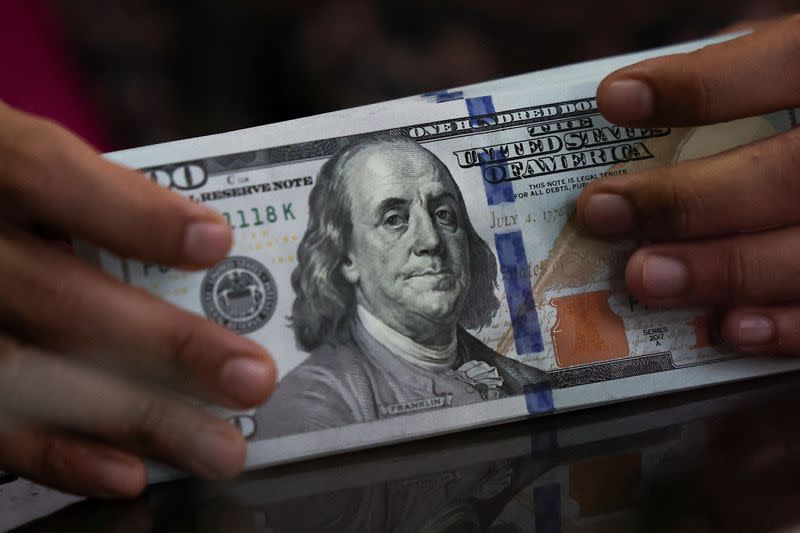
By Gregor Stuart Hunter and Lucy Raitano SINGAPORE/LONDON, May 25 (Reuters) - The dollar dropped against major currencies on Monday as hopes of a deal to reopen the Strait of Hormuz pushed oil prices below $100 per barrel, even as the U.S. and Iran played down the chances of reaching an agreement soon. Many markets - including in the U.S., Hong Kong, Britain and much of the rest of Europe - were closed for public holidays, reducing liquidity. Against the yen, the dollar was down 0.2% at 158.91 yen. Japan will build up an extra $19 billion in reserves to subsidise fuel costs and help tackle cost-of-living pressures, Prime Minister Sanae Takaichi said on Monday, while looking to assuage bond market concerns by promising no extra borrowing overall. The supplementary budget was first reported earlier this month. The euro rose 0.33% to $1.1641 and the British pound gained 0.55% to $1.3499. The Australian dollar advanced 0.58% to $0.717, while its kiwi counterpart tacked on 0.5% to $0.5874. The U.S. dollar index fell about 0.3% to 98.969. U.S. AGREEMENT WITH IRAN DRAWING CLOSER? As diplomatic efforts to find a resolution to the Iran war continue, U.S. Secretary of State Marco Rubio said there would either be a good agreement or Washington would deal with the country in "another way". Iran's foreign ministry spokesperson said conclusions had been reached on many topics discussed in a potential memorandum of understanding with the U.S., but this did not mean Tehran was close to signing an agreement. "If and when a peace deal is secured, the USD will weaken for a period. However, once that impulse washes through, the USD will re‑strengthen because of its better fundamentals against the major currencies," wrote Samara Hammoud, international economist and currency strategist at CBA. Oil markets tumbled on hopes of a peace deal, with Brent crude prices down 5% to $98.43 a barrel, while U.S. West Texas Intermediate was at $88.83 a barrel, off 4.8%. Over the weekend, there were conflicting signals over the likelihood of a deal. U.S. President Donald Trump said on social media on Saturday that a memorandum of understanding on a peace deal with Iran had been "largely negotiated," with both countries and mediators in Pakistan reporting progress. However, on Sunday Trump said on Truth Social that the U.S. blockade on Iranian ships in the Strait of Hormuz would "remain in full force and effect until an agreement is reached, certified, and signed". "Markets have become conditioned to be incredibly patient on a tangible breakthrough, but the base case of a deal remains firm, with the weekend news providing further conviction, even if the timing remains unclear," said Chris Weston, head of research at Pepperstone Group Ltd in Melbourne. He added that if Brent drops towards $90 this would give risk assets renewed life as short-term inflation expectations fall and implied rate hike bets for 2027 are pared back. European Central Bank policymaker Yiannis Stournaras said on Monday that if euro zone inflation overshoots the ECB target temporarily but significantly, there should be a cautious adjustment of monetary policy in a more restrictive direction. Traders are looking ahead to some key data due this week including a U.S. ADP employment report on Tuesday and euro zone confidence surveys on Thursday. Elsewhere, bitcoin was up 0.9% at $77,271.20, while ether rose 1.1% to $2,114.30. (Reporting by Gregor Stuart Hunter in Singapore and Lucy Raitano in London. Editing by Aidan Lewis, Gareth Jones and Mark Potter)
Comments
You must be logged in to comment.