yahoo Press
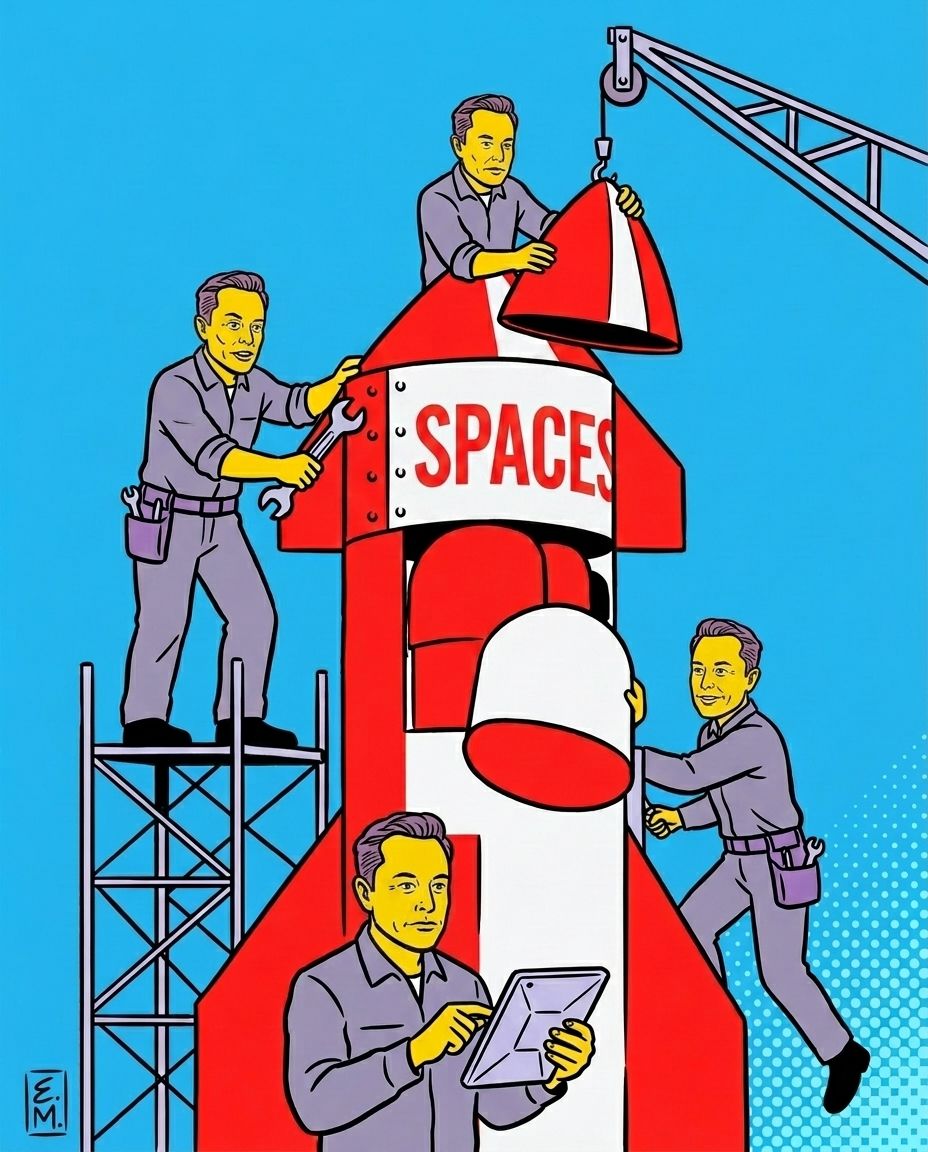
SpaceX Finally Filed and the S-1? Well, She’s a Lot
Images

1 / 5
2 / 5

3 / 5

4 / 5

5 / 5
The above button links to Coinbase. Yahoo Finance is not a broker-dealer or investment adviser and does not offer securities or cryptocurrencies for sale or facilitate trading. Coinbase pays us for certain activity generated through this link. Prices displayed are informational.

Our analysts just identified a stock with the potential to be the next Nvidia. Tell us how you invest and we'll show you why it's our #1 pick. Tap here.

SpaceX filed to go public Wednesday, and the S-1 is (we mean this as a genuine compliment to the sheer ambition of the document), the most Elon thing Elon has ever done.

At 308 pages, it covers rockets, brain chips, asteroid mining, a chatbot feature the company was legally required to disclose to the SEC as "Unhinged Voice Mode," ongoing CSAM litigation, a Tesla collaboration project subtly named “Macrohard” with financial terms not yet finalized, and at least three sale-leaseback deals with a related party called Valor totaling over $12 billion in obligations. It is… a lot.

The finances, however, are the truly dizzying part.

Revenue is real and growing: $10 billion in 2023, $14 billion in 2024, $19 billion last year. Now the part they'd prefer you skim. SpaceX lost $4.9 billion in 2025 and is annualizing toward $17 billion in losses through Q1 2026. R&D spending consumed 46 cents of every revenue dollar last year and hit 75 cents in the first quarter of 2026. Total liabilities are $60 billion. The company burned $9 billion in cash in a single quarter. It carries 12.5% senior secured notes inherited from the xAI acquisition, which is a junk-bond-level interest rate and a fairly clear statement of what the market thought of xAI as a credit. The CFO's bonus is tied to hitting $10 billion in adjusted EBITDA, and the filing notes that none of those options vested in 2025. Buried in the footnotes is a $10 billion contingent termination fee tied to a call option on Cursor, an AI coding startup valued at $60 billion, exercisable 30 days after IPO. That's basically a rounding error the size of a mid-cap company.

We've seen a version of this before, but that one was called "WeWork." Staggering losses, baroque self-dealing, governance that handed one founder control no reasonable board would sanction. That story ended badly and fast. The difference, the important one, is that Musk actually builds things that work. The rockets are real. Starlink has genuine margins. SpaceX is not a co-subletting operation cosplaying as a tech company. But the S-1 asks you to do something Neumann also asked: believe the man at the center is a feature, not a liability.

One stock. Nvidia-level potential. 30M+ investors trust Moby to find it first. Get the pick. Tap here.

Here is what the filing says about that man, under oath.

Musk serves simultaneously as CEO, CTO, and Chairman, a trifecta from which he can only be removed by shareholders he already controls. He doesn't work there full time. The filing says so directly. He holds no employment agreement requiring him to stay. SpaceX carries no life insurance on him, despite acknowledging that finding a replacement "could be lengthy and uncertain" and may never happen. His public statements, on any topic, on any platform, are a formally disclosed investment risk. His other companies, including Tesla, Neuralink, and The Boring Company, can legally compete with SpaceX for business opportunities with zero obligation to bring them to the rocket company first. The company has formally renounced, in its charter, certain opportunities that pass through Musk and his affiliates. Brazil already seized SpaceX assets because of something Twitter did, at a time when Twitter wasn't even owned by SpaceX. The filing warns this could happen again.

There is also a disclosed risk that breakthrough nuclear energy on Earth could make SpaceX's orbital data centers economically pointless. That one's almost refreshing in its nerd futurist honesty.

Like we said, Starlink is profitable. The launch business is extraordinary. The vision of cheap access to space, satellite internet for the planet, and eventually Mars is legitimately more compelling than anything Neumann ever sketched on a whiteboard after a bong hit. But at $60 billion in liabilities, $17 billion in annualized losses, and a governance structure built around one man who is also running five other companies and has a well-documented habit (not that one) of treating shareholder communications as a creative outlet, you are not buying a balance sheet.

Yes, it’s an incredible thing to witness a $1.5 trillion IPO that could also act as a prequel for Star Trek, but we would like to preach a little caution here. By investing in SpaceX, you are buying a bet on Elon's continued attention. Price accordingly.
Comments
You must be logged in to comment.