yahoo Press
'Financials look reckless': Lifting the xAI hood in the SpaceX IPO
Images
1 / 5
2 / 5

3 / 5

4 / 5
5 / 5
XAI , the artificial intelligence company Elon Musk founded that was subsequently acquired by SpaceX, has seen its losses mount, according to the latter’s newly published S-1 filing. XAI had an operating loss of $2.47 billion on $818 million in revenue in Q1 2026, representing 17% of SpaceX’s overall revenue of $4.69 billion for the quarter.

SpaceX’s IPO prospectus, which details the user and revenue growth of xAI, is the most detailed picture yet of an AI frontier model company’s finances. And the picture that’s emerged is one of accelerating losses and increasing spending as xAI fights to keep up with its chief rivals.

In 2025 alone, xAI lost $6.36 billion on $3.2 billion in revenue.

“If you compare xAI to a traditional SaaS company, the financials look reckless,” said Harrison Rolfes, a senior research analyst at PitchBook who covers the major AI frontier labs. “The ‘insanity’ isn’t in the spending but the bet that by the time other firms get their GPU clusters online, xAI will have already moved the goalposts toward autonomous physical agents. If that payoff happens, the $1B+ per month burn will be viewed as a bargain.

“If it doesn’t, we are looking at the largest venture-funded correction in history.”

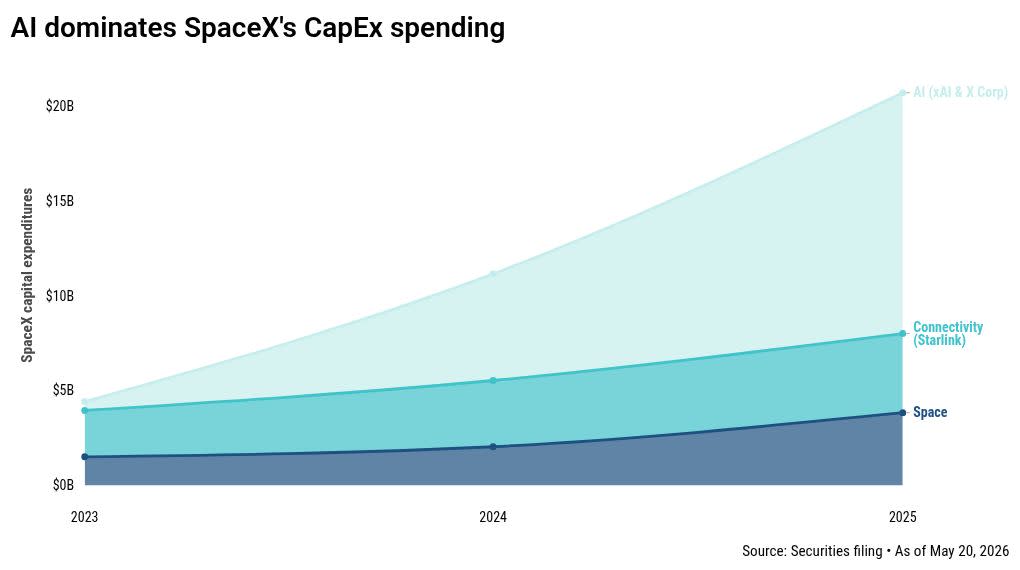
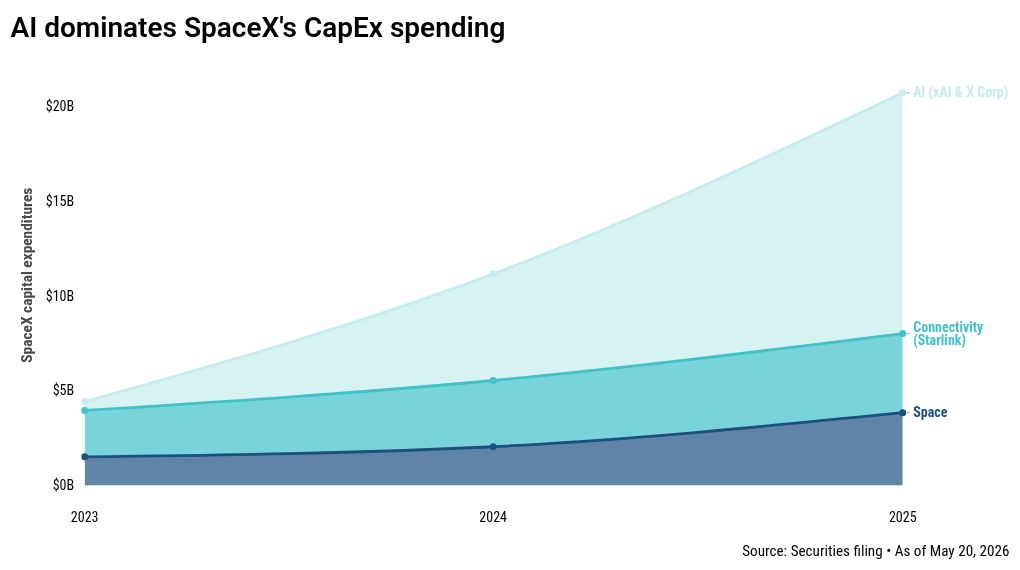
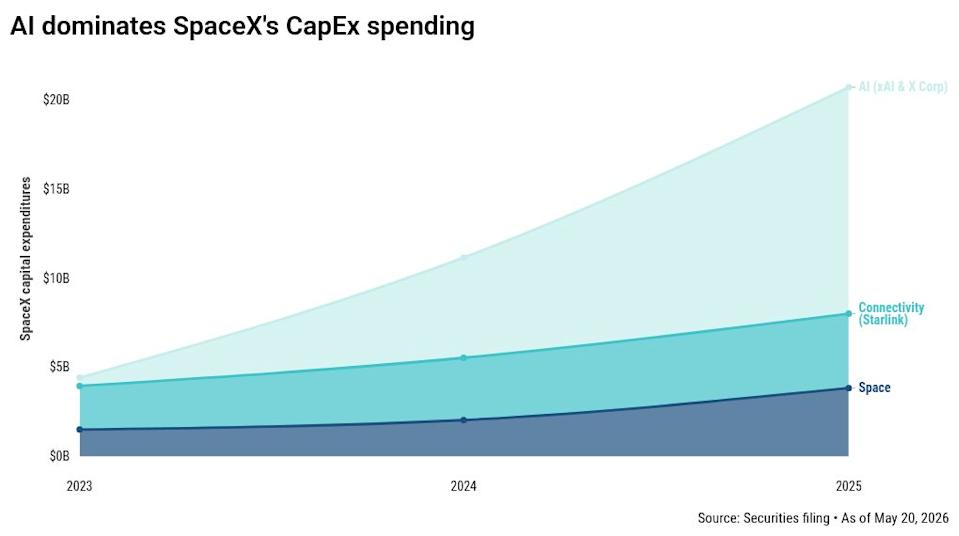
The Grok chatbot maker’s capital expenditures have ballooned, providing the fullest picture yet of the cost of GPU spending and data center expansion for a major AI large language model maker. In 2025, xAI spent $12.7 billion in CapEx, more than the combined $8 billion SpaceX spent on its Starlink satellite internet service and rocket launch service.

For 2026, xAI is already on track to far exceed last year’s spending, with $7.7 billion in Q1 alone.

But xAI’s growing CapEx spend isn’t without a business case. In May, Anthropic—one of the company’s chief competitors—entered into an agreement to pay xAI $1.25 billion per month to access compute through its Colossus data center. The prospectus states that either party can terminate the agreement with 90 days’ notice and that SpaceX is looking to enter into similar deals.

There are 117 million monthly active users of xAI’s Grok model, but with a caveat: Only 1.9 million subscribers pay to access xAI’s advanced models, which are SuperGrok, SuperGrok Heavy and SuperGrok Lite. There are also 4.4 million paying X users who have access to some of Grok’s models as well.

A bright spot for the company, however, is that xAI’s merger with SpaceX has improved its debt situation. xAI had been an aggressive borrower, taking on $16 billion in new debt during 2025 alone to fund its GPU buildout. In March 2026, SpaceX took out a $20 billion bridge loan at a significantly cheaper rate and used the proceeds to pay off xAI’s debt stack, effectively refinancing it onto SpaceX’s balance sheet.

How xAI performs over the coming quarters will be an important signal for investors eyeing OpenAI and Anthropic’s IPOs. Both companies are reportedly considering pulling the trigger as soon as Q3, as they look to the public markets to fund their ever-expanding capital requirements.

Despite media reports of heavy losses, OpenAI and Anthropic haven’t had difficulties attracting investors. The latter signed a term sheet valuing it at $900 billion earlier this month, the Financial Times reported. And multiple news outlets report that OpenAI could confidentially file a draft of its prospectus with the SEC as soon as Friday.

XAI’s revenue growth is dwarfed by that of OpenAI and Anthropic, whose flagship ChatGPT and Claude products are driving their business sales. In 2025, OpenAI’s revenue grew by more than 230% from the previous year, CFO Sarah Friar has publicly said. On Wednesday, The Wall Street Journal reported that Anthropic expects to generate $10.9 billion in revenue in Q2 (up from $4.8 billion in Q1) and post an operating profit of $559 million.

While SpaceX’s public debut and subsequent public performance won’t be a perfect proxy for the market’s confidence in LLM companies, it will provide investors with some visibility into the category’s economics.

This article originally appeared on PitchBook News
Comments
You must be logged in to comment.