yahoo Press
Tech stocks today: Samsung strike talks break down, tech stocks bounce ahead of Nvidia earnings
Images
1 / 8

2 / 8

3 / 8

4 / 8

5 / 8

6 / 8

7 / 8

8 / 8
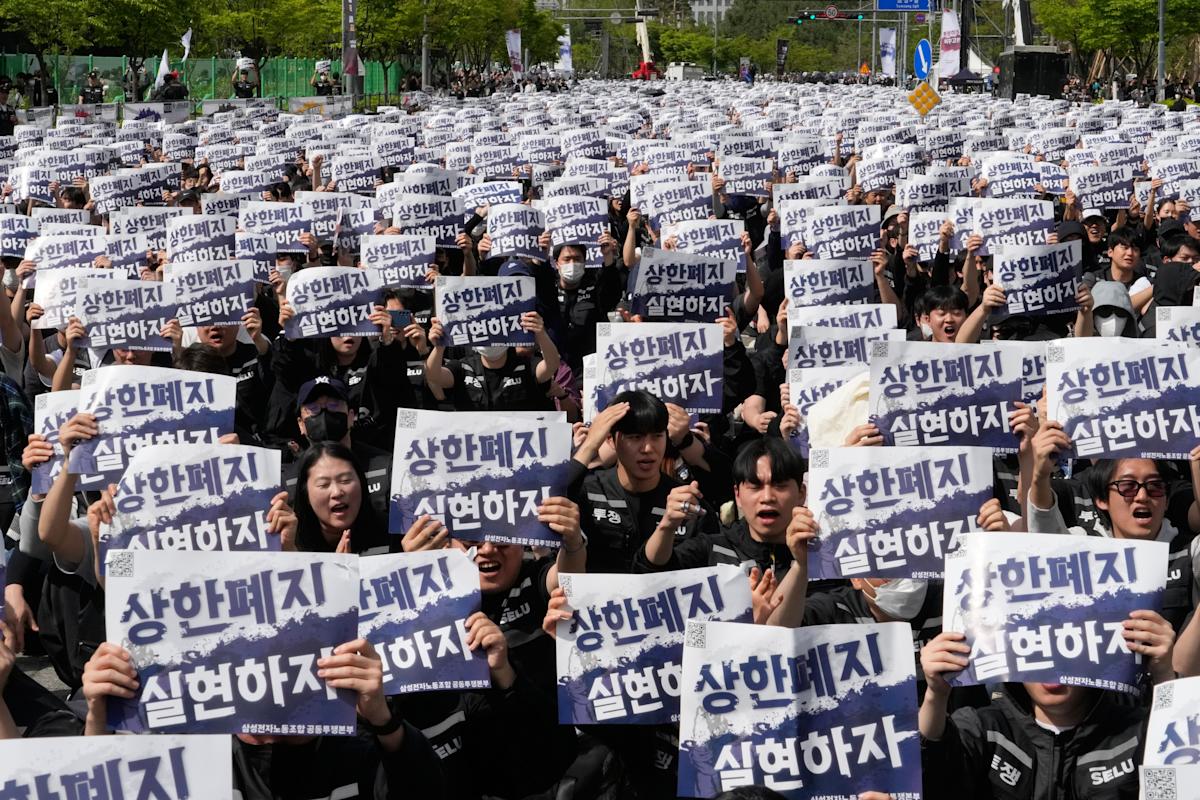
The above button links to Coinbase. Yahoo Finance is not a broker-dealer or investment adviser and does not offer securities or cryptocurrencies for sale or facilitate trading. Coinbase pays us for certain activity generated through this link. Prices displayed are informational. Tech stocks recovered from heavier losses on Tuesday and continued to rise on Wednesday as investors looked toward Nvidia’s (NVDA) earnings report. Nvidia’s results on Wednesday come with high expectations for earnings and AI demand amid rising competition among chipmakers. Nvidia’s results follow CEO Jensen Huang’s trip to China with President Trump and other CEOs. On Tuesday, Google (GOOG, GOOGL) unveiled several new products, including its Gemini 3.5 family of AI models and a line of smart glasses made with Samsung (005930.KS). Speaking of Samsung, investors are also watching a potential 18-day strike at the world’s largest memory chip manufacturer that could begin on May 21. Talks broke down earlier this week, but the two sides are still working to come to a last-minute agreement. A strike at Samsung would cause significant disruption to South Korea’s economy and to global supply chains that rely on its chips. Meanwhile, in a shakeup in the artificial intelligence space, OpenAI (OPAI.PVT) co-founder and former Tesla (TSLA) AI executive Andrej Karpathy announced he joined Anthropic (ANTH.PVT). Negotiations between Samsung (005930.KS) and its labor union to avert a massive strike are coming down to the wire, and the implications are global. Bloomberg reports: Talks between Samsung Electronics Co. and its largest labor union broke down, raising the prospect of a strike that may disrupt global chip supply and hamper an important engine of Korean economic growth. A general work stoppage will go ahead on Thursday after Samsung’s management rejected a proposal from government mediators that had been accepted by the union, labor leader Choi Seung-ho told reporters. Hours later, South Korean labor minister Kim Young-hoon called for direct negotiations between the two sides, though it’s unclear whether even that intervention could resolve their differences. Samsung shares tumbled as much as 4.4% before recouping losses in afternoon trading. The collapse in negotiations puts the global technology supply chain at risk because Samsung is the world’s biggest supplier of the chips that go into devices from data center servers to smartphones and electric vehicles. The global AI infrastructure rollout has enriched South Korean companies on a scale not seen before, putting Samsung on track to become one of the world’s most profitable firms this year. Its semiconductor arm posted a 48-fold jump in profit for the March quarter. Read more here. Google (GOOG, GOOGL) unveiled its newest AI model family during its annual Google I/O conference on Tuesday. Called Gemini 3.5, the company said the models combine frontier intelligence with the ability to perform actions via AI agents. Google said Gemini 3.5 Flash will be the first of the new models, with a Pro version coming next month. Flash, the company said, provides intelligence that rivals other large flagship models, with faster response rates, and is its most powerful coding and agentic model, topping even its Gemini 3.1 Pro. The model is available today via the Gemini app, in Google Search via AI Mode, and via Google’s new Gemini Spark AI agent. Google is in a constant back-and-forth race between Anthropic (ANTH.PVT), OpenAI (OPAI.PVT), and other model builders to lead in AI capabilities. The company was widely seen as lagging well behind its competitors until it launched its Gemini 3.0 in November 2025. That helped reset the narrative surrounding Google’s AI know-how on Wall Street and contributed to its stock price climbing 126% since the company debuted the software. Read more here. Google (GOOG, GOOGL) on Tuesday debuted an updated version of its all-important Search product, rolling out improved AI capabilities that let you ask more detailed questions, create search-based AI agents, and better visualize topics via AI-generated interface tools. Unveiled today at the company’s annual Google I/O conference in Mountain View, Calif., the upgraded Search bar gets the web giant’s latest Gemini 3.5 Flash AI model and lets you search for photos, videos, files, and Chrome tabs, the company explained. In one example, a user uploaded two reference photos, one of a dress and the other of a piece of orange fabric. The person then asked Google to find a similar dress in the same fabric color for under $150. Search returned a series of matches, followed by questions asking for the user’s size and the occasion to narrow down the options. You can also have back-and-forth conversations with the updated Search from Google’s AI Overview panel, which will automatically launch you into AI Mode to continue the chat. Read more here. Samsung (005930.KS) and Google (GOOG, GOOGL) revealed their upcoming line of smart glasses on Tuesday. The companies said the intelligent eyewear is intended to be used as a companion device for users’ smartphones and will feature designs from Gentle Monster and Warby Parker (WRBY). According to Samsung, the glasses are meant to be used hands-free and can perform tasks like helping you navigate by voice, providing personalized suggestions for locations like a nearby coffee shop on your regular walking route, and placing an order for pickup. The glasses will also summarize text notifications and allow you to add events to your calendar. Samsung said the eyewear will also offer real-time voice translation and can translate text, such as menus and signs. “This intelligent eyewear marks an important step in Samsung’s vision for AI,” Jay Kim, Samsung’s executive vice president and head of consumer experience office and mobile experience business, said in a statement. “With this new AI form factor, we are further expanding the Galaxy device ecosystem, where each device is optimized to deliver unique AI experiences that best fit each form,” Kim said. Read more here. OpenAI (OPAI.PVT) founding member Andrej Karpathy has joined rival lab Anthropic (ANTH.PVT), Karpathy said on Tuesday. In a post to X, Karpathy announcing his decision, the AI researcher wrote, “I think the next few years at the frontier of LLMs will be especially formative.” After working as a founding member of OpenAI, Karpathy joined Elon Musk’s Tesla (TSLA) as the carmaker’s head of artificial intelligence and autopilot vision. He then re-joined OpenAI before departing the AI lab once more. Karpathy is also credited with popularizing the term “vibecoding.” Anthropic announced Tuesday that the auditing giant KPMG is integrating the AI lab’s Claude product throughout its operations, and that all of KPMG’s employees will have access to the AI software. Tech stocks broadly fell on Tuesday as investors went risk-off and perhaps took some profits as higher bond yields weighed on equity markets. As my colleagues Brian Sozzi and Ines Ferré pointed out this morning, high-flying chip stocks like Micron (MU) and SanDisk (SNDK) have fallen over the past five days, while beaten-down software names saw some momentum return. But by afternoon trading, the tech sector was a sea of red, and both the Tech-Software Sector ETF (IGV) and the Philadelphia Semiconductor Sector Index (^SOX) fell. The “Magnificent Seven” stocks — Apple (AAPL), Alphabet (GOOGL, GOOG), Microsoft (MSFT), Amazon (AMZN), Meta (META), Tesla (TSLA), and Nvidia (NVDA) — were under pressure too, with Amazon and Tesla seeing the biggest declines. Reuters reports: Samsung Electronics and its South Korean labour union began another round of government-mediated talks on Tuesday to break an impasse in negotiations over pay and bonuses and avert the biggest strike in the tech conglomerate's history. The two sides are under mounting pressure to prevent an imminent strike by 45,000 workers that could hurt the Korean economy and global supply chains by disrupting chip production. South Korea's prime minister threatened over the weekend to step in through emergency arbitration to resolve the crisis. Samsung and the labour union remained far apart during talks on Monday, the chairman of the National Labor Relations Commission told reporters. But he said on Tuesday the two sides are narrowing some differences and there is still a possibility that they could reach an agreement. Read more here. Yahoo Finance’s David Hollerith reports: Google (GOOG, GOOGL) and Blackstone (BX) are launching an artificial intelligence cloud company, the latest sign that Wall Street is getting deeper in the AI infrastructure race. The joint venture will provide data center capacity, operations, networking, and Google Cloud's Tensor Processing Units (TPUs) as a compute-as-a-service offering. The business will give customers another way to access Google’s TPUs, in a similar fashion to cloud provider CoreWeave (CRWV). Blackstone said it will make an initial $5 billion equity investment through its funds. It expects the company’s first 500 megawatts of power to come online by 2027. Though precise figures aren't disclosed, Blackstone would be a majority shareholder, according to a person familiar with the deal. The announcement is a major signal for how the hard assets that power artificial intelligence’s computing needs are becoming a highly appealing investment for finance. Read more here. A jury rejected claims by Tesla (TSLA) leader Elon Musk that OpenAI (OPAI.PVT) and its leader, Sam Altman, violated key tenets of its nonprofit status, finding that Musk waited too long to file the suit and exceeded the statute of limitations. Judge Yvonne Gonzalez Rogers accepted the advisory jury’s verdict, bringing to a close a sprawling legal case that could have sent shockwaves through Silicon Valley. On Monday afternoon, a nine-person federal jury rejected Musk’s $150 billion case against OpenAI, closing a two-week trial that featured testimony from two of Silicon Valley’s most visible leaders. The jury ruled that Musk’s “Breach of Charitable Trust” claim against Sam Altman, OpenAI co-founder Greg Brockman, and OpenAI itself is barred by the statute of limitations. The jury also ruled that Musk’s “Aiding and Abetting Breach of Charitable Trust” claim against Microsoft (MSFT) exceeded the statute of limitations. Musk’s lawyers argued over the past two weeks that OpenAI breached its founding agreement as a nonprofit by adding on a for-profit entity and raising outside capital, including $13 billion from Microsoft. Musk had been seeking $150 billion in damages for Altman’s removal from OpenAI’s board of directors. A dispute over semiconductor workers’ bonuses in Korea could upend global technology supply chains and weigh on South Korea’s economy, as Samsung’s (016360.KS) labor union has threatened to go on strike on May 21 for 18 days. On Sunday, Samsung and the union agreed to extend negotiations after the first round of government-mediated talks failed and a South Korean court granted a partial injunction that could compel workers to show up amid a strike, according to Reuters. Relations between the world’s largest memory chip manufacturer and its workers broke down over how bonuses are allocated. Samsung is expected to bring in $200 billion in operating profits this year amid booming chip demand, and employees are seeking a 15% share of those profits. At stake, should the strike move forward, is 22.8% of South Korea's exports, which come from Samsung, as well as broader economic fallout across industries that rely on memory chips, including artificial intelligence, gaming, and consumer electronics like laptops. Already, companies are dealing with supply bottlenecks for memory and storage as AI data centers scoop up these components to try to meet booming demand. "Just one day of suspension at Samsung Electronics' semiconductor factory is expected to incur direct losses of as much as 1 trillion won [$667.68 million]," South Korea’s Prime Minister Kim Min-seok said on Sunday, per Reuters. Read more here. SpaceX (SPAX.PVT) is barreling toward its initial public offering, and it is trying to make its stock even more attractive with a stock split before it even debuts. Bloomberg reported over the weekend that SpaceX told its investors it will implement a 5-for-1 stock split, a move that would potentially reduce the price of the stock ahead of its IPO. SpaceX informed shareholders that the current fair market value per share has been adjusted to about $105.32 from $526.59 as a result of the split, per Bloomberg sources. The stock split will be processed this week and is expected to be officially completed by May 22, the sources said. News of the split comes as SpaceX is quickly headed toward the public markets. On Friday, Reuters reported that SpaceX is planning to price its IPO as early as June 11, with the rocket company listing on the Nasdaq starting on June 12. Read more. Yahoo Finance’s Jared Blikre reports: For Nvidia (NVDA) investors, the first move after earnings has historically been only part of the story. Buying the stock just before quarterly results has produced modest short-term gains, but the longer-term picture has been much stronger. This chart shows the difference clearly. Since 2016, Nvidia’s post-earnings returns have been positive across every holding period studied. But the edge has been far more modest over the next day, week, or month than over a quarter or a year. The median gain has been only 0.3% after one day, 3.3% after one week, and 0.4% after one month. That rises to 11.1% over one quarter and 87.6% over one year. That helps frame what traders are up against heading into the next report. Options are pricing in a 6% post-earnings move, well above Nvidia’s typical daily range over the prior quarter. But it’s also close to what the stock has already shown it can do around earnings, based on its most recent setup. Read more here. AI heavyweight Nvidia (NVDA) will report its first quarter results on May 20, in what is easily one of the most anticipated announcements of the earnings season. Yahoo Finance’s Daniel Howley previews what to expect: In addition to its China woes, Nvidia is contending with increasing competition in the AI chip space. Chip company Cerebras (CBRS) held its initial public offering on Thursday, with shares climbing 68%. Cerebras sells a different form of AI processor than Nvidia, which the company says offers faster overall performance speeds. Nvidia is also facing ever-increasing competition from AMD (AMD), which will launch a competing rack-scale server system later this year, as well as from customers, including Amazon (AMZN) and Google (GOOG, GOOGL), which are offering their AI chips to third-party customers. In its latest earnings report, Amazon announced that its chip business now has an annual revenue run rate of more than $20 billion and is growing at triple-digit percentages year over year. Read more here.
Comments
You must be logged in to comment.