yahoo Press
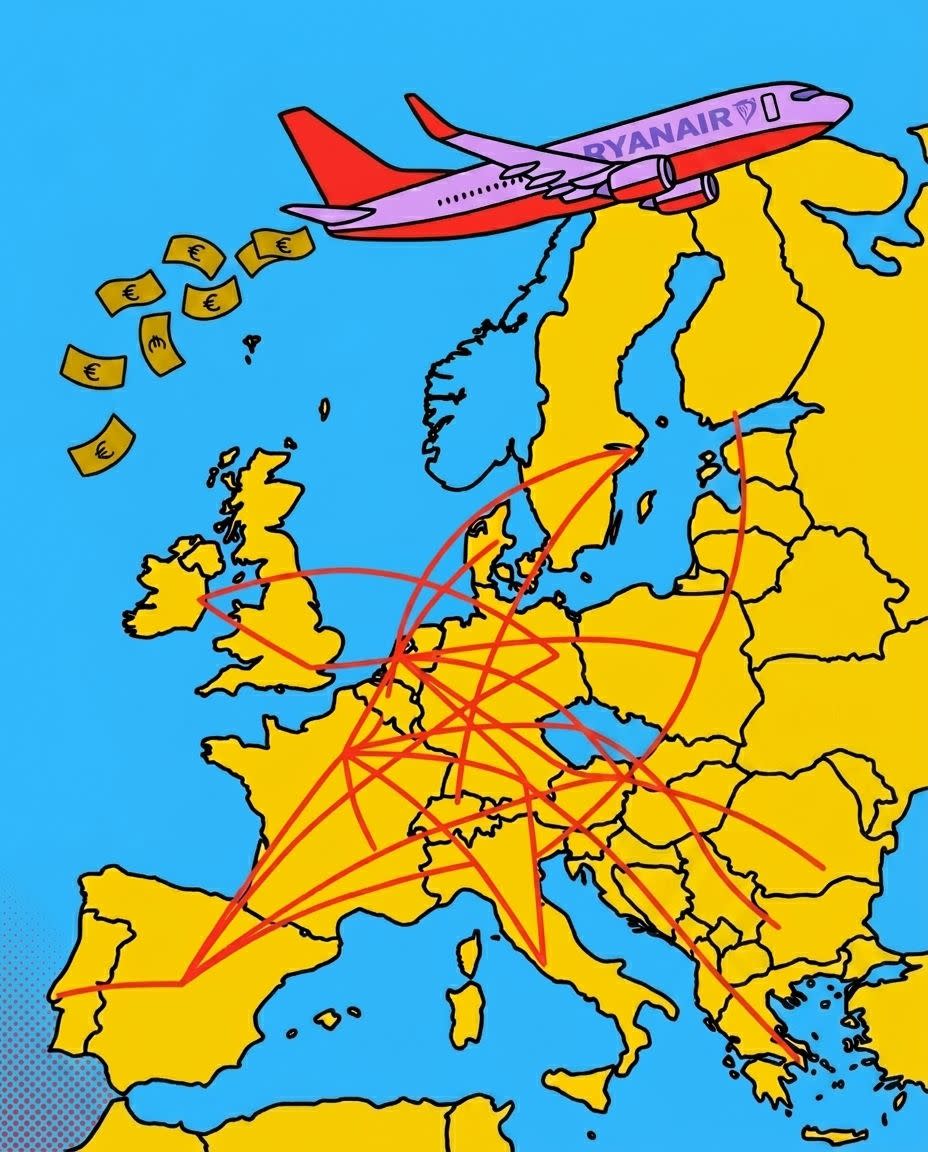
Ryanair Lands a Record Profit But Refuses to Map the Flight Path
Images
1 / 5
2 / 5

3 / 5

4 / 5
5 / 5
The above button links to Coinbase. Yahoo Finance is not a broker-dealer or investment adviser and does not offer securities or cryptocurrencies for sale or facilitate trading. Coinbase pays us for certain activity generated through this link. Prices displayed are informational.

Our analysts just identified a stock with the potential to be the next Nvidia. Tell us how you invest and we'll show you why it's our #1 pick. Tap here.

Ryanair just printed the biggest annual profit in its history, but investors are still dumping the stock.

The budget carrier posted a record pre-exceptional profit of €2.26 billion (about $2.6 billion), up a staggering 40% year on year, thanks to a relentless surge in passenger numbers and double-digit fare hikes.

But instead of taking a victory lap, CEO Michael O’Leary refused to give Wall Street a full-year profit forecast for 2027, sending shares down 3% as fuel price volatility and Middle East tensions cloud the summer horizon.

The headline numbers from Ryanair's fiscal 2026 report were objectively spectacular. Total revenue climbed 11% to €15.54 billion, powered by a 4% increase in passengers to a massive 208.4 million. Fares jumped 10% to an average of roughly €51 per passenger, helping the airline completely recover from the pricing slumps of previous years.

Even with an exceptional €85 million provision set aside for a messy antitrust fine in Italy, the underlying business proved to be an absolute cash machine. Net cash stood at €2.10 billion at the end of March, allowing the airline to announce it will repay its final €1.20 billion bond this month, rendering the group entirely debt-free. Shareholders are also getting a final dividend of €0.195 per share alongside an ongoing €750 million buyback program.

Yet, the market focused entirely on O’Leary’s total lack of visibility for the second half of the year. Spot jet fuel prices have blasted past $150 per barrel due to the ongoing Iran war and the effective closure of the Strait of Hormuz. Ryanair has hedged a highly conservative 80% of its fuel requirements at about $67 per barrel through April 2027, but the remaining 20% is completely exposed to the open market.

Worse for short-term sentiment, the airline warned that first-quarter fares are trending lower by a mid-single-digit percentage compared to last year. Consumers are shifting toward a shorter booking window, waiting until the last minute to lock in holiday flights, which makes it nearly impossible for management to predict peak summer yields.

In the brutal world of aviation, one airline's misery is Michael O’Leary’s favorite business opportunity. While a 3% stock dip feels annoying, Ryanair is arguably in the strongest competitive position in Europe precisely because the macro environment is so hostile.

One stock. Nvidia-level potential. 30M+ investors trust Moby to find it first. Get the pick. Tap here.

The jet fuel crisis is a perfect example of this dynamic. Daily shipments through the Strait of Hormuz have collapsed from 20 million barrels to just 2 million, causing an acute fuel crunch across Europe. While Ryanair is sweating over the 20% of its fuel that remains unhedged, its European rivals are in a far worse position.

Many legacy carriers are exposed to floating spot prices, rising aircraft lease costs, and expensive debt. CFO Neil Sorahan was remarkably candid about this, noting that if oil stays at $150 a barrel through the summer, a wave of weaker European airlines will simply collapse before winter.

O’Leary has spent decades playing a game of chicken with his competitors, using Ryanair's low cost base to bleed them dry during recessions. This time is no different. The airline is actively withdrawing its scarce capacity from uncompetitive, high-tax markets like Germany, Belgium, and regional Spain, and redeploying it to countries like Albania, Italy, and Morocco that are cutting aviation taxes to incentivize traffic growth.

The delay in Boeing aircraft deliveries remains an annoying speed bump, but it also acts as an artificial cap on industry capacity.

European short-haul capacity is expected to remain severely constrained until at least 2030 due to OEM backlogs and engine repair delays. For a low-cost giant with an unencumbered fleet of 620 aircraft and a shiny new A rating from the Carbon Disclosure Project, a constrained market means Ryanair can maintain immense pricing power the moment consumer confidence stabilizes.

The primary data point to watch will be Ryanair’s first quarter results release in late July, which should give the market its first clear read on actual peak summer pricing.

If late summer bookings snap back and the unhedged 20% fuel hit remains manageable, the current 27% year to date slide in the stock price will look like a massive overreaction.

Investors should also watch for the official announcement of Michael O’Leary’s contract extension. The board is currently finalizing a deal to keep him at the helm until April 2032, complete with an option over 10 million shares. The catch is that these options are tied to incredibly ambitious profit and share price targets.

If O’Leary signs on the dotted line, it means the ultimate aviation insider believes that navigating the current global fuel shock is just the prelude to a massive corporate expansion.
Comments
You must be logged in to comment.