yahoo Press
Iran’s Building a Bitcoin Empire for the Strait of Hormuz
Images
1 / 7
2 / 7

3 / 7

4 / 7

5 / 7

6 / 7
7 / 7
Our analysts just identified a stock with the potential to be the next Nvidia. Tell us how you invest and we'll show you why it's our #1 pick. Tap here.

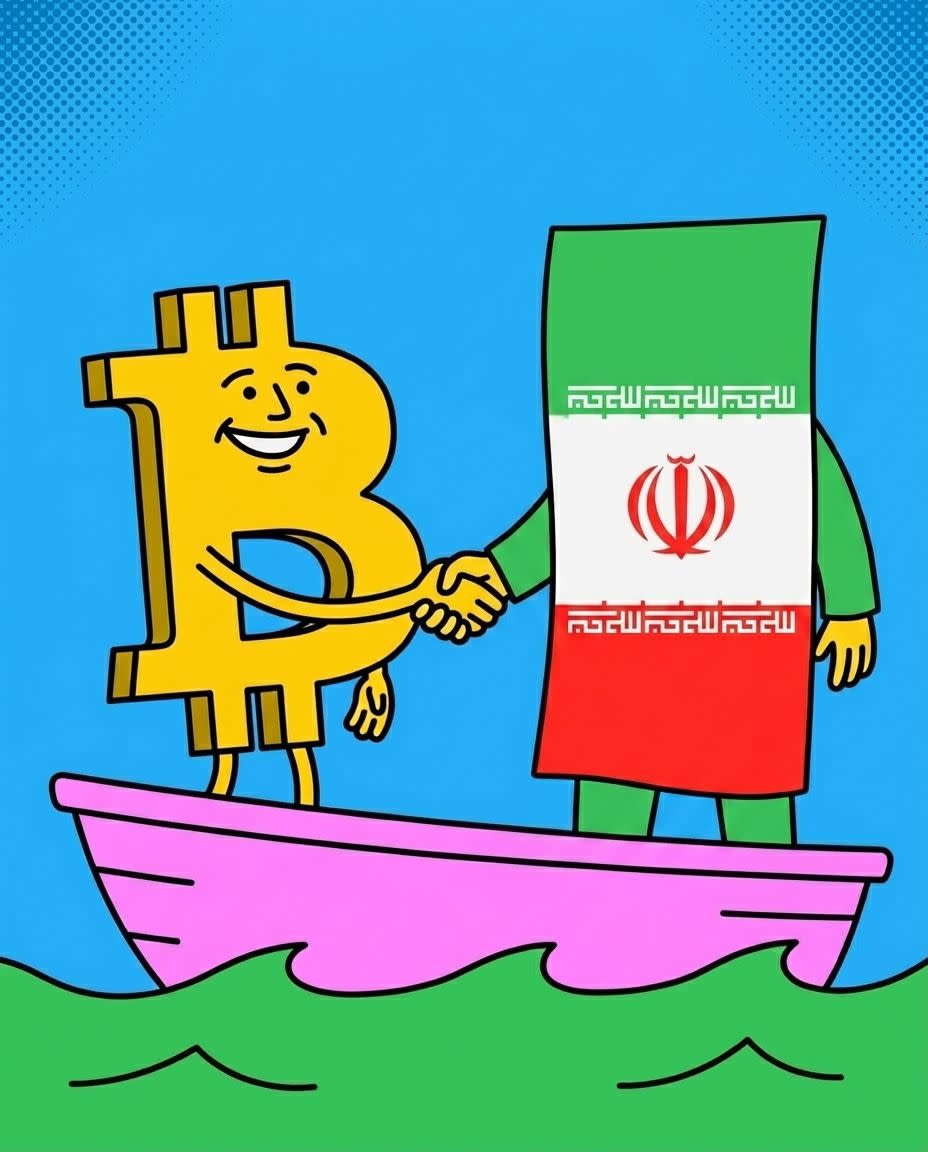
Much to the frustration of the Trump Administration, Iran’s using Bitcoin to build the kind of financial digital infrastructure never thought possible.

They’re calling it the "Hormuz Safe," a Bitcoin-based “maritime insurance platform” tied to ships passing through the contested Straight of Hormuz, a key energy corridor.

There’s some irony here, given President Trump in 2024 ran on a pro-crypto platform, only to have the country he launched a hot conflict with turn around and use it.

Developed by Iran’s Ministry of Economy in mid-May, the “Hormuz Safe” is a clear step by Tehran to turn its military grip on the Strait of Hormuz into a legitimate-looking commercial operation.

Still, Western insurance firms, SWIFT (the international banking rails), and the U.S. dollar are unavailable for Iran to collect their Hormuz payments because there’s still no peace treaty between Iran the U.S.

Here’s how it works: After filing a mandatory "Vessel Information Declaration” form, commercial shipping companies, cargo owners, and oil tankers will then go onto the Iranian Revolutionary Guard Corp’s online platform (hope there’s good WiFi!), detail their cargo, and then send the required Bitcoin to a specified wallet. If you’ve ever done this on Coinbase, there’s a terrifying moment when you think you've entered the wrong wallet address, even though you're waiting for the money to show up. We can’t imagine how tense the first few go-arounds will be. Once the transaction clears Bitcoin’s blockchain, the vessel receives a cryptographically signed digital receipt, proof of coverage, and their way.

Sounds easy enough, right?

Not quite. At some point the IRGC will have to withdraw this Bitcoin from a custodial exchange and swap it for an asset more stable and widely accepted. This has already happened via various crypto exchanges, as well as by directly freezing on-chain crypto stablecoins like USDT (Tether).

Treasury Secretary Scott Bessent announced in late April that the U.S. government coordinated the freezing of $344 million in USDT tied to Iranian sanctions as part of "Operation Economic Fury.” Bessent later said that the figure was actually higher, somewhere around $500 million. But this is only possible because the federal government and Tether are close, likely because Tether is in the process of launching USA₮ (USAT), a stablecoin designed specifically for the American market.

Bitcoin, unlike USDT, can’t be frozen because of its design. Bitcoin is entirely decentralized, meaning there’s no corporate off-switch like Tether. Of course, the federal government can blacklist wallets, which would make it impossible withdraw from certain crypto exchanges. But Iran could then go to China, Russia, North Korea, or other U.S. adversaries. While the cryptocurrency is transparent and can be tracked, we saw last week that China told its companies to ignore U.S. sanctions targeting domestic refineries involved in the Iranian oil trade.

So, who’s going to tell them otherwise? Iran could also simply hold the Bitcoin, which would be great for Bitcoin given the recent scarcity narratives touted by crypto bulls like Michael Saylor.

General reporting on how the “Hormuz Safe” works is still spotty, with most of the information coming from Iranian state-linked and regional Middle Eastern media outlets like the Fars News Agency.

Worse, there is no verified public website or active portal for "Hormuz Safe" that international shipping lines can log into, leaving the potential for scam Bitcoin and crypto sites acting as the “Hormuz Safe” a very real possibility. This already happened in late April, when one stranded ship fell for the scam, paid the crypto fee, and believed it had official clearance from Tehran to exit the Gulf, only to have its boat eventually shot at by the IRGC.

That shouldn’t take away from the fact that, if the IRGC can pull off the "Hormuz Safe,” they stand to make $10 billion annually, per reports. None of this infrastructure existed before the Trump Administration and Israel launched their attack on Iran. It could end up hurting the U.S. dollar’s supremacy — and throw a wrench into global trade.

MicroStrategy (MSTR) — As a significant corporate holder of Bitcoin, increased utility and demand for Bitcoin reinforces its investment thesis.

One stock. Nvidia-level potential. 30M+ investors trust Moby to find it first. Get the pick. Tap here.

Cryptocurrency Industry — The "Hormuz Safe" demonstrates a novel, high-profile use case for Bitcoin, potentially driving adoption and reinforcing its scarcity narrative.

Bitcoin — Its use by Iran for a critical financial platform increases its utility and demand, highlighting its censorship-resistant design.

Iran — Gains a new, substantial revenue stream ($10 billion annually) and a mechanism to circumvent international sanctions.

China — Could benefit from increased trade with Iran and a strengthened position against U.S. sanctions by providing alternative crypto exchange access.

Russia — Stands to benefit from increased financial and trade ties with Iran, further undermining U.S. sanctions.

North Korea — Could find new avenues for financial transactions and trade with Iran, bypassing traditional financial systems.

Coinbase (COIN) — While potentially seeing increased crypto activity, it faces significant regulatory risks and would likely be prohibited from directly facilitating Iranian transactions.

Tether — Demonstrated vulnerability to U.S. government freezing actions for USDT, but is also launching USA₮, a stablecoin for the American market, indicating a mixed regulatory relationship.

Global Shipping Industry — Faces increased operational complexity and potential costs from the "Hormuz Safe" but also gains a new, albeit risky, method for transit through the Strait of Hormuz.

U.S. Government — Faces frustration over Iran's use of Bitcoin but has demonstrated capability to freeze stablecoins like USDT, indicating a mixed ability to enforce sanctions.

JPMorgan Chase (JPM) — As a major player in international banking and SWIFT transactions, any circumvention of traditional financial rails poses a long-term threat to its business model.

Bank of America (BAC) — Similar to JPMorgan, its reliance on the traditional global financial system makes it vulnerable to initiatives that bypass SWIFT and the U.S. dollar.

Citigroup (C) — As a global bank heavily involved in international trade finance, the "Hormuz Safe" could erode the dominance of the U.S. dollar and traditional banking services.

Wells Fargo (WFC) — While more domestically focused, its international operations and reliance on the U.S. dollar's global supremacy face headwinds from such alternative financial systems.

Chubb (CB) — As a major global insurer, it stands to lose maritime insurance business in the Strait of Hormuz and faces a challenge to the legitimacy of traditional insurance.

AIG (AIG) — A significant player in commercial insurance, it could see reduced demand for maritime coverage in critical shipping lanes due to Iran's alternative platform.

Travelers (TRV) — As a large property and casualty insurer, it faces a direct threat to its maritime insurance offerings and the broader traditional insurance market.

Frontline (FRO) — As an oil tanker company, it faces increased operational costs and complexity due to mandatory Bitcoin payments and potential risks from the IRGC.

Euronav (EURN) — An independent tanker company, it will incur new costs and navigate the risks associated with the "Hormuz Safe" for transit through the Strait.

Teekay Tankers (TNK) — As a major owner and operator of oil tankers, it will be directly impacted by the requirement to pay fees in Bitcoin for passage through the Strait of Hormuz.

Star Bulk Carriers (SBLK) — As a dry bulk shipping company, it faces new operational hurdles and costs if its vessels transit the Strait of Hormuz.

ZIM Integrated Shipping Services (ZIM) — As a global container shipping company, it will face the logistical and financial challenges of the "Hormuz Safe" for its routes.

ExxonMobil (XOM) — As a major oil and gas producer and refiner, it faces increased geopolitical instability in a key energy corridor and potential complications in global oil trade.

Chevron (CVX) — Similar to ExxonMobil, it faces risks from disrupted oil flows, increased geopolitical tension, and challenges in navigating sanctions related to Iranian oil.

Shell (SHEL) — A global energy company, it faces potential supply chain disruptions and increased costs related to oil transport through the Strait of Hormuz.

BP (BP) — As a major oil and gas company, it is exposed to the geopolitical risks and potential for increased oil prices stemming from instability in the Strait of Hormuz.

TotalEnergies (TTE) — A multinational energy company, it faces similar risks to other oil majors regarding the security and cost of oil transit through the region.

Valero Energy (VLO) — As a major independent refiner, it could face higher crude oil input costs due to increased geopolitical risk in the Strait of Hormuz.

Marathon Petroleum (MPC) — As a large refiner, it is exposed to potential disruptions in global oil supply and price volatility caused by tensions in the Strait of Hormuz.

Traditional Maritime Insurance Industry — Faces direct competition and erosion of market share from Iran's Bitcoin-based platform, undermining its legitimacy and revenue.

International Banking Industry — The circumvention of SWIFT and the U.S. dollar by Iran poses a long-term threat to the established global financial system.

Commercial Shipping Industry — Faces increased operational costs, logistical complexities, and potential security risks when transiting the Strait of Hormuz.

Oil & Gas Industry — Faces heightened geopolitical risk in a critical energy corridor, potentially leading to supply disruptions and price volatility.

U.S. Dollar — Its global supremacy is challenged by Iran's successful use of Bitcoin to bypass traditional financial systems for significant revenue generation.

United States — Faces a direct challenge to its sanctions regime and financial influence, potentially weakening its geopolitical leverage.

Israel — Mentioned as having launched an attack on Iran, implying continued geopolitical tension and potential for conflict, which is a negative for regional stability.

Crude Oil — Increased geopolitical tension and potential for disruption in the Strait of Hormuz could lead to higher prices and supply uncertainty.

[Immediate] Increased Bitcoin Demand and Price Volatility — The "Hormuz Safe" legitimizes Bitcoin as a tool for state-level financial operations, potentially driving immediate speculative demand and price fluctuations as investors react to its enhanced utility. Confidence: High.

[Short-term] Heightened Geopolitical Risk in Strait of Hormuz — The implementation of the "Hormuz Safe" and the IRGC's involvement will likely lead to increased tensions and potential for incidents in the critical energy corridor, impacting shipping and oil markets. Confidence: High.

[Medium-term] Erosion of U.S. Sanctions Effectiveness — Iran's ability to generate significant revenue ($10 billion annually) via Bitcoin directly undermines the U.S. sanctions regime, reducing its economic leverage and potentially encouraging other sanctioned entities to adopt similar strategies. Confidence: High.

[Long-term] Challenge to U.S. Dollar Supremacy — The successful operation of the "Hormuz Safe" could set a precedent for bypassing the U.S. dollar in international trade, gradually eroding its role as the primary global reserve and transaction currency. Confidence: Medium.

[Medium-term] Increased Operational Costs for Shipping Companies — Commercial shipping, cargo owners, and oil tankers will incur new costs and logistical complexities associated with mandatory Bitcoin payments and navigating the "Hormuz Safe" platform for transit through the Strait. Confidence: High.

↑ Bitcoin Price — Increased utility and demand from state-level adoption will likely drive up Bitcoin's price.

↑ Crude Oil Prices — Heightened geopolitical risk in the Strait of Hormuz, a key energy corridor, will likely lead to an increase in global crude oil prices.

↓ USD Index — The challenge to the U.S. dollar's supremacy in international trade could put downward pressure on the USD Index over time.

↑ Baltic Dry Index — Increased operational costs and potential for delays or disruptions in a critical shipping lane could contribute to higher shipping rates.

↑ VIX — Elevated geopolitical tensions and uncertainty surrounding global trade and financial systems will likely lead to an increase in market volatility.
Comments
You must be logged in to comment.