yahoo Press
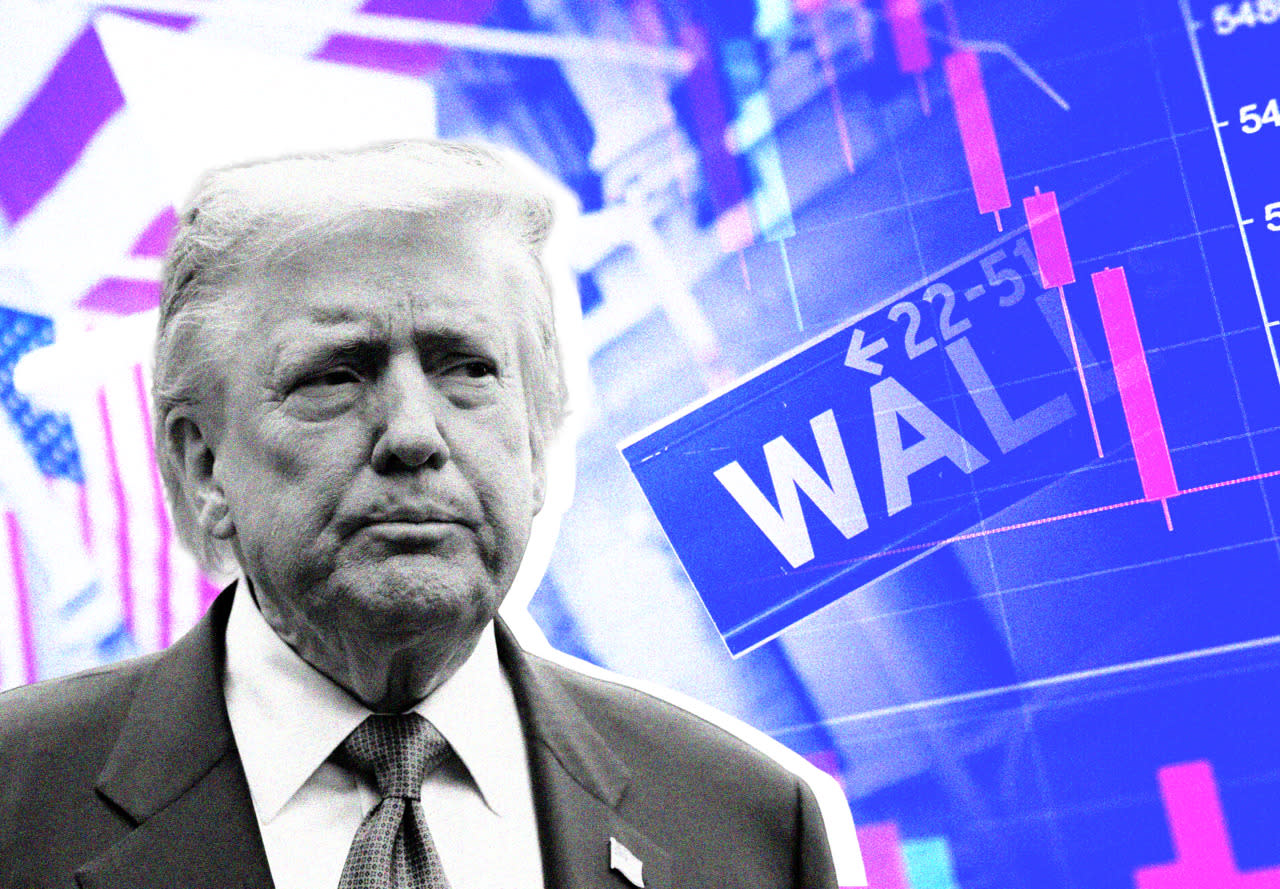
Stocks and bonds get swept up in a selloff, as Trump’s China visit fails to pry open the Strait of Hormuz
Images
1 / 5
2 / 5

3 / 5

4 / 5
5 / 5
The above button links to Coinbase. Yahoo Finance is not a broker-dealer or investment adviser and does not offer securities or cryptocurrencies for sale or facilitate trading. Coinbase pays us for certain activity generated through this link. Prices displayed are informational.

U.S. markets sold off sharply Friday as global oil prices topped $109 a barrel, inflation fears gripped Wall Street and President Donald Trump’s China trip ended without a breakthrough to reopen the Strait of Hormuz.

The leaders of the world’s two biggest economies wrapped up the high-stakes U.S.-China summit in Beijing on Friday, but there were few indications that Trump had gained Chinese leader Xi Jinping’s help to persuade Iran to reopen the crucial waterway.

My wife and I retired with 22 times our income. Why don’t more people do what we did?

‘I experienced many years of poverty’: I worked until 70. Why do wealthy retirees look down on those with less savings?

Stocks and bonds get swept up in a selloff, as Trump’s China visit fails to pry open the Strait of Hormuz

You may be making a big mistake with your Roth conversion, this expert says

“It’s kind of messy out there when you look at the price action,” said Garrett Melson, a portfolio strategist at Natixis Investment Managers Solutions. Markets were “losing a bit of an anchor” from the intensifying rout in global bond markets, he added.

Trump didn’t offer details of trade agreements as he left Beijing. A White House official said Xi “expressed interest” in purchasing more American oil, and said both nations want the Strait of Hormuz open without tolls.

Related: Trump’s China visit could rattle markets if it doesn’t bring an Iran breakthrough

The U.S. president said he didn’t ask his Chinese counterpart to urge Iran to ease traffic through the strait, but predicted Xi later would.

“I didn’t ask him to put pressure, because I don’t need favors,” Trump said on Air Force One. “I think, automatically, he’d like to see it opened up.”

U.S. stocks tumbled across the board, with the S&P 500 SPX closing 1.2% lower, the Dow Jones Industrial Average DJIA down 1.1% and the Nasdaq Composite Index COMP 1.5% lower, according to FactSet data.

Trump also told reporters aboard Air Force One that U.S. farmers would be “very happy” with China’s purchases of American soybeans. Trump said he and Xi discussed lifting sanctions on Chinese companies that buy Iranian oil, and that a decision would be made in a few days.

Trump announced that China would buy 200 Boeing aircraft, but that amount was fewer than the expected 500. The company’s stock BA fell nearly 4% Friday.

“As we keep kicking the can down the road, the market is only going to get more worried,” said Johnathan Owen, a portfolio manager at TwentyFour Asset Management, about ending the Iran conflict. However, hope remains that tumult in financial markets will prompt a resolution before the global oil supply shock turns into something catastrophic.

“Trump very clearly wants out,” said Owen. “The market is banking on this being resolved in the near term. But if we are here in two months, there’s likely going to be a pretty significant inflation problem.”

U.S.-traded West Texas Intermediate crude oil for June delivery CL00 CL.1 CLM26 rose about 4% to over $105 a barrel, while global benchmark Brent crude for July delivery BRN00 BRNN26 advanced more than 3% to top $109 a barrel, according to Dow Jones Market Data. The global oil benchmark gained almost 8% for the week.

Wall Street has been confronted by an oil shock that’s now seeping into U.S. economic data. Wholesale-prices data — where inflation shows up first — climbed in April to the highest level in four years.

“It feels a bit like 2022,” said Melson at Natixis, pointing to the growing chorus of voices sounding alarms about inflation risks and the rise of longer-duration bond yields. U.S. Treasury yields broke through key resistance levels this week and have kept climbing. That’s when “you kind of lose the plot and price action takes over,” he said.

The Cboe Volatility Index VIX, known as Wall Street’s “fear gauge,” was up more than 6% Friday but still below its long-term average of around 20.

Read: The bond market is already hiking rates as Kevin Warsh takes over as Fed’s new chair

Yet the biggest moves were in U.S. government bonds, on deepening concerns that the resurgence of inflation brought on by the Iran war could force the Federal Reserve to pursue higher interest rates.

The chances of at least one rate hike this year were near 50%, according to the CME FedWatch Tool.

“I don’t see how the Fed can justify hiking rates in the face of rising energy prices,” said Mike Sanders, head of fixed income at Madison Investments. Eventually, if oil prices around $100 a barrel are sustained, consumers and the economy will likely face damage, he said.

The 30-year Treasury yield BX:TMUBMUSD30Y shot up to 5.127% Friday, its highest level since July 2007, according to Dow Jones Market Data. The benchmark 10-year yield BX:TMUBMUSD10Y surged to 4.595%, and the policy-sensitive 2-year yield BX:TMUBMUSD02Y climbed above 4% — the highest levels for both since February 2025. Bond yields move in the opposite direction to prices.

“The big issue right now is on the rates front,” said Melson at Natixis. Yet he also sees a bias to the upside for equity markets. “I wouldn’t be surprised to see some profit-taking and consolidation,” he said, though adding that’s also probably going to be short-lived.

While it “feels like 2022” on the inflation front, Melson said it also feels a lot like last year, when the worst-case scenarios didn’t pan out and there was a mad dash to get rerisked. “That’s still at play,” he noted.

Also see: The U.S. dollar has barely budged this year — but that could be about to change

Robert Schroeder contributed.

My husband took out a $100,000 Parent PLUS loan for his daughter. She dropped out, citing mental-health issues. Should we refinance?

The stock market surge has delivered a rare signal. Here’s what history suggests happens next, says Goldman Sachs.

George Soros’s fund buys Berkshire Hathaway stock — now that Buffett is gone

‘He is retired’: Should my husband take his Social Security at 62 and invest it?
Comments
You must be logged in to comment.