yahoo Press
Oil prices rise as tensions flare in Middle East, Trump says US-Iran ceasefire is 'on life support'
Images
1 / 5
2 / 5

3 / 5

4 / 5

5 / 5
Oil prices rose on Tuesday as tensions remained inflamed in the US after President Trump said the ceasefire agreement between the countries was “on life support,” while the Strait of Hormuz remained essentially closed to traffic, further pressuring global inventories.

Futures on Brent crude (BZ=F), the international benchmark, gained 3.6% to trade above just under $108 per barrel, while contracts on US benchmark WTI crude (CL=F) rose an equal 3.6% to trade north of $101.50.

Investors spent Tuesday morning looking for any signs of relief or renewed aggression in the Gulf region after President Trump told reporters on Monday that the Iranian response received by the White House was “garbage.”

In their response to a US proposal for a framework under which to reopen peace negotiations, Iran has demanded lifting the US naval blockade of the Strait of Hormuz, which has been choking off Iranian export revenues, as well as sanctions relief and some degree of control over traffic through the strait moving forward.

Tensions also flared over worries of a potential restart to a “hot war.”

Kuwait on Tuesday said Iran’s Revolutionary Guard Corps had launched a skirmish against an island within Kuwaiti territory, which the Kuwait Ministry of Foreign Affairs called a “flagrant violation of the sovereignty” of the country. The UAE, which has taken the brunt of Iranian missile and drone strikes, has reportedly been secretly striking Iran without disclosing the actions, the Wall Street Journal reported on Monday.

Read more: It's not just gas prices. How the Iran war is coming for your grocery bill.

The US said it struck Iran throughout the tail end of last week after Tehran fired on US warships transiting the Strait of Hormuz.

Traffic through the strait, a critical chokepoint for global energy flows, remained essentially halted Tuesday morning, adding to supply losses throughout the market. Saudi Aramco (2223.SR) CEO Amin Nasser said Monday that the world is set to lose 100 million barrels of oil supply each day the war continues.

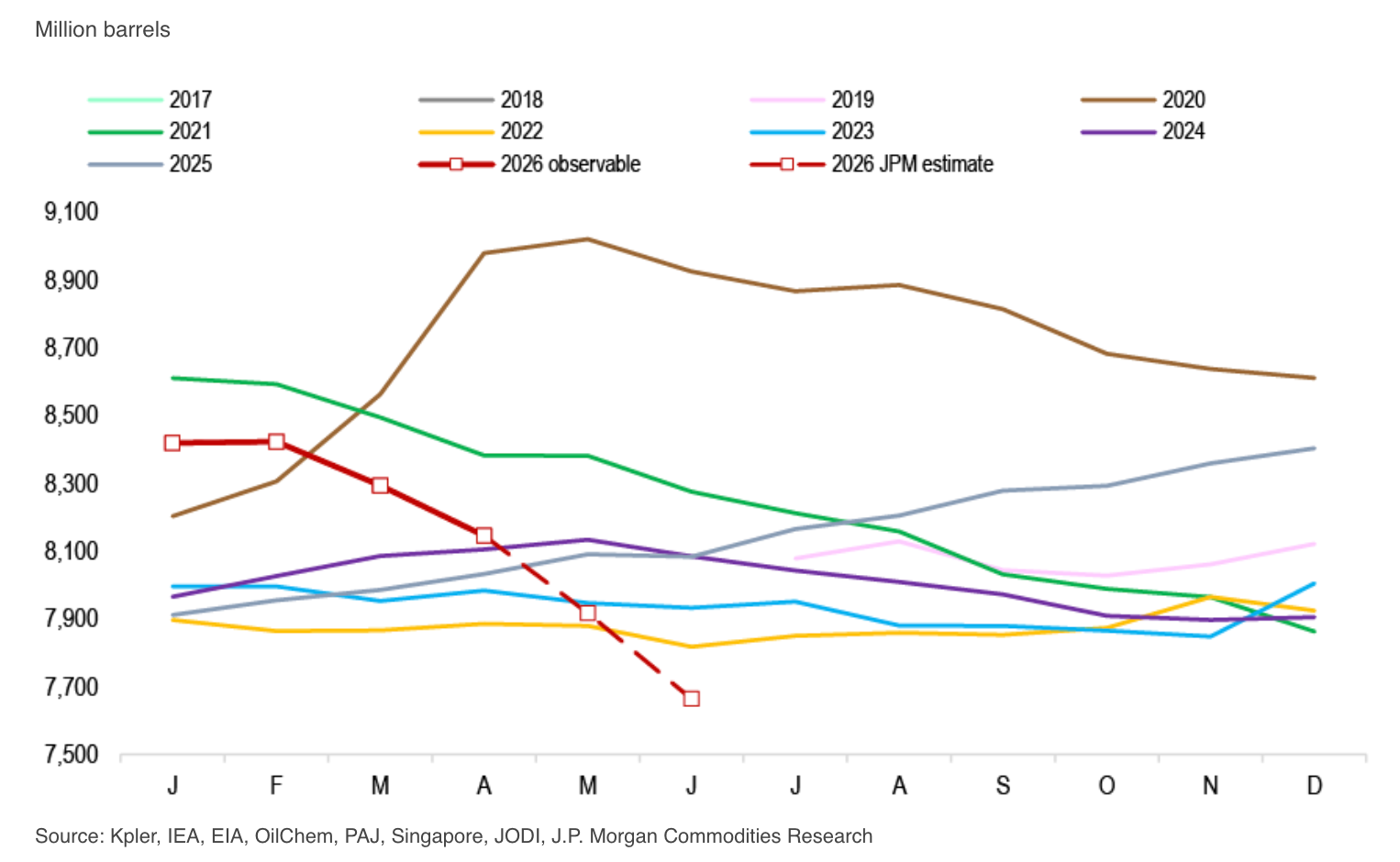
As the strait has remained closed, global oil inventories have plunged. While a heavily oversupplied market heading into the war has helped keep prices contained as countries have been able to draw down ample inventories, that buffer is nearing exhaustion, according to JPMorgan.

Global stocks in OECD countries are now expected to reach operational stress levels by June, and operational minimum levels — the level below which pipelines, refineries, storage tanks, and other infrastructure can’t operate — by September, per JPMorgan.

“A core assumption of our framework is that the accelerating pace of oil inventory depletion will ultimately force the reopening of the Strait of Hormuz, one way or another,” JPMorgan analysts led by Natasha Kaneva said in a recent report on the oil market.

Global oil demand fell by 2.8 million barrels per day (mbd) in March and by 4.3 mbd in April, according to JPMorgan research, with demand-driven losses expected to reach 5.6 mbd in May. Governments in Southeast Asia have implemented the most drastic measures, enforcing shortened workweeks and fuel rationing, while European airlines have begun cutting back on noncritical regional flight routes.

Even if the Strait of Hormuz were to reopen tomorrow, “the time required to restart fields, repair refineries and reposition tanker tonnage means the market is on track to lose another billion barrels over the balance of 2026,” Morgan Stanley analysts wrote in a recent report.

Though it remains doubtful what a reopened strait would look like. Even if an agreement is nominally in place, shipowners will look for full ratification from Iran, while a now-emboldened Tehran will seek to extend its influence over the waterway through tolls, threats, and other measures, energy analysts and maritime risk specialists told Yahoo Finance.

“Ten weeks into the Hormuz crisis, the question is no longer whether the strait is open or closed – that binary became less useful weeks ago,” said Arsenio Longo, founder of maritime risk intelligence firm HUAX.

“What has replaced it is a layered access system, in which passage still exists, but under conditions that are increasingly political, selective and operationally managed,” he said.

The US government on Tuesday released 53.3 million barrels of oil from its strategic petroleum reserve — part of an agreement coordinated with the IEA to release 172 million barrels in total — as prices for crude and its derivatives have surged.

Gasoline pump prices on Tuesday averaged $4.50 per gallon nationally, with only months to go until the midterm elections, where affordability issues are set to be top of mind for voters.

Jake Conley is a breaking news reporter covering US equities for Yahoo Finance. Follow him on X at @byjakeconley or email him at jake.conley@yahooinc.com.

Click here for in-depth analysis of the latest stock market news and events moving stock prices

Read the latest financial and business news from Yahoo Finance
Comments
You must be logged in to comment.