yahoo Press
Project44 launches Autopilot, an AI-enabled logistics operating system that offers infinite labor
Images

1 / 6

2 / 6

3 / 6

4 / 6
5 / 6

6 / 6
Project44 has launched Autopilot, a no-code platform that lets shippers, brokers and 3PLs deploy AI agents across their supply chain workflows without writing prompts, building integrations or hiring an engineering team to wire it up.

The product is the culmination of more than 18 months of agent deployment across the project44 network. According to the company, that work has already produced a 4% reduction in freight spend, a 70% reduction in manual coordination, sourcing cycles up to 75% faster and as much as a 40% reduction in disruption-related costs.

But Autopilot is more than another feature release. It is project44’s bet on what the next decade of supply chain software looks like. It is also a direct challenge to the wave of agentic AI startups that have raised hundreds of millions over the past two years to automate the very workflows project44 is now automating itself.

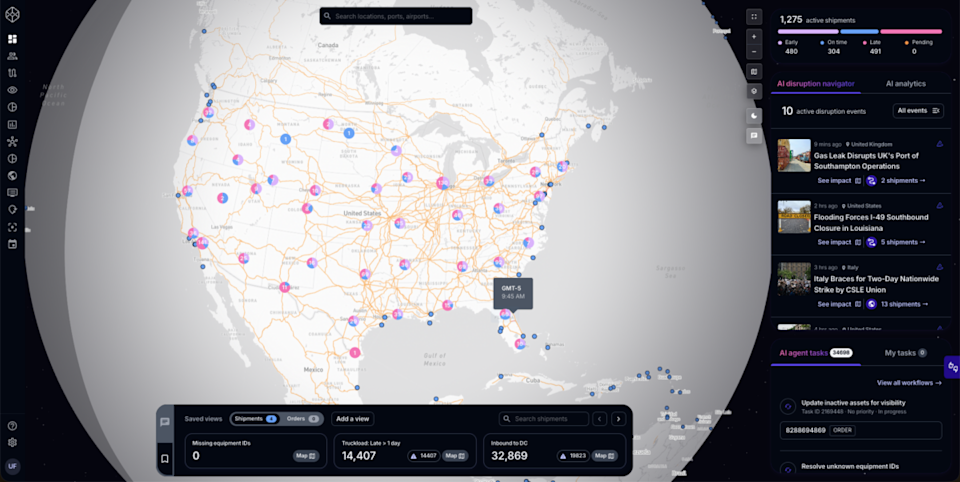
(A screenshot of project44’s Autopilot. (Image: project44)

Autopilot gives users a visual workflow canvas where AI agents respond to real-time logistics signals (a late shipment, a missing PRO number, a container dwelling too long at the port of discharge) and act on them autonomously. Customers configure the triggers, set conditional branching by carrier or lane, define escalation paths and choose post-agent actions like notifications, task creation or routing work to a human operator. A draft-and-publish model lets teams iterate on workflow configurations without disrupting live operations, and every agent action is logged and auditable through project44’s Movement Collaboration Center.

The pre-built library covers about 40 workflows today, including collecting truck milestones, late shipment reason codes, missing PRO numbers, and carrier outreach for ETA confirmation. Project44 says it is shipping two to three new ones a week. Administrators can toggle any of them on with a click and tailor the steps to fit their own escalation paths and notification preferences. No prompt engineering. No TMS integration project. No data normalization.

Eastman Chemical Co., an early customer, said in the launch announcement that the platform let its team expand into APAC and onboard less-technical carriers without adding operational complexity. “The right work reaches the right people without manual intervention,” said Josh Moss, Eastman’s process lead for global supply chain.

In a conversation previewing the launch, founder and CEO Jett McCandless walked me through what he called the signal-trigger-action evolution of project44’s platform, and by extension of supply chain visibility itself.

“Signal” is the network. It’s the data graph project44 has spent more than a decade building, which now connects 259,000 carriers and processes 1.5 billion shipments a year across 186 countries and territories, ingesting more than 700 million logistics events a day. McCandless calls it the world’s largest synchronous logistics data graph, and he is not subtle about what it cost.

“It costs me a billion dollars to build this layer here,” McCandless said. “Maybe even more, but that’s the context that we need for everything.”

“Trigger” is what project44 layered on top during the COVID era: an exception engine, released around 2022, that turned the firehose of raw shipment data into prioritized work items. “Action,” the new layer, is Autopilot.

McCandless’ framing captures something most supply chain software companies dance around: visibility didn’t solve the underlying problem. It exposed it.

“When we turn the lights on, what came back was chaos,” he said. “Right now you can see everything that’s going on. But how do you separate noise from signal? How do you know what the actual exceptions are?”

By the time exception engines arrived, customers had a different problem: they could see what was wrong, but they couldn’t process it fast enough. “Humans don’t have the ability to process as much as that’s there,” McCandless said. “So you’d actually have to hire more humans.”

Autopilot, in his telling, is what closes that gap, turning the action layer into something that scales with the work rather than with headcount. “People have been buying technology to help humans do jobs,” he said. “Now we’re finally at the point where you can buy this technology and it will do the job.”

(Image: project44)

The most provocative thing about Autopilot isn’t the product. It’s the competitive claim project44 is making around it.

McCandless argues that the agentic AI startups crowding logistics conferences, are not really competitors. They are, in his framing, blank-canvas tools without the underlying data, system of record or distribution to deploy at scale on their own.

McClandless stated, “They don’t have any context. So all these companies have to create data lakes, normalize the data, sync it with their TMS and their CRM and all these other systems. Then they have to hire prompt engineers. They have to connect into project44 and extract the data. And then piece agents together to communicate and hand information back and forth. Most of the projects are failing.”

The wrinkle: project44 actually uses some of those same vendors inside Autopilot. The platform routes specific tasks, like a carrier callback in a particular language or an inbound voice agent for a fleet that won’t take a webhook, to whichever agent vendor performs best for the job. All the top agent vendor brands all show up in the routing layer. Customers never see them and never get a separate invoice.

That is a meaningful repositioning. McCandless is effectively arguing that the agent companies aren’t a layer; they are a commodity input, features inside a larger platform. He cited a line he attributes to logistics-tech investor Art Mesher: “One man’s product is just another man’s feature.” “The answer,” he said, of whether project44 has built a defensible platform versus a feature, “is yes for us.

Why not “control tower”

Notably absent from project44’s positioning is the phrase the rest of the category has spent five years trying to own: control tower. FourKites uses it. So do most of the legacy TMS vendors. McCandless rejects the framing.

Control towers, in his telling, evoke air traffic: tens of thousands of human controllers operating a system built on 1960s technology. That is the opposite of what Autopilot is designed to do. When project44 rebranded from a visibility company to a “decision intelligence platform” last summer, McCandless said the company seriously considered calling itself an “intelligent operating system,” and held off only to make sure it could ship product that delivered on the framing first. “When you look at what this is,” he said, “this is that intelligent operating system. And we haven’t rebranded to that.” Yet.

Autopilot arrives at an interesting moment for project44 commercially. McCandless said the company has reached cash flow break-even and is growing its shipper business, a strategic cohort t segment of its book, at 20% +  year over year.

Headcount, which peaked at 1,200, now sits at 582. McCandless said the company will never exceed 600 people. The reason: AI now writes roughly 85% of project44’s code. And we leverage AI for Operations.McCandless argues that as the cost of building software trends toward zero, the moat shifts to three things: distribution into the largest shippers and LSPs, proprietary data and a culture that can absorb constant change. The first two are defensible by the same billion-dollar data graph that underwrites Autopilot.

And there is one more wrinkle that may matter most for shippers evaluating the platform: Autopilot is currently free. “We actually don’t charge for it at all right now,” McCandless said. The implied pricing model is outcome-based. Project44 will share in the savings or efficiency Autopilot delivers rather than billing on seats, tokens or per-agent fees. That is consistent with where AI software broadly is heading, but freight tech vendors have been notably slow to commit to it.

Autopilot is a category claim. Project44 is arguing that the action layer, not the visibility layer, is where the next wave of supply chain software value will be captured, and that the only companies positioned to capture it are the ones with all three:  the data graph,  the distribution into the largest shippers and 3PLs and the culture of self disruption.

The bet is not unreasonable. The agentic AI vendors raising aggressively against this thesis will need to prove they can do more than build standalone tools. Legacy TMS players will need to figure out how to bolt agents onto on-premises architectures that were never built for it. And for shippers and 3PLs, if Autopilot delivers anything close to the freight-spend, manual-coordination and sourcing-cycle improvements project44 is advertising, the math on staffing logistics operations teams changes quickly. The action layer, as McCandless puts it, finally has infinite labor.

The post Project44 launches Autopilot, an AI-enabled logistics operating system that offers infinite labor appeared first on FreightWaves.
Comments
You must be logged in to comment.