yahoo Press
New James Webb Space Telescope images reveal how massive star clusters can reshape galaxies
Images
1 / 8
2 / 8

3 / 8

4 / 8
5 / 8

6 / 8

7 / 8

8 / 8
When you buy through links on our articles, Future and its syndication partners may earn a commission.

Astronomers have captured an extraordinary new look at the hidden birthplaces of star clusters, uncovering fresh clues about how galaxies evolve — and how young planets may be shaped by their stellar environments.

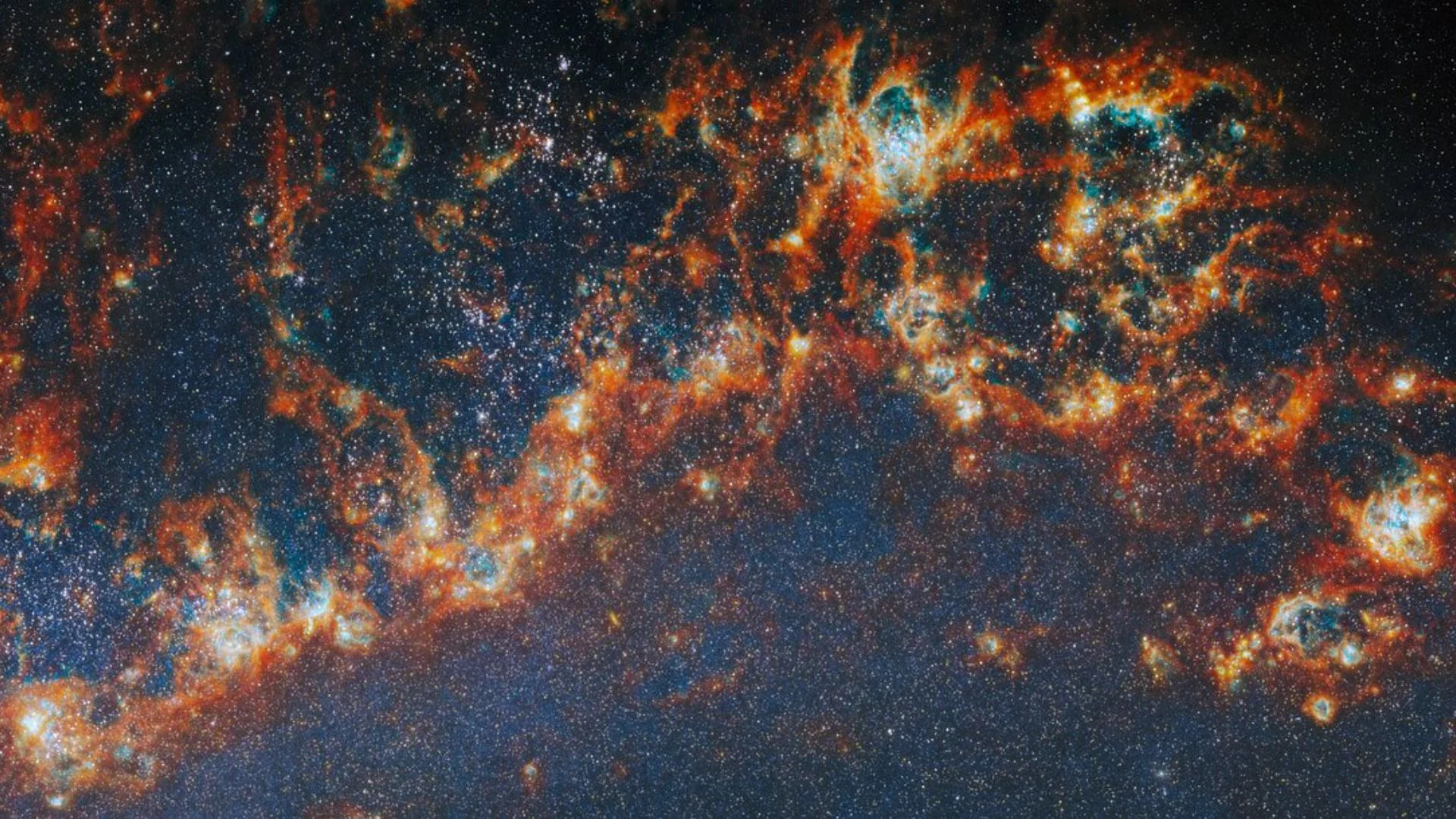
Using observations from the James Webb Space Telescope (JWST) and the Hubble Space Telescope, astronomers studied nearly 9,000 young star clusters across four nearby galaxies: Messier 51, Messier 83, NGC 628 and NGC 4449. The newly released images reveal glowing clouds of gas and dust where thousands of stars are actively forming, while also highlighting the JWST's growing ability to uncover hidden galactic structure. Brilliant knots of newborn stars, dark rivers of dust and glowing cavities carved by stellar winds combine to create a vivid portrait of galaxies in constant motion.

While the JWST's infrared vision allowed scientists to peer through thick cosmic dust, Hubble traced older, fully exposed clusters in visible light. Together, the observations allow researchers to study star clusters from their earliest, dust-shrouded stages to fully emerged stellar groups, according to a statement from NASA.

"This work brings together researchers simulating star formation and those working with observations, as well as groups researching planet formation," Alex Pedrini, lead author of the study from Stockholm University and the Oskar Klein Centre in Sweden, said in the statement. "Using Webb, we can look into the cradles of star clusters and connect planet formation to the cycle of star formation and stellar feedback."

By developing simulations that account for stellar dynamics in emerging star clusters, researchers discovered the universe's largest star clusters break free from their birth clouds much faster than expected, dramatically altering their surroundings in the process. The team found that the most massive clusters cleared away their natal gas clouds in about five million years, while smaller clusters took up to eight million years to emerge — a relatively small difference that could influence how star formation unfolds within galaxies over time.

"Simulations of star formation and stellar feedback have struggled to reproduce how star clusters form and emerge from their natal clouds," said Angela Adamo, co-author of the study and Principal Investigator of the FEAST (Feedback in Emerging Extragalactic Star Clusters) program, which collected the observations used in the research as part of a broader effort to investigate how newly formed stars shape the galaxies around them. "These results give us important new constraints on that process."

Once freed from their birth material, these giant clusters unleash intense ultraviolet radiation and stellar winds that heat and disperse nearby gas — a process known as stellar feedback. Because cold gas is the raw material needed to form new stars, stellar feedback can effectively regulate future star formation inside galaxies.

The findings could also reshape scientists' understanding of planet formation. Young planetary systems developing around stars inside these clusters may become exposed to harsh ultraviolet radiation earlier than expected. That radiation can erode the disks of gas and dust surrounding newborn stars, potentially limiting how large planets are able to grow, according to the statement.

Their findings were published May 6 in the journal Nature Astronomy.
Comments
You must be logged in to comment.