yahoo Press
Opinion - Trump’s presidency has desiccated the conservative movement
Images
1 / 10
2 / 10

3 / 10

4 / 10

5 / 10

6 / 10
7 / 10

8 / 10

9 / 10

10 / 10
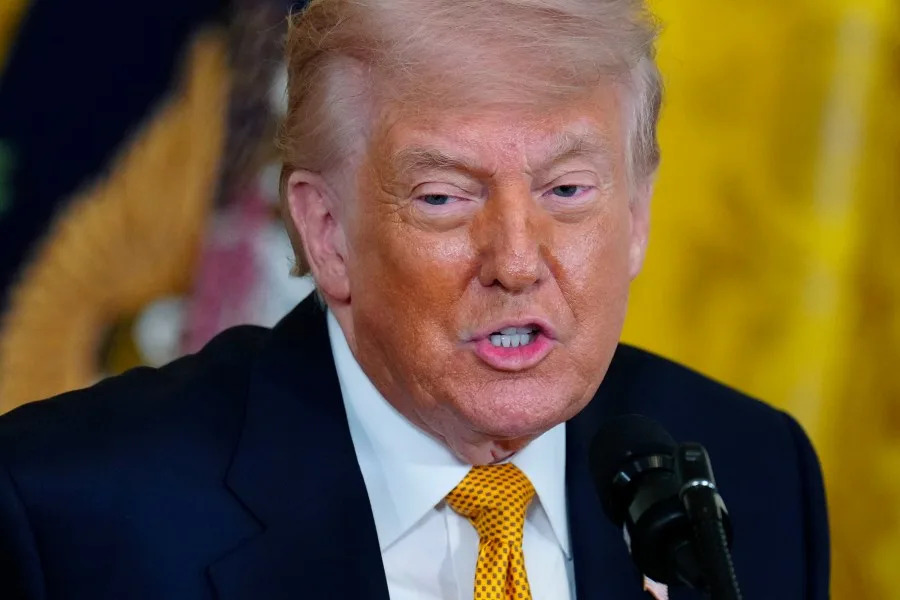
As President Trump’s second term limps along, it’s beginning to look like “everything Trump touches dies” isn’t so much a snarky slogan as it is a field report.

Take the pro-life movement. Here was one of the great unlikely marriages in modern politics: earnest, churchgoing activists linking arms with a casino-owning, thrice-married Stormy Daniels-dating real estate developer. What could possibly go wrong?

It actually worked — for a while. The alliance helped elect Trump, and his subsequent Supreme Court picks helped overturn Roe v. Wade, which had been the movement’s white whale for decades.

Enter Marjorie Dannenfelser, president of Susan B. Anthony Pro-Life America and formerly one of Trump’s more reliable supporters. She once called Trump “the most pro-life President in history.” Now she’s out there saying, “Trump is the problem.”

Not “a problem.” Not “part of the problem.” “The problem.”

She’s not wrong to notice that, post-Roe, things haven’t gone according to plan. Abortion rates are rising. Dangerous abortion pills are flooding mailboxes, and Trump’s FDA even approved a generic version of the abortion pill mifepristone.

Tired of all the winning, yet?

This was not entirely unpredictable — nor is it new. In 2022, columnist David French warned that under Trump, “the culture of life lost ground.” Then, in 2024, French observed that Trump’s “follow your heart” abortion advice was “the most pro-choice position a Republican presidential candidate has taken since at least Gerald Ford.”

Still, kudos to Dannenfelser for coming to terms with reality. But here’s the thing: Her critique isn’t merely about her socially conservative wing of the conservative movement. It is about a Faustian bargain in which the entire conservative movement traded long-term credibility for short-term gains (and survival).

It is worth taking a moment to recall that there was a time — not all that long ago — when conservative institutions had real weight to throw around. Names like Paul Weyrich, Ed Feulner, James Dobson and Phyllis Schlafly weren’t just footnotes. They were powerhouses.

Directly or indirectly, organizations like the Heritage Foundation, Concerned Women for America, the National Rifle Association, the Family Research Council — and numerous other groups I don’t have room to list — helped elect conservatives, hold politicians accountable, and generally set the terms of debate.

Many of these groups are still around (in some cases, enjoying lavish offices), but are any of these organizations — or the conservative causes for which they advocate — better off today than they were before Trump came down the escalator? I don’t think so.

This isn’t just about generational decline or a nostalgia for “the good old Reagan days.” The same downward trend can be found in organizations more recently associated with the libertarian economic ethos of the Tea Party era.

There was a time when the fiscally conservative Club for Growth could take down political candidates who supported policies like, say, tariffs. Remember when the Koch Brothers network’s Americans for Prosperity was a big deal and the bogeyman trotted in every Democrat’s rhetoric? Remember when FreedomWorks … even existed?

Once upon a time, there were guardrails and litmus tests. There were consequences for deviation. Most shocking of all, there was the sense that philosophical principles mattered.

Then came Trump. At first, many of these groups saw the writing on the wall and tried to stop him. The Club for Growth spent millions opposing him in the 2016 primaries. Their president even participated in National Review magazine’s “Against Trump” edition, which included essays from a wide range of movement conservatives most of whom are now Trump fans or have at least made their peace with his accession.

Pro-lifers were alarmed, too. Dannenfelser herself once urged Iowa voters to choose “anyone but Donald Trump.”

The first thing Trump did was reveal that these leaders and institutions were less powerful than advertised. The second thing he did was co-opt the ones most desperate to stay in the game.

But the fundamental problem for these groups wasn’t just that Trump lacked a deep-abiding commitment to their causes. As problematic as that might be, the real problem was that Trump always makes everything revolve around himself.

This, too, was predictable. Way back in 2017, Trump adviser Kellyanne Conway predicted that CPAC (the annual Conservative Political Action Conference) would soon be renamed “TPAC.” And in a sense it was, but that was just a microcosm for the whole movement.

So if you want to advance a policy idea today, the path isn’t through conservative writers or intellectuals, advocacy groups, or movement gatekeepers. It is through someone in Trump’s orbit (Trump loyalists or former staffers, billionaires, etc.), or perhaps a TruthSocial post or a well-placed Fox News segment designed to catch his attention.

Or let’s say you want to help a like minded conservative get elected to Congress. That can work, so long as Trump agrees. But if, on a whim, he endorses the other candidate, it’s going to be a steep climb.

In the Trump era, traditional conservative leaders have not merely lost influence. Their organizations — the ones that still exist, anyway — have been rendered largely ornamental. Most have been exposed as weak or broken or corrupt, or they have morphed into Trump toadies. This makes it nearly impossible to hand over to a new generation of conservative leaders any institutional credibility or physical infrastructure.

This evolution happened over the last decade, even though it was clearly telegraphed from day one.

One conservative veteran I spoke to paraphrased a line from the 1994 movie “Legends of The Fall” to explain Trump’s influence on the conservative movement: He’s like the water that freezes inside a rock and breaks it apart. It’s no more his fault than it is the fault of the water when the rock shatters.

That’s the pattern. Wherever Trump goes, institutions weaken, coalitions fray, and movements that once had a sense of purpose start to look like they’re being held together with duct tape.

The inevitable transformation wasn’t caused by any malice or ill-intention. He might be a builder by profession, but Trump is, by his very nature, also a destroyer.

Matt K. Lewis is a columnist, podcaster and author of the books “Too Dumb to Fail” and “Filthy Rich Politicians.“

Copyright 2026 Nexstar Media, Inc. All rights reserved. This material may not be published, broadcast, rewritten, or redistributed.

For the latest news, weather, sports, and streaming video, head to The Hill.
Comments
You must be logged in to comment.