yahoo Press
Opinion - Ending military aid to Israel would be good for Israel and bad for America
Images
1 / 8
2 / 8

3 / 8

4 / 8
5 / 8

6 / 8

7 / 8

8 / 8
Supporters of Israel long warned it was becoming a partisan issue. We have finally passed the point of no return. For Democrats, Israel has become a litmus test. Among very liberal voters, the bloc that decides any Democratic primary, 70 percent view Israel unfavorably, worse than Iran or China.

Candidates are rushing to signal they will be tough on Israel, if not back a full arms embargo. Even Rahm Emanuel, a likely 2028 candidate with deep ties to Israel, told Bill Maher: “The days of taxpayers subsidizing Israel militarily, that’s over. No more financial aid.”

In April, 40 of 47 Senate Democrats voted to block weapons sales to Israel, up from 24 in 2025 and 19 in 2024. The self-described pro-Israel, pro-peace organization J-Street has dropped its support for the annual aid package, including for Iron Dome interceptors. Its president, Jeremy Ben-Ami, declared that “the era of a blank check support for Israel is over.”

The left sees ending aid as distancing from an unpopular ally. The right calls it “America First.” Both miss the strategic reality: Ending the $3.8 billion aid package would probably help Israel, and it would clearly hurt America.

Israeli analysts have been arguing that the aid had become more of a burden than a lifeline, but for politicians, it was a sacred cow. That changed this year, when Netanyahu openly said he wants to “taper off” the aid until it reaches zero.

Israel just approved a record defense budget of roughly $45.8 billion. The American package now amounts to 8 percent of what Israel already spends on its own defense. That is meaningful, but nothing like the lifeline it was in past decades, when it exceeded 25 percent.

Israel’s economy has grown into that role. GDP per capita is projected to reach roughly $70,000 in 2026, putting Israel ahead of the United Kingdom, France, Italy, Spain and Japan.

More importantly, the aid comes with strings that actively harm Israeli industry. Under the 2007 memorandum of understanding, Israel could spend roughly a quarter on its own defense firms. The 2016 memorandum, signed under former President Barack Obama, phased that out, and by 2028, 100 percent must flow to American contractors.

Former Israel Defense Forces financial adviser Reem Aminoach has documented how this pushed Israeli firms to relocate manufacturing to the U.S., hollowing out domestic production and forcing Israel to buy American systems designed for American needs.

Israel has grown heavily reliant on American arms, with 66 percent of its imports coming from the U.S. from 2020 to 2024. Israel should buy from the U.S. only what the U.S. alone can provide — F-35s, specialized helicopters, top-tier missile defense — and source the rest at home or from partners like India.

Cutting the aid would be a short-term financial hit. It would also liberate one of the world’s top arms exporters: Israeli arms exports grew 56 percent between 2016-2020 and 2021-2025, pushing Israel past the United Kingdom into seventh place globally with 4.4 percent of the market.

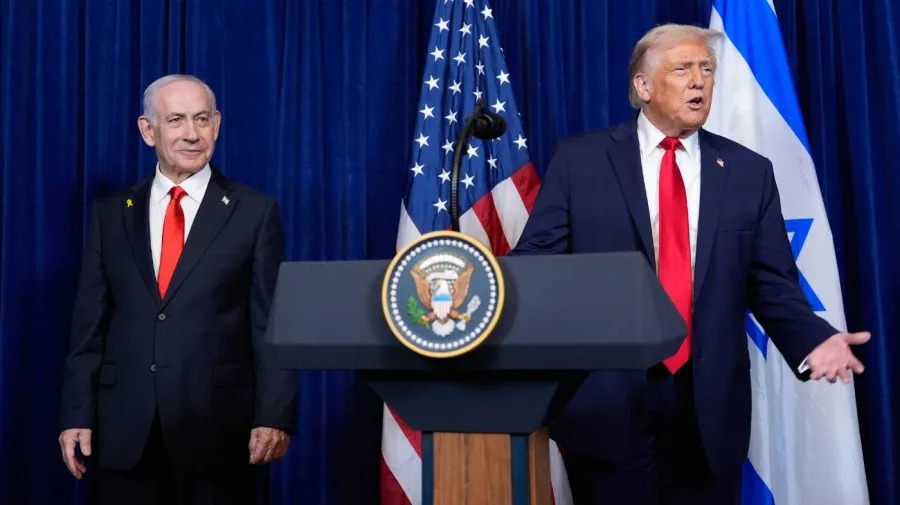
Ending the aid may also increase Israeli autonomy on wartime decisions. When the Biden administration tried to block Israel’s Rafah operation in 2024, the threat of withholding munitions was the lever. Last month, Trump publicly “PROHIBITED” Israel from further strikes in Lebanon. Netanyahu, according to Axios, learned of it from the media and was “stunned.” The argument for ending the aid is no longer taboo in Jerusalem.

As for the American case for keeping the aid, almost every dollar spent with Israel comes home. More than a thousand American companies across 48 states hold contracts funded by aid to Israel, supporting over 20,000 U.S. jobs directly and thousands more indirectly. Ending the program does not save $3.8 billion, it eliminates jobs in swing districts. Progressives who believe cutting aid will pressure Netanyahu should understand that the immediate victims are American factory workers, not the Israeli cabinet.

Israel is also the cheapest serious ally America has. Few Americans are aware that the Pentagon spends roughly $5 billion a year sustaining U.S. forces in Japan and $3-4 billion in South Korea — costs buried inside the defense budget, with tens of thousands of troops exposed to real risk. Israel, in contrast, fights its own wars at its own risk and shares battle-tested intelligence and weapons that improve American systems.

Removing aid from Israel accelerates the retreat of American power projection. Pulling back from one of the most capable militaries on Earth signals to Gulf states, East Asian allies and adversaries that U.S. commitments are negotiable. China, which already quietly courts Israeli defense firms, would not miss the opening.

Activists have never hidden that the $3.8 billion aid package is only the first target. The next is the American Jewish philanthropic network. J Street may believe that conceding on aid will buy peace with the left flank, but in truth it will just buy the next demand.

For Israel, ending aid is a manageable blow with long-term upside. For the U.S., it is a tiny savings that ships American jobs overseas and weakens a proven alliance. The cruel irony is that the loudest voices calling to cut aid and punish Israel are about to give Israel more freedom, and America less.

Barak Sella is a senior research fellow at the Harvard Kennedy School’s Belfer Center, where he leads the Middle East Initiative’s Israel Program, and the founder and U.S. director of the Abraham Tent, a nonprofit advancing people-to-people initiatives between the U.S. and the MENA region.

Copyright 2026 Nexstar Media, Inc. All rights reserved. This material may not be published, broadcast, rewritten, or redistributed.

For the latest news, weather, sports, and streaming video, head to The Hill.
Comments
You must be logged in to comment.