yahoo Press
Airline Stocks Heading Into Summer 2026: Pricing Power vs Cost Pressure
Images
1 / 4
2 / 4

3 / 4

4 / 4
The above button links to Coinbase. Yahoo Finance is not a broker-dealer or investment adviser and does not offer securities or cryptocurrencies for sale or facilitate trading. Coinbase pays us for certain activity generated through this link. Prices displayed are informational.

Here we rank five top public U.S. airlines from most exposed to most resilient heading into the 2026 peak travel season.

Pricing power from premium cabins, loyalty programs, and international networks separates resilient carriers, like Delta Air Lines (DAL) and United Airlines (UAL), from those carrying outsized fuel and balance-sheet risk, like American Airlines (AAL) and JetBlue (JBLU).

The analyst who called NVIDIA in 2010 just named his top 10 stocks and American Airlines Group wasn't one of them. Get them here FREE.

Summer 2026 will be a stress test for U.S. airlines. Second quarter jet fuel is tracking $4.10 to $4.30 per gallon, with benchmark West Texas Intermediate (WTI) crude at $99.89 per barrel and in the 96th percentile of its 12-month range. University of Michigan consumer sentiment fell to 49.8 in April 2026, complicating the "demand remains strong" narrative. Below, we rank five carriers from most exposed to most resilient heading into peak season.

JetBlue (NASDAQ: JBLU) is the most fragile carrier. Q1 2026 adjusted EPS came in at a loss of $0.87, missing estimates by 19.51%, on revenue of $2.24 billion. Q2 fuel is guided to $4.13 to $4.28 per gallon, roughly 75% higher year over year, with management expecting to recapture only 30% to 40% of that pressure.

The balance sheet is the bigger problem: $8.4 billion of debt, cash down to $1.86 billion, and shareholders' equity that fell 25.97% year over year. Capex was cut to ~$800 million. CEO Joanna Geraghty said the company is "mitigating the impact of elevated fuel prices" while leaning on the JetForward plan, which targets $310 million of incremental EBIT in 2026. Shares fell 6.5% in the past week.

The analyst who called NVIDIA in 2010 just named his top 10 stocks and American Airlines Group wasn't one of them. Get them here FREE.

Verdict: highest downside risk this summer.

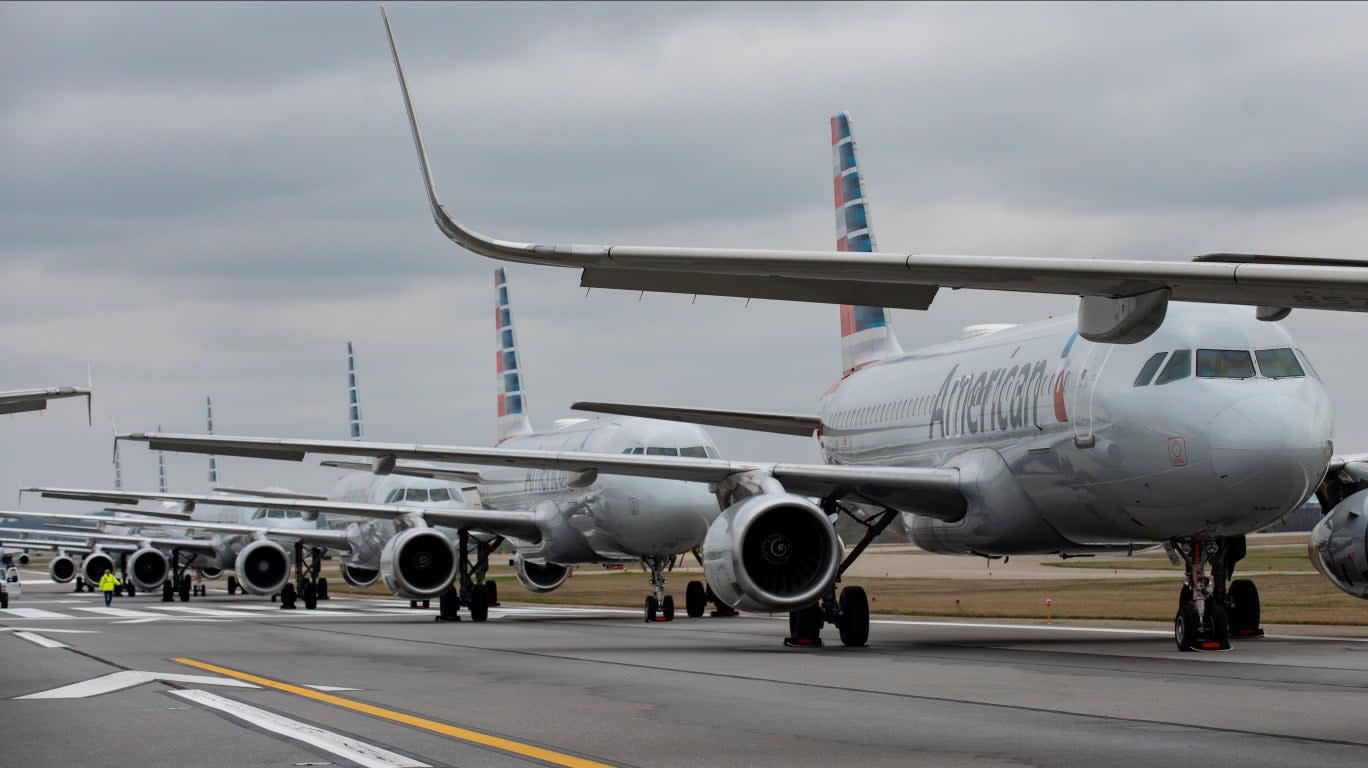
American Airlines (NASDAQ: AAL) carries the heaviest leverage: $34.7 billion in debt and negative shareholders' equity of $4.08 billion. Q1 revenue rose 10.84% to $13.91 billion, with TRASM up 7.6% and Atlantic PRASM up 16.7%, but adjusted EPS was a loss of $0.40.

FY2026 fuel is a headwind of more than $4 billion, and the full-year adjusted EPS range runs from a loss of $0.40 to a profit of $1.10. CEO Robert Isom said the company "still anticipate[s] modest profitability for the year assuming the current forward fuel curve." Shares are down 22.6% year to date. A Reddit thread titled "Shorting American Airlines - Oil Shocks Ahead" drove bearish sentiment in late April.

Verdict: thin margin buffer, high fuel beta.

Southwest Airlines (NYSE: LUV) recently terminated its long-standing hedging program and has a domestic-heavy network, leaving it directly exposed. Q1 EPS was $0.45, missing the $0.47 estimate, as revenue grew 12.77% to $7.25 billion and RASM jumped 11.2%. Q1 fuel ran $0.33 per gallon above guidance, a $164 million headwind.

Pricing power is translating: assigned and extra-legroom seating drew about a 60% buy-up rate, versus roughly 20% in 2025, and managed business revenue rose 25% in March. The airline did not reaffirm its $4.00 full-year EPS target, citing macro uncertainty. CEO Bob Jordan called it a "turning point for Southwest." Capital returns continue, with $1.25 billion in Q1 buybacks.

Verdict: tangible product momentum, but unhedged fuel caps near-term upside.

United Airlines (NASDAQ: UAL) delivered Q1 adjusted EPS of $1.19, beating the $1.09 consensus, on revenue of $14.61 billion. Premium and business revenue each grew 14%, and Atlantic revenue rose 18.0%, with the Middle East and Africa corridor up 23.9%.

The full-year adjusted EPS range is $7.00 to $11.00, reflecting fuel uncertainty. Management expects to recover 40% to 50% of fuel cost increases in Q2, building to 85% to 100% by Q4. CEO Scott Kirby said, "Moments of uncertainty for the airline industry may also create opportunity for United." Shares are down 17.3% year to date.

Verdict: strong international franchise; fuel recapture lag is the risk.

Delta Air Lines (NYSE: DAL) is the most resilient. Q1 adjusted EPS rose 44% to $0.64, with revenue up 9.4% to $14.20 billion. Premium ticket revenue grew 14%, loyalty rose 13%, American Express remuneration topped $2.00 billion, and high-margin streams reached 62% of adjusted revenue.

Delta owns the Monroe Energy refinery, which is projected to deliver a $300 million Q2 benefit. Delta TechOps revenue grew 152% to $380 million. Q2 guidance calls for adjusted EPS of $1.00 to $1.50 and roughly $1 billion of pretax profit. CEO Ed Bastian said Delta expects to "lead the industry with $1 billion of profit" in Q2.

Verdict: best positioned to monetize summer demand.

Pricing power from premium cabins, loyalty programs, and international networks separates resilient carriers (Delta, United) from those carrying outsized fuel and balance-sheet risk (American, JetBlue), with Southwest in transition. With WTI in the 96th percentile of its 12-month range and consumer sentiment 49.8 and falling, key uncertainties are fuel direction, pace of fare recapture, and whether peak summer demand holds. Capacity discipline across the industry is the offset retirement-focused investors should track.


This analyst's 2025 picks are up 106% on average. He just named his top 10 stocks to buy in 2026. Get them here FREE.
Comments
You must be logged in to comment.