yahoo Press
‘American industry is winning’: White House touts factory boom — how investors can ride the reshoring wave
Images
1 / 4
2 / 4

3 / 4

4 / 4
The above button links to Coinbase. Yahoo Finance is not a broker-dealer or investment adviser and does not offer securities or cryptocurrencies for sale or facilitate trading. Coinbase pays us for certain activity generated through this link. Prices displayed are informational.

Moneywise and Yahoo Finance LLC may earn commission or revenue through links in the content below.

American manufacturing is back, and it's better than ever. In a new White House press release (1), officials point to a string of improving indicators: The Institute for Supply Management's manufacturing index has expanded for three consecutive months, hitting its strongest level since 2022, while production has climbed for five straight months as factories ramp up output (2).

"The numbers don't lie," the release states, arguing "the manufacturing sector is growing as key indicators show broad strength" after what it characterizes as years of decline.

Thanks to Jeff Bezos, you can now become a landlord for as little as $100 — and no, you don't have to deal with tenants or fix freezers. Here's how

Dave Ramsey warns nearly 50% of Americans are making 1 big Social Security mistake — here’s how to fix it ASAP

The IRS usually taxes gold as a collectible — but this little-known strategy lets you hold physical bullion tax-free. Get your free guide from Priority Gold

But the bigger story isn't just momentum. It's scale.

The White House is framing the shift as "the largest reshoring wave in American history," with companies investing trillions to bring production back to U.S. soil.

Apple is committing $600 billion to U.S. manufacturing over the next four years, while NVIDIA has pledged $500 billion to produce AI chips and infrastructure entirely in the United States.

Pharmaceutical giants are also joining the push, with companies like Johnson & Johnson , AstraZeneca and Bristol Myers Squibb collectively committing tens of billions to expand domestic production.

Industry leaders are echoing that optimism.

"Customers are increasingly focused on securing dependable domestic supply they can count on over the long term," said David Burritt, CEO of U.S. Steel.

For investors, though, the question is whether this so-called "Trump effect" is actually creating opportunities or just headlines.

Inarguably, the term has seen quite a few uses — socially, internationally and economically. For example, according to the British Journal of Political Science, one social application is the emboldening of prejudiced individuals to express racial bigotry (3). Meanwhile, abroad, it refers to a popularity boost for left-of-center parties in democracies such as Canada and Australia (4).

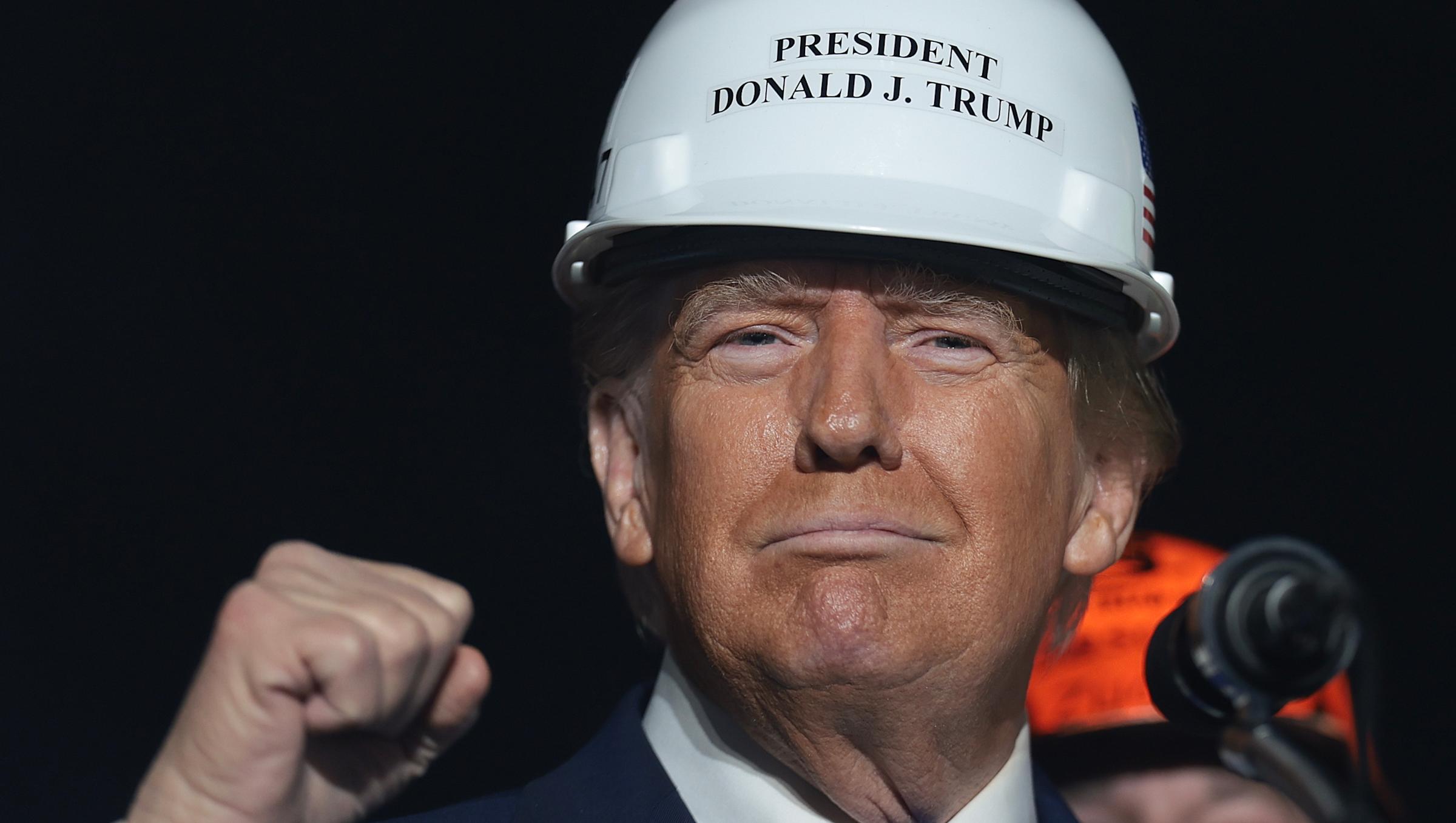
But to the White House, the "Trump effect" refers to deliberate policy shifts aimed at bringing production back to America through tariffs, trade enforcement and incentives for domestic investment.

The main economic argument? The reshoring of industry and manufacturing to U.S. soil is good for jobs and GDP.

Officials point to what they describe as "the largest reshoring wave in American history," with companies "investing trillions to build and expand here at home."

Manufacturing tends to move in cycles, and several of the forces driving investment today, including supply chain disruptions, geopolitical tensions and the rapid expansion of AI infrastructure, were already in motion before the current administration.

In other words, the "Trump effect" may be part policy, part momentum, part branding.

The distinction matters here because in markets, a narrative alone can move money. Spectra Markets explains that there is a "dynamic interplay between price and narrative" in which "the story drives the price, and the price drives the story," making it difficult to determine which is driving the movement (5).

So when policymakers signal support for reshoring, tariffs or large-scale investment, capital can start to flow — with markets quickly reacting to policy expectations.

From tax cuts and trade policy to stimulus and industrial spending, even the anticipation or hope of supportive conditions has been enough to push equities higher (6).

Of course, that doesn't mean every market rally is justified (or exempt from correction), but it can create opportunity.

Read More: Robert Kiyosaki warned of a 'Greater Depression' — with millions of Americans going poor. Was he right?

If capital does indeed roar back into U.S. industries, one of the simplest ways to position yourself is to own the companies at the center of it.

Many of the firms highlighted in the White House release are already publicly traded, including Apple and NVIDIA, as well as major pharmaceutical and industrial players (7). They include:

U.S. Steel (NYSE: X)

Apple (NASDAQ: AAPL)

NVIDIA (NASDAQ: NVDA)

Johnson & Johnson (NYSE: JNJ)

AstraZeneca (NASDAQ: AZN)

Bristol Myers Squibb (NYSE: BMY)

GSK (NYSE: GSK)

GlobalFoundries (NASDAQ: GFS)

Stellantis (NYSE: STLA)

Where it gets tricky is that not every company is going to benefit equally, and certainly not every one will really last.

Some firms are already priced for perfection. Others may be positioned to gain from supply chain shifts, infrastructure buildout or long-term industrial demand. Those companies don't necessarily share in the benefits of dominating headlines, but are worth monitoring.

That's where having a research edge can make all the difference.

Moby offers expert insights and recommendations to help investors identify strong, long-term opportunities, backed by former hedge fund analysts. In the past four years, and across nearly 400 stock picks, their recommendations have beaten the S&P 500 by almost 12% on average.

Their team spends hundreds of hours analyzing financial data and market trends to deliver stock and crypto reports straight to your inbox.

That means instead of trying to interpret headlines or political narratives on your own, you can focus on where the data is pointing and make more informed decisions about stocks and ETFs.

Moby's reports are easy to understand and can help you become a smarter investor in just five minutes. And if it's not the right fit, there's a 30-day money-back guarantee.

In times of economic shifts, the biggest gains don't always go to the companies making headlines. They can also go to the infrastructure that supports them. This is called pick-and-shovel investing (8).

If manufacturers are truly ramping up domestic production, then that buildout's going to require more than just capital. It's going to need space, physical infrastructure and time.

Factores need land. Supply chains need warehouses. AI infrastructure needs data centers.

That's where industrial real estate enters the picture.

Historically, individual investors haven't had many options to access high-quality private-market real estate — including industrial properties.

In times of volatility, they often benefit from renters "trading down" from higher-cost options, while limited new supply keeps vacancies in check. Low tenant turnover and long leases can also lead to consistent net operating income and stable, robust cash flow for Limited Partner investors.

Now, crowdfunding platforms have opened access to a broader demographic of retail investors, but outcomes often depend on factors such as deal structure, platform incentives and the sponsor's expertise.

That's when it can pay to work with experts, especially if you're an investor with capital on hand.

Lightstone DIRECT's direct-to-investor model ensures a high degree of alignment between individual investors and a vertically-integrated, institutional owner-operator — a sophisticated and streamlined option for individual investors looking to diversify into private-market real estate.

With Lightstone DIRECT, accredited individuals can access the same multifamily and industrial assets Lightstone pursues with its own capital, with minimum investments starting at $100,000.

If companies continue shifting operations back to the U.S., demand for these types of assets could increase.

Of course, capital and accreditation are not something that every investor has to spare.

For those looking for a more accessible real estate entry point, you can tap into this market by investing in shares of vacation homes or rental properties through Arrived.

You can get started with as little as $100 for access to shares of SEC-qualified investments in rental homes and vacation properties. No need to buy or manage an entire property yourself.

Backed by investors like Jeff Bezos, Arrived is designed to make real estate investing more accessible, allowing both accredited and non-accredited investors to add income-generating properties to their portfolios. Arrived can also help you scale up your real estate investing over time, with access to a secondary market.

The platform offers a curated selection of properties chosen for their income and appreciation potential, and you can browse their full list of vetted properties to find an investment that fits your goals.

Robert Kiyosaki says this 1 asset will surge 400% in a year and begs investors not to miss this ‘explosion’

No time to lower your crippling car insurance rate? Here’s how to do it within minutes — you could end up paying $29/month without a single phone call

Millionaires under 43 are reshaping investing — just 25% of their portfolios are in stocks. Here’s where their money is going

Dave Ramsey says this 7-step plan ‘works every single time’ to kill debt, get rich in America — and that ‘anyone’ can do it

Join 250,000+ readers and get Moneywise’s best stories and exclusive interviews first — clear insights curated and delivered weekly. Subscribe now.

We rely only on vetted sources and credible third-party reporting. For details, see our ethics and guidelines.

The White House (1),(7); Institute for Supply Management (2); Cambridge University Press (3); Policy Magazine (4); Spectra Markets (5); U.S. Bank (6); Investopedia (8)

This article provides information only and should not be construed as advice. It is provided without warranty of any kind.
Comments
You must be logged in to comment.