foxnews Press
Think we're losing the war in Iran? Consider where things really stand
Images
1 / 20

2 / 20

3 / 20

4 / 20

5 / 20
6 / 20

7 / 20

8 / 20
9 / 20
10 / 20
11 / 20
12 / 20

13 / 20
14 / 20
15 / 20
16 / 20
17 / 20
18 / 20

19 / 20

20 / 20
President Donald Trump unilaterally canceled a diplomatic trip to Pakistan for Iran peace talks, stating the U.S. holds 'all the cards' and Iran's leaders can call anytime. Correspondent Matt Finn reports on the stalled negotiations, while retired Navy Captain Brent Sadler discusses escalating U.S. military deployments to the Strait of Hormuz and new economic sanctions targeting nearly 40 entities in Iran's oil network in China.

If you told me just a few years ago that this is where Iran would stand today, I would have dismissed it as fantasy.

The mistake that many analysts are making today is confusing the Iranian regime’s survival with its strength. A regime can persist and still be strategically hollowed out. The Islamic Republic of Iran is that regime.

Iran’s nuclear program has been set back by years: enrichment and reprocessing gutted, weaponization sites destroyed, the Fordow and Natanz enrichment facilities in ruins, and a generation of senior nuclear scientists eliminated.

Iran’s ballistic missile enterprise is badly crippled. Monthly output has collapsed from roughly 100 missiles to almost nothing. About half of the regime’s missile arsenal and launch infrastructure has been destroyed. The Islamic Revolutionary Guard Corps (IRGC) Aerospace Force commander who helped build that missile machine is dead.

Vice President JD Vance speaks during a news conference in Islamabad, Pakistan, on April 12, 2026, after meeting with representatives from Pakistan and Iran. Jared Kushner and Steve Witkoff listen during the event. (Jacquelyn Martin/AP)

US 'WINNING DECISIVELY' AGAINST IRAN, WILL ACHIEVE 'COMPLETE CONTROL' OF AIRSPACE WITHIN DAYS, HEGSETH SAYS

Iran’s air defense network has been shattered. American and Israeli fighter jets and drones now operate over Iranian territory with near impunity.

Economic warfare has moved beyond decades of Treasury sanctions to direct military pressure: maritime interdiction, oil exports reduced to a trickle, imports squeezed, major industrial sectors like steel and petrochemicals battered, inflation surging into triple-digit levels, and a currency almost worthless. Storage capacity for crude is nearing exhaustion. Iranian losses from the war are at least $144 billion, nearly 40% of pre-war GDP, with some estimates even double that.

The regime has been decapitated. Iran’s Supreme Leader Ali Khamenei is dead. His top national security advisor, Ali Larijani, is dead. Hundreds of senior IRGC, intelligence, military, and Basij commanders have been killed, including the IRGC commander-in-chief, the armed forces chief of staff, and two successive IRGC intelligence chiefs. The new Supreme Leader Mojtaba Khamenei, who is badly injured from Israeli strikes, inherits a hollowed-out regime with no supreme authority and a gutted command structure.

Motorists ride past the Imam Sadiq (AS) mosque with a giant Iranian flag installed on its front at the Palestine Square in Tehran on April 19, 2026. (ATTA KENARE / AFP via Getty Images)

FROM HOSTAGE CRISIS TO ASSASSINATION PLOTS: IRAN’S NEAR HALF-CENTURY WAR ON AMERICANS

The Islamic Republic is increasingly isolated in its own region. Gulf governments are freezing Iranian funds, closing off the sanctions evasion networks and money laundering schemes the regime depended on for years. No Arab capital is prepared to rescue it. China and Russia remain limited in what they will provide.

Iran’s terrorist proxy network is shattered. Hezbollah and Hamas are heavily degraded. Israel decapitated the Houthi political leadership. The "Axis of Resistance" and "ring of fire" are now more slogans than the severe threats they once were.

The Syrian corridor has been severed. Former Syrian President Bashar Assad is hiding in Moscow. The new government in Damascus is actively blocking Iranian arms transfers to Hezbollah: arresting smugglers and publicly declaring Syria will no longer serve as a transit corridor for Tehran’s terrorists. The land bridge to the Mediterranean that took decades to build is closing.

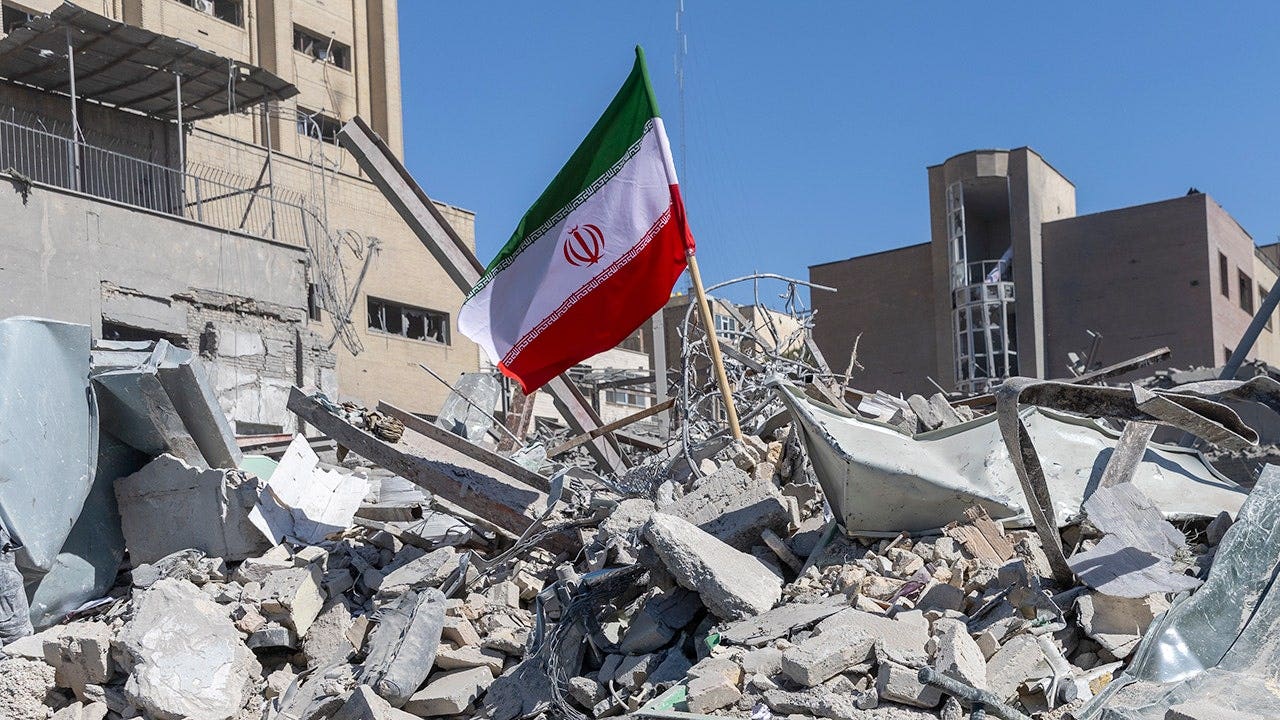
An Iranian flag is planted in the rubble of a police station, damaged in airstrikes yesterday, on March 3, 2026 in Tehran, Iran. (Majid Saeedi/Getty Images)

IRAN DIDN’T ADAPT TO AMERICA'S PLAYBOOK. RUSSIA AND CHINA ALREADY HAVE

Lebanon is pivoting West. With Hezbollah battered and resupply choked, Israel and Lebanon have opened direct peace talks for the first time since 1983, aimed at a permanent agreement and Hezbollah’s disarmament. Beirut now asserts that the Lebanese armed forces alone are responsible for national defense. This is a direct repudiation of Hezbollah’s "resistance" claim. The onus now is on the Lebanese government to see this through

Iranian deterrence has been exposed as a bluff. Four direct attacks on Israel — April 2024, October 2024, June 2025, March 2026 — failed to impose strategic costs on the Jewish state and instead triggered heavy Israeli retaliation. Iran could not even use Syria or Iraq as meaningful launchpads.

The economy is hollowed out. The country faces power shortages, water crises, factory shutdowns, pension unrest, fuel shortages and mass protests. Nationwide demonstrations erupted again in December 2025 after a year of economic free fall, with bazaar merchants, oil workers and truckers — the regime’s traditional support base — joining strikes across all 31 provinces. The regime had to slaughter its way out of the biggest challenge to its rule in 47 years.

Maps4Media processed and enhanced Sentinal-2 satellite imagery shows a broad view of the Strait of Hormuz between southern Iran and Oman's Musandam Peninsula, including surrounding islands, coastal terrain, and turquoise shallow-water zones at the entrance to the Persian Gulf. (Photo enhanced and published by maps4media via Getty Images)

TRUMP'S GOT IRAN CORNERED BY FOLLOWING REAGAN'S DOCTRINE

Iran has suffered a scientific and technical brain drain. Beyond the nuclear experts, Iran has lost a generation of expertise in missile design, centrifuge engineering, and weapons development. The survivors are harder to recruit and easier to target, eliminate or deter.

Iran’s naval power has been decimated. The regular navy shattered. The IRGC Navy is taking growing losses as U.S. Central Command moves to reopen the Strait of Hormuz.

Against all of this, the regime was forced to play its Hormuz card at its weakest possible moment — when the U.S. has options instead of when it did not.

THE UNINTENDED CONSEQUENCES OF HAMAS’S WAR ON ISRAEL FOR THE US AND GLOBAL SECURITY

Namely, before Tehran had nuclear-armed ICBMs, 10,000 ballistic missiles, a Chinese- and Russian-built military, hundreds of thousands of attack drones, a fully operational terror network, and hundreds of billions of dollars to harden its economy.

That was the lethal Iranian trajectory if President Donald Trump hadn’t withdrawn from the fatally flawed 2015 Obama administration nuclear deal. That agreement gave Tehran patient pathways to nuclear weapons, ICBMs and a massive economic windfall as nuclear and UN missile restrictions expired.

That’s the strategic picture. It’s extraordinary. For analysts who have worked for decades countering the Islamist regime, it’s hard to comprehend how much has been achieved.

A cargo ship sails in the Persian Gulf toward the Strait of Hormuz on April 22, 2026. (AP Photo)

THE IRAN CEASEFIRE WAS JUST EXTENDED. THE REAL TEST FOR WASHINGTON STARTS NOW

Still, many challenges remain: the battle of Hormuz; Houthi threats to Red Sea shipping; the remaining enriched material; the deeply buried PickAxe Mountain; ongoing repression of Iranians; the potential reconstitution of nuclear and missile programs and proxies; negotiations leading to a fatally flawed deal; an American success that leads us to abandon Iranians; and the critical importance of replacing depleted war materials for the challenges ahead from China and Russia.

These are significant issues. They will require a resolute president, a patient public and the American and Israeli militaries to see them through. The biggest risk may be political: the American political calendar including a president in 2029 who gives up.

CLICK HERE TO DOWNLOAD THE FOX NEWS APP

But what is clear to analysts tracking Iran is that the regime has suffered strategic defeat.

The question is whether America has the discipline to turn that defeat into a durable victory.

CLICK HERE FOR MORE FROM MARK DUBOWITZ

Mark Dubowitz is the CEO of the Foundation for Defense of Democracies.

Get the recap of top opinion commentary and original content throughout the week.

By entering your email and clicking the Subscribe button, you agree to the Fox News Privacy Policy and Terms of Use, and
        agree to receive content and promotional communications from Fox News. You understand that you can
        opt-out at any time.

Subscribed

You've successfully subscribed to this newsletter!
Comments
You must be logged in to comment.