huffpost Press
Are You Talking To Someone Who Is Using MAGA-Coded Language? These 5 Phrases Are A MAJOR Sign.
Images
1 / 9

2 / 9
3 / 9
4 / 9

5 / 9

6 / 9

7 / 9

8 / 9

9 / 9
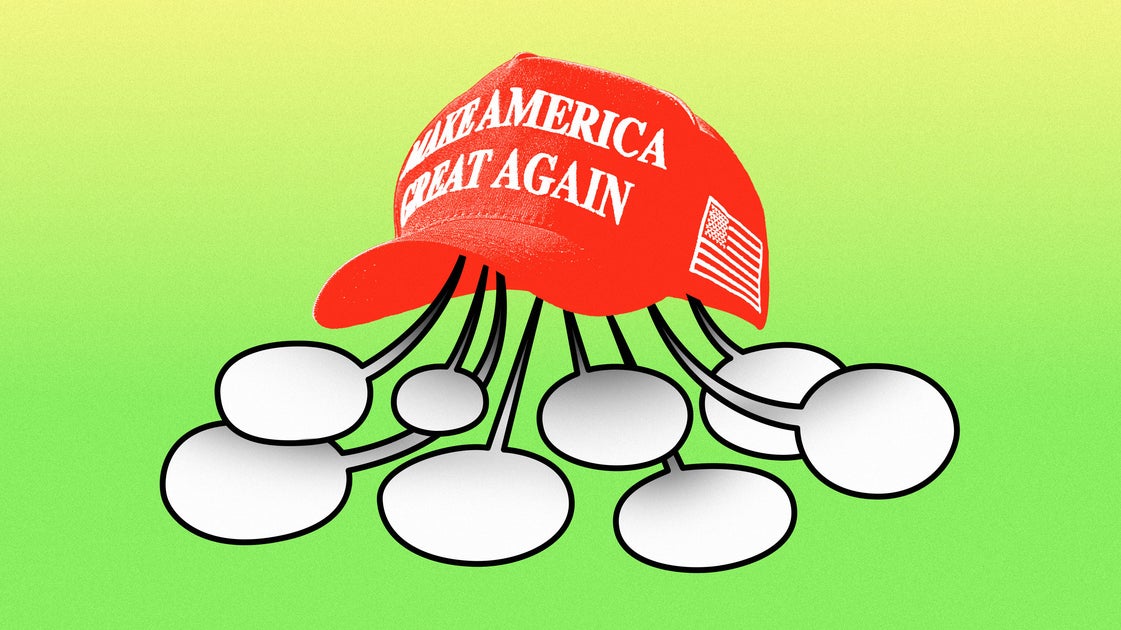
Many followers of Donald Trump and the Make America Great Again movement often make themselves pretty well known with their bright red MAGA hats or giant Trump 2028 yard signs. But with skyrocketing gas prices, a wildly unpopular war in Iran and Trump’s criticism of Pope Leo XIV, not all MAGA supporters are quite as open about their support — even if they still privately align with the movement.

While a red MAGA hat is a definitive way to tell that someone supports Trump, there are some quieter phrases that experts say MAGA-aligned folks rely on to spread their message and beliefs.

HuffPost spoke to left-leaning political content creators who see these kinds of phrases from followers (and trolls) on a daily basis. Here are the MAGA-coded phrases they said you should know ― and why they’re so pervasive:

“‘I don’t know about all that’ is a very MAGA-coded phrase,” said Anna Connelly, a political content creator based in Minnesota.

If someone is talking to their family and giving them facts around one of the many divisive topics that divide MAGA supporters and non-MAGA folks, “you’ll always hear, ‘Oh, well, I don’t know about all that,’” Connelly added.

This response to a statistic or fact is a way for MAGA supporters to immediately discredit the facts and information you’re sharing, she said.

Phrases like this often lead to subject changes or the end of uncomfortable conversations.

“I think it is ― and it’ll sound harsh ― a lack of critical thinking,” Connelly said. “When you’re having a conversation, and then it abruptly stops with the ‘Well, I don’t know about all of this,’ it’s, I believe, because they can’t go further with that conversation.”

“They have heard these lines repeated on Fox News or wherever else, and that’s what they believe. And so they repeat them over and over, and when they’re presented with evidence to the contrary ... they can’t go further in that conversation,” Connelly added.

“Traditional family values” is a MAGA-coded phrase you likely hear over and over again from both conservative politicians and conservative family members, said Jess Britvich, a political content creator based in Pittsburgh.

On its face, there is nothing wrong with this phrase. “It’s like, what’s wrong with being a family man? What’s wrong with being a family woman? Someone who cares about their family,” Britvich said. “When you actually dig deeper, it’s always cloaked in this anti-LGBTQ rhetoric. It’s always about who belongs where in society ― these strict gender hierarchies.”

It’s also about a family made up of the outdated dominant husband and submissive, subordinate wife roles, Britvich added.

The impact doesn’t stop at an off-putting phrase like “traditional family values,” either, according to Britvich. “We start seeing that trickle into policy, because it’s not just these individual choices we’re making in the home, it’s how those individual choices in the home make it more palatable on a national scale.”

You now see restrictions on reproductive rights, anti-trans legislation and more, Britvich said. “A lot of these MAGA-coded phrases are now cloaked in religious language, too,” she explained, including “traditional family values.”

While there is nothing wrong with religion, there is a problem when it’s tied to white Christian nationalism. “And I just think the parallel between white Christian nationalism and MAGA is ... becoming a lot more overt,” Britvich said.

“You hear a lot of ‘DEI hire,’” Britvich said, along with phrases about the idea of a “merit-based” hiring system or education system.

Calling someone a DEI hire is a not-so-quiet MAGA dog whistle to disparage their qualifications because of their identity, while referencing merit-based hiring is a more subtle way of invoking the same idea.

“I feel like that’s another one trying to undo all of the progress we’ve made in terms of civil rights,” Britvich said.

The Trump administration has worked to end diversity, equity and inclusion programs throughout the country, calling the programs “racially discriminatory.” Yet research shows that DEI programs help Black and brown communities have more representation in primarily white spaces and help disabled folks, veterans and women succeed, as well.

It’s also worth nothing that the playing field is also not even for Black and brown people, who face discrimination in schools, health care settings, workplace hiring and more.

According to Britvich, it’s becoming more and more common to see phrases like “marry a provider” on social media when women post about a desire to go to a Pilates class on a Tuesday instead of to the office.

“Around Christmas, the big one was these trends like ‘he might not know what’s under the tree, but he paid for it,’ or something like that,” she said. “And it never addresses the root cause of capitalism, or why people — women, specifically — might be burned out in society,” she said.

These kinds of statements blame feminism for the exhaustion many women feel at work and at home, but that’s misguided, according to Britvich. Folks are told to subscribe to a “strict version of patriarchy,” yet the real reasons people are burnt out are never addressed, she added.

“[They’ll] never advocate for things like paid family leave or universal child care or better maternal health, nothing like that, it just says, marry a provider and give up your economic freedom,” Britvich said.

“‘Protect women.’ If I hear that, I immediately think you’re talking about anti-trans stuff,” Connelly said.

On the other side of the spectrum, if someone says “believe women,” they’re likely talking about more progressive topics like holding men accountable for sexual harassment and assault, she added. “So, that is a fascinating difference,” Connelly said.

The phrase “protect women” doesn’t actually mean that ― instead, “you’re actually just saying ‘don’t protect trans kids,’” Connelly said.

“I’m working with the National Women’s Law Center on a campaign around trans youth and sports, and a statistic that they really want us to hit home on is to how over 70% of people believe, it is not that this is necessarily true ... but 70% of people believe that they have never met a trans individual,” Britvich said.

“So, if there’s 70% of people who feel that they’ve never interacted with this group, and the only way they’re encountering this population is through Fox News or these just made up stories on Instagram ... it is so much easier to ‘other’ this group of people,” Britvich added.

These MAGA-coded phrases resonate online specifically because they’re “fear-based,” Britvich said.

“All this misinformation, all of these dog whistles or MAGA-coded things, they lack nuance and they prey on your emotions,” Britvich explained. “They’re usually trying to portray some fear of the ‘other,’ which is one of the worst human emotions I think there is.”

Trump has repeatedly attacked people on the basis of their race or nationality, including by saying that Somalis “just run around killing each other” and spreading lies about Haitian immigrants. There’s also the long list of anti-trans legislation that “others” trans people, and Trump’s notorious statements about Mexican immigrants, whom he called “bad hombres” during a 2016 presidential debate.

The more subtle phrases we mentioned above also capitalize on this fear of the “other” while making sweeping statements that go on to impact policy and the way folks are viewed.

“These grifters really know how to phrase things in a certain way [and] appear like they have some level of expertise when they really don’t,” Britvich said.

By entering your email and clicking Sign Up, you're agreeing to let us send you customized marketing messages about us and our advertising partners. You are also agreeing to our Terms of Service and Privacy Policy.
Comments
You must be logged in to comment.