huffpost Press
A Body Language Expert Noticed Something About Tucker Carlson's Viral Apology — And It's Telling
Images
1 / 10
2 / 10
3 / 10
4 / 10
5 / 10
6 / 10
7 / 10
8 / 10

9 / 10

10 / 10
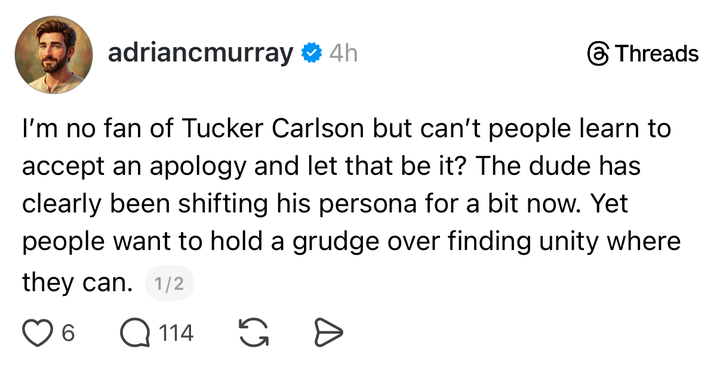
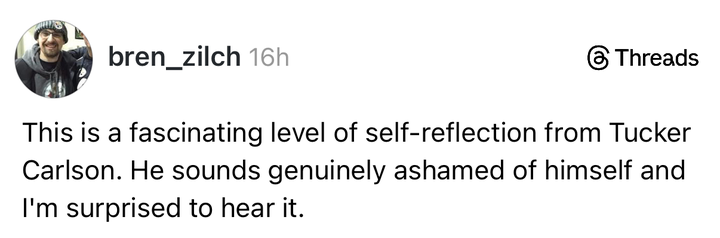
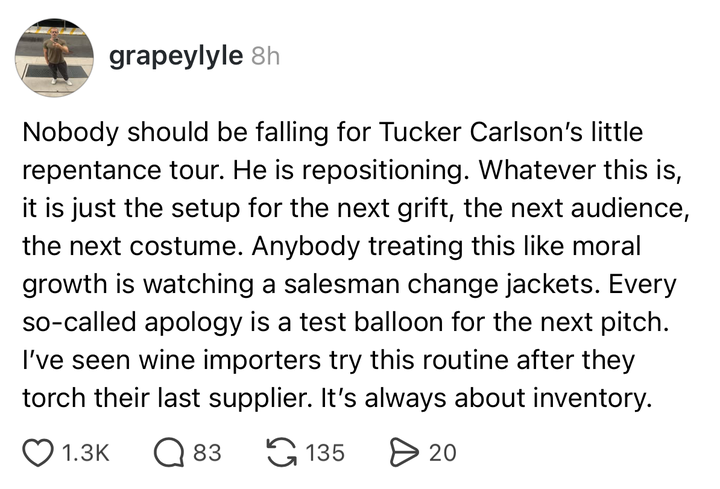
In the hours after conservative commentator Tucker Carlson apologized for voicing support for President Donald Trump during the 2024 election, social media users seemed divided on whether Carlson was telling the truth.

Reactions ran quite the gamut:

Carlson now joins other conservative public figures like Megyn Kelly, Joe Rogan, Alex Jones and Candace Owens, who have cut ties with the president. Carlson endorsed Trump for the 2024 presidential election and interviewed the president when Trump chose to skip the first Republican primary debate in August 2023.

Not everyone was convinced by Carlson’s apology, which Cindy Frantz, a social psychologist at Oberlin College, said is to be expected for a public figure.

“Whenever a public figure apologizes, there’s always a bunch of people who say it isn’t sincere, it isn’t a real apology,” Frantz said. “In part, that’s because there are so many mixed motives why somebody might be apologizing, [and] it’s really hard for people to know what to think or to be able to really tell with any certainty why they’re apologizing.”

Frantz, who has studied how timing can impact apology effectiveness, noted that a lot of public apologies do not take responsibility: “So often, the apologies are like, ‘I’m sorry people were offended’ or ‘I’m sorry my intention was misunderstood’” — but Carlson did seem to take responsibility more explicitly than others.

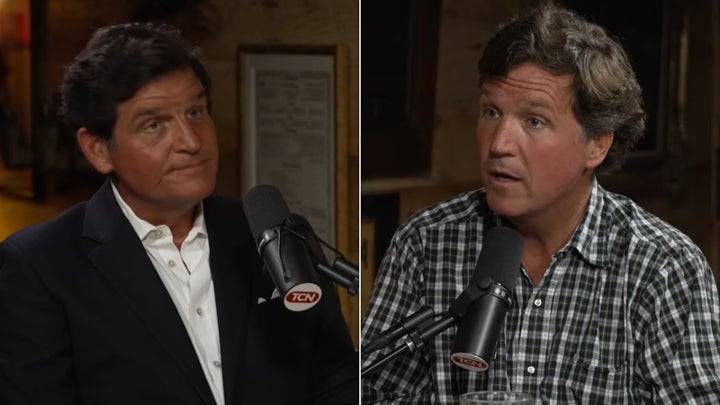
“You and I and everyone else who supported him — you wrote speeches for him, I campaigned for him — I mean, we’re implicated in this for sure,” Carlson said to his brother, Buckley Carlson, in Monday’s episode of “The Tucker Carlson Show.” Buckley confirmed on the podcast that he wrote speeches for Trump during his 2016 presidential campaign.

“I want to say I’m sorry for misleading people,” Carlson told listeners. “It was not intentional.”

A big determining factor could be whether they actually watched the podcast video.

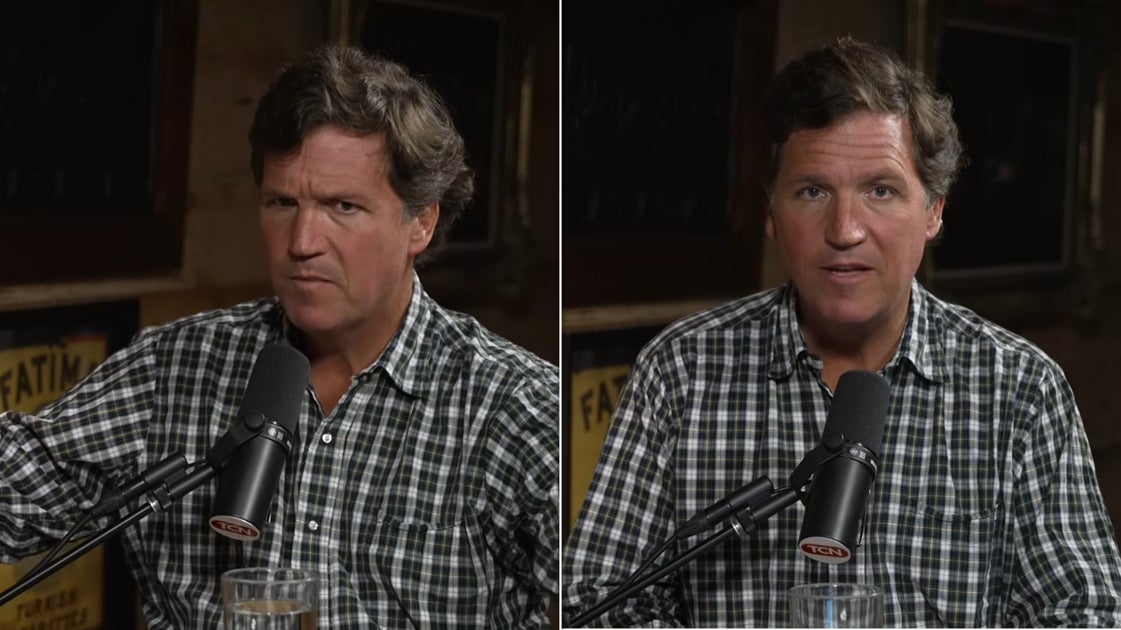
Susan Constantine, a body language expert, told HuffPost: “He goes from introspective to performative. He jumps back and forth, so that’s why people are getting mixed messages — because he’s giving you two mixed messages.”

Constantine, who watched multiple older videos of Carlson to get a sense of his normal body language, flagged that Carlson’s language is also mixed messaging.

“He also moves from ‘I’ to ‘we’ at the very beginning,” Constantine said. “He says, ‘It wasn’t just me, we all did this.’”

When Carlson presses his lips together and crosses his arms, it could indicate he’s reflecting on the situation and what he’s saying, Constantine said. But then there are times when he transitions into looking up to the ceiling and starts to laugh, which could convey that he’s dismissing his comments as serious.

The back-and-forth is “basically saying that he’s holding something back,” Constantine said. “He’s continuing to go through some sort of internal disagreement, or he’s restraining himself from saying something.”

Two missing pieces could have helped sell Carlson’s apology, Frantz argues. For one, Carlson did not mention any action for making amends for what he regrets.

“I think what really undercuts his apology is that a lot of people could reasonably infer you could have and should have and probably did know all of this, and you did it,” Frantz said. “There’s no effort to make amends, not much effort to really acknowledge the enormity.”

The other element is one neither Carlson nor the general public can fix: There’s no interpersonal relationship here. Carlson is a public figure in front of a camera — there are too many barriers for people to trust what he’s saying.

“There are all kinds of clues that we can get in face-to-face interactions with somebody that we know reasonably well, or someone who we interact with regularly, that can help us develop some confidence that the person really means [their apology],” Frantz said. “That’s kind of impossible in a public apology.”

That lack of personal relationship is also why social media users instinctively search for ulterior motives rather than taking him at his word. Many have speculated that Carlson had an ulterior motive for his apology, ranging from prioritizing his income to running for office. (Carlson has not formally announced any political campaigns. As of reporting, Carlson’s team has not responded to HuffPost’s request for comment.)

Simply writing the apology or only releasing the audio of the podcast recording wouldn’t have solved the confusion, either, Constantine said.

“He says, ‘I want to say sorry,’ he doesn’t say, ‘I’m sorry,’” she said. “He’s actually distancing himself from any sort of direct ownership of it.”

In an April 6 podcast episode, Carlson called out Trump’s Truth Social post on Easter morning, in which the president wrote, “Tuesday will be Power Plant Day, and Bridge Day, all wrapped up in one, in Iran. There will be nothing like it!!! Open the Fuckin’ Strait, you crazy bastards, or you’ll be living in Hell – JUST WATCH! Praise be to Allah.”

“Who do you think you are?” Carlson asked. “You’re mocking the religion of Iran. … No president should mock Islam. That’s not your job. This is not a theocracy.”

In March, Carlson told Status’ Oliver Darcy, “There are times I get annoyed with Trump, right now definitely included, but I’ll always love him no matter what he says about me.”

Court filings made public in March 2023 revealed that the then-Fox News host said he “passionately” hated Trump in a text message to an unnamed recipient in January 2021.

“We are very, very close to being able to ignore Trump most nights. I truly can’t wait,” Carlson texted. “I hate him passionately. I can’t handle much more of this.”

By entering your email and clicking Sign Up, you're agreeing to let us send you customized marketing messages about us and our advertising partners. You are also agreeing to our Terms of Service and Privacy Policy.
Comments
You must be logged in to comment.