yahoo Press
Fed confirmation live: Kevin Warsh testifies in Senate hearing that he won't be President Trump's 'sock puppet'
Images
1 / 8

2 / 8

3 / 8

4 / 8

5 / 8

6 / 8

7 / 8

8 / 8
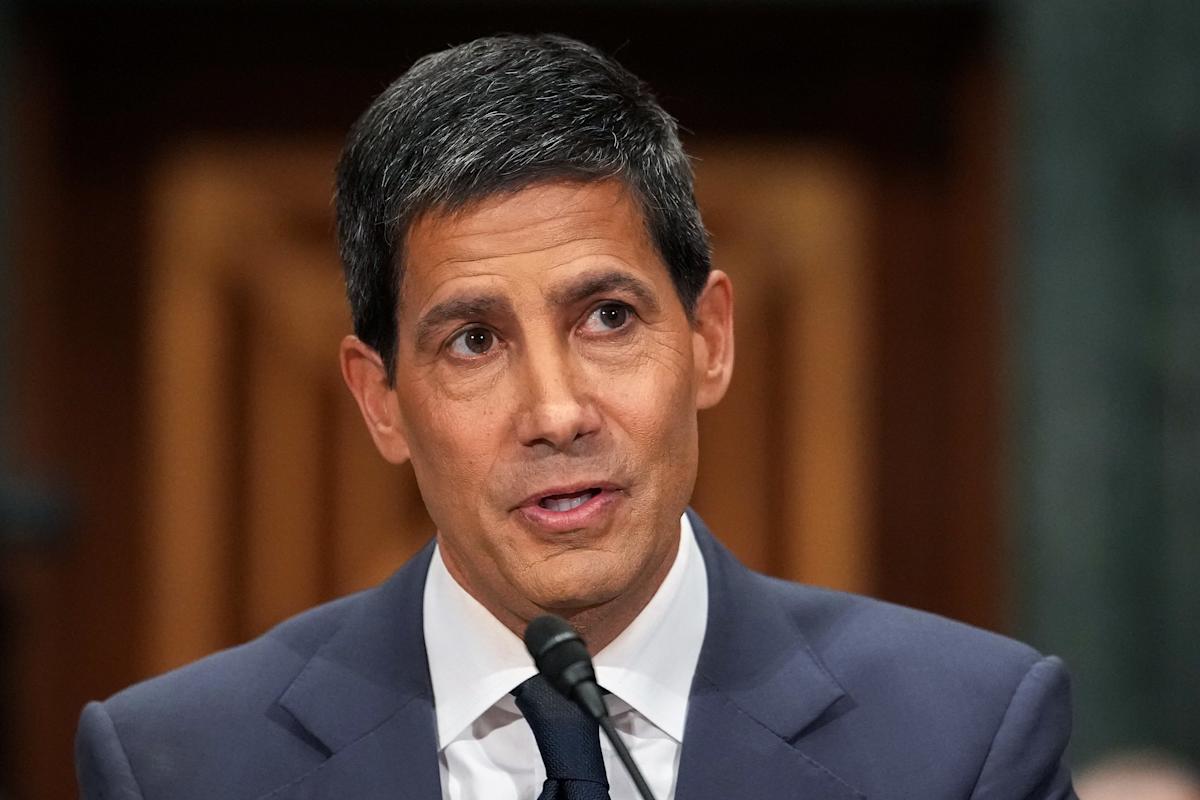
Kevin Warsh, President Trump’s pick to lead the Federal Reserve, testified before the Senate Banking Committee on Tuesday amid pressure from the Trump administration to lower interest rates. Here were the moments that stood out from the hearing:

Central bank independence: Warsh underscored that central bank independence “is essential” in his opening remarks. The theme of independence was in focus amid the Department of Justice’s criminal investigation into the central bank and current Fed Chair Jerome Powell’s handling of the renovations at the Fed headquarters.

A new inflation framework: Warsh was critical of the Fed’s policy moves in recent years and argued that the central bank should be less forward-looking when making interest rate decisions. On inflation specifically, Warsh said that “the trajectory … is improving, but there's more work to do.”

No interest rates deal with Trump: Warsh stated that the president never asked him to commit to lower interest rates in exchange for the nomination, “nor would I ever agree to do so,” he said.

One GOP holdout: Sen. Thom Tillis, a Republican from North Carolina who has said he would block any Fed confirmation until the DOJ’s investigation is dropped, didn’t ask Warsh any questions. Instead, he used his time to reiterate his view that the government should end the criminal probe into the Fed.

Warsh also weighed in on artificial intelligence, the Fed’s balance sheet, FOMC meetings, and more.

Fed chair nominee Kevin Warsh pushed back on the idea that he will do whatever President Trump asks him to do.

Asked by Sen. John Kennedy whether he would be Trump’s “human sock puppet,” Warsh responded, “absolutely not.”

As mentioned below, Kennedy also asked Warsh whether he had agreed with Trump to lower interest rates.

“The president never asked me to pre-determine, commit, fix, or decide on any interest rate decision, in any of our discussions — nor would I agree to do so,” Warsh said during his nomination hearing on Capitol Hill.

Two hours of back-and-forth with lawmakers on Tuesday did little to clarify a central question surrounding Federal Reserve chair nominee Kevin Warsh: How soon can he be confirmed?

Warsh appears likely to prevail eventually, but a criminal probe of current Chair Jerome Powell remains a roadblock for Republican Sen. Thom Tillis, who said he wants to vote for Warsh but will not back down from plans to block the nomination until that investigation is resolved.

“Let’s get rid of this investigation so I can support your confirmation,” the North Carolinian told Warsh on Tuesday as he again lambasted the probe as “bogus.”

Tillis affirmed his stance to reporters after the hearing, adding that the possibility of Trump firing Powell would make things even worse and “extend the time before we get an eminently qualified person on the board.”

Democrats, meanwhile, remained united in their opposition to even considering the nomination while the Justice Department’s criminal probe is ongoing.

Read more here.

Kevin Warsh’s Fed chair confirmation hearing had a decidedly partisan tone, Yahoo Finance’s Jennifer Schonberger notes.

Democrats pressed Warsh to account for President Trump’s attacks on the central bank over the past year and to address his financial holdings, which exceed $100 million, while Republicans emphasized Warsh’s previous tenure at the central bank and lengthy economic experience.

Schonberger recaps the top takeaways from the hearing:

As expected, Fed independence came up repeatedly during the hearing on a day that President Trump, in an interview with CNBC, stressed — again — his desire for lower interest rates.

… Warsh was at times critical of past and current Fed moves, saying the US economy is still dealing with ripples from the spike in inflation from the pandemic and said the Fed made policy errors in 2021 and 2022 to address it.

Warsh also reaffirmed he favors a smaller balance sheet and that if the Fed had kept a smaller balance sheet, interest rates could be lower, inflation could be better, and the economy could be stronger.

Read more here.

Kevin Warsh declined to take a stance on President Trump’s firing of Fed Governor Lisa Cook, a stark difference from current Fed Chair Jerome Powell, who has publicly defended Cook.

“If I stand for anything, it’s [that] the Fed should stay in its lane. As I understand that matter, it’s pending before the United States Supreme Court. It’s inappropriate for me to weigh in on that, especially because in the event that I am confirmed, I could be a party to that matter.”

Maryland Sen. Angela Alsobrooks pushed back, telling Warsh, “This is your future colleague who was confirmed by both this committee and this Senate to serve her country. Chairman Powell has defended her tenure, and your answer is you will not defend her. Is that correct?”

“That’s not my answer. My answer is there’s a pending case before the Supreme Court,” Warsh said.

Powell attended the court’s oral arguments in person and told reporters later he considers the Cook case “perhaps the most important legal case in the Fed’s 113-year history.”

Alsobrooks referred to comments from conservative Justice Brett Kavanaugh, who said that allowing Cook’s firing to go forward “would weaken if not shatter” the Fed’s independence. She pressed Warsh on whether he agreed with Kavanaugh.

He declined to answer directly: “What I can say is Fed independence means everything to me.”

Kevin Warsh said he sees artificial intelligence having two major implications for Fed policy.

“One is the increase in capital expenditures to build data centers and … that will have an effect on demand. That will increase demand, my guess is, a few tenths of 1%.”

“But on the supply side of the economy, to increase the potential output of the economy, that could be considerably bigger,” Warsh added. “We don't know that. We can't bank on that, but considerable work needs to be done by the Federal Reserve in evaluating this productivity wave.”

Current Fed Chair Jerome Powell has also said the central bank has been closely monitoring the pace of AI development.

Powell and Treasury Secretary Scott Bessent met with big US bank CEOs last week to discuss the risks from Anthropic’s (ANTH.PVT) new Mythos model. Those risks largely center on the model’s ability to exploit vulnerabilities in existing software and its potential use in cyberattacks.

But the larger consequences of the technology on the labor market, productivity, and demand could also shape the Fed’s policy in the years to come.

“I am more confident that there will be improved output than I am certain about when the effects of that would be on the labor market,” Warsh said.

GOP Senator Katie Britt of Alabama offered a nudge during Tuesday’s hearing with Federal Reserve chair nominee Kevin Warsh toward a possible offramp to get Warsh confirmed.

“It's absolutely appropriate for Congress to ask questions, and it is absolutely appropriate for Congress to get answers,” the close Trump ally said of a controversial ongoing renovation effort at the central bank.

Left unsaid was how the Trump administration approach so far has been to use a criminal probe of current Chair Jerome Powell to address the issue so far.

That approach has led Republican Sen. Thom Tillis of North Carolina to blockade Warsh’s nomination for now.

Britt added, “I urge everyone involved to make sure that any outstanding questions on this matter come to fruition, so that we can get answers and move on and have a smooth and timely transition and a confirmation process.”

Left unclear is whether this is an approach the president will agree with.

In a CNBC appearance on Tuesday, the president was asked about the idea and didn’t endorse it.

He said instead, "We have to find out why a small building cost close to $4 billion," even suggesting there was an outside chance that Powell was “taking money” on the ongoing renovation effort.

Kevin Warsh provided some insight into the leadership style he would bring to the Federal Reserve.

“We should have a big, robust deliberation inside the FOMC,” Warsh said during questioning from Sen. Cynthia Lummis. “I tend to favor messier meetings than some, where people don’t show up with rehearsed scripts, but we can have a good family fight.”

“If the central bank has that good family fight, I think they’re going to make better decisions,” Warsh added. “And if they happen to make mistakes, they’ll correct them sooner.”

Warsh was mildly critical of Fed officials being too forward-looking, saying he favored a stance that’s more responsive to current conditions and events.

“Too many Fed officials, past and present, opine in advance about where they think interest rates should be next meeting, next quarter, next year,” he said. “I think that’s quite unhelpful.”

“You need central bankers that are humble, that are nimble, that are open-minded, that can react when we have good data, when events strike us.”

Partway through the hearing, markets are picking up on an implicit hawkish tilt in some of Kevin Warsh’s remarks.

Stocks, which started the day in the green, slipped into negative territory by less than 1%. While Warsh hasn’t made any direct statements on how he would adjust monetary policy, he did note that he intends to implement “a different, new inflation framework” if confirmed as Fed chair.

Treasury yields also rose as Warsh faced questioning by Senate lawmakers. The 10-year yield (^TNX) climbed 4 basis points to 4.29%. The five-year yield (^FVX) jumped 6 basis points to 3.91%.

Fed Chair nominee Kevin Warsh said that President Trump didn’t ask him to commit to lowering interest rates in exchange for the nomination to the top central bank role.

“The president never asked me to predetermine, commit, fix, decide on any interest rate decision in any of our discussions, nor would I ever agree to do so,” Warsh said.

Warsh’s statement comes as Fed independence has remained the primary test for his Senate approval amid pressure from the president to lower interest rates.

Warsh framed that pressure as typical for presidents, albeit Trump has been more outspoken about his wish for low interest rates.

Punchbowl’s Laura Weiss reported ahead of Tuesday’s hearing that seated behind Kevin Warsh would be NFL legend Larry Fitzgerald.

And there he is.

Thom Tillis, the North Carolina GOP senator, whose vote Kevin Warsh’s confirmation depends upon, said he will use his time to lay out why he’s vowed to block the confirmation until the Department of Justice’s investigation into the Fed is dropped.

"I'm not going to ask you anything," Tillis said. “I'm going to talk about what's preventing me from being in a position to vote for you.”

Tillis then broke down some reasons why the Fed’s building renovation — the locus of the DOJ’s criminal investigation — may have run over budget.

“As a matter of fact, if we put everybody in prison in the federal government that had had a budget go over, we'd have to reserve an area roughly the size of Texas, for a penal colony because of the way government projects work,” Tillis said, calling the DOJ investigation “bogus.”

“Let's get rid of this investigation so I can support your confirmation,” Tillis said.

Sen. Elizabeth Warren opened up the high-stakes hearing for Kevin Warsh with a few topics a bit afield of monetary policy.

After a testy back-and-forth over Warsh’s finances, she turned to the 2020 election and asked Warsh whether President Trump had won it. She then pressed the nominee to name any disagreement with President Trump’s economic policy.

The questions appeared in part to drive a further wedge between moderate Republican Senators who have been wary of advancing Warsh’s nomination while a criminal investigation into current Fed Chair Jerome Powell.

Sen. Thom Tillis, as a main example, has offered that he could block Trump nominees who don’t give clear answers on the events around the 2020 election, saying he could block Trump’s future attorney general pick depending on their answer on the events of Jan. 6.

Tillis has also told Politico he is leaving the door open to exercising his power even more broadly and potentially blocking both the attorney general and Federal Reserve picks over the issue.

For the record, Warsh largely dodged both questions from Warren. He would only say that Congress certified the 2020 election and offered a quip on his disagreements with Trump’s oft-mentioned line that he’s from “central casting.”

“Adorable,” Warren said in response.

Asked by Senator Jack Reed (D-RI) about whether or not he pledged President Trump that he would cut interest rates as Fed chair, Kevin Warsh said that all the presidents he’s met — and those he’s studied — tended to prefer lower rates.

On whether the Federal Reserve under his leadership would continue to act independently from the President’s desire, Warsh said Fed independence is up to the Fed.

In opening remarks on Tuesday morning, Kevin Warsh said the Federal Reserve’s inability to return inflation to its 2% target is still a result of what he called “policy errors” made in 2021 and 2022.

During that period, the Fed was slow to raise interest rates as inflation started to accelerate, holding rates at zero all through 2021.

The Fed then raised rates in rapid succession from mid-2022 through January 2023.

Warsh’s framing in his remarks suggests how he sees his potential leadership of the central bank will serve as a break from the views of the Powell-era Fed.

The confirmation hearing has started. You can watch the questioning of Kevin Warsh live below.

Sens. Tim Scott and Elizabeth Warren, the top Republican and Democrat on the committee, respectively, opened the hearing with statements.

Scott, a Republican from South Carolina and the chair of the banking panel, voiced support for Kevin Warsh while highlighting the importance of central bank independence.

In the statement he’s set to give before senators this morning, Kevin Warsh wrote that he does not believe Fed independence is “particularly threatened when elected officials — presidents, senators, or members of the House — state their views on interest rates.”

President Trump, in an interview with CNBC, immediately put that idea to the test. Host Becky Quick asked the president, “Will you be disappointed if your new Fed chair, if he gets approved, doesn't cut rates right away?”

“I would,” Trump answered, before pivoting to the topic of Iran.

Earlier in the interview, Trump complained about the cost of renovations at the Fed building in Washington, which is the subject of a federal investigation into current Chair Jerome Powell.

Trump joked, “I’m afraid Kevin will have to have an office next to me in the White House because that building's not going to be done."

Later, he added, “Maybe I’d like him [Warsh] next to me, actually, it’s not a bad idea.”

Outgoing US Senator Thom Tillis may get nearly as much attention as Federal Reserve chair nominee Kevin Warsh during Tuesday’s hearing.

That’s because the North Carolina Republican is set to question Warsh later today and says he remains determined to block President Trump’s pick for the central bank until the Justice Department drops a criminal investigation into current Fed Chair Jerome Powell.

Tillis also has little reason to back down as he’s retiring at the end of the year. That has led to increased commentary from other Republicans that it’s Trump who should relent.

Senator Mike Rounds, a South Dakota Republican also set to question Warsh today, recently met with him and told reporters he wants to confirm Warsh, but to get that done, Trump and the Justice Department need to resolve the prosecution.

Senate Majority Leader John Thune has offered a similar message, telling Politico that Warsh’s final confirmation remains in limbo and, of the Trump administration, “they’re going to have to deal with Tillis.”

Another Republican, Lisa Murkowski of Alaska, has also expressed her support for Tillis and gone further, suggesting she will vote no if the nomination reaches the Senate floor (she is not a member of the Banking panel where Warsh is appearing today).

For his part, Trump and his team have repeatedly doubled down on their criminal investigation into whether Powell lied to Congress about cost overruns at the Fed’s Washington headquarters, even after a judge recently effectively halted the criminal probe, saying it was “a mere pretext” to pressure the Fed on interest rates.

Federal Reserve chair nominee Kevin Warsh is set to make a case to lawmakers on Tuesday that Federal Reserve independence is not “particularly threatened” when figures like the president state their views.

The issue, of course, is that President Trump has gone significantly farther than simply stating his views. He has repeatedly threatened to fire the current chair, Jerome Powell, after demanding lower interest rates and mocking him personally for not doing so.

The president has also made pointed comments about what he expects from Powell’s successor, which Warsh may be hard-pressed to explain when he appears before lawmakers today.

One post in particular from December saw the president lay out “THE TRUMP RULE” on Truth Social.

“I want my new Fed Chairman to lower Interest Rates if the Market is doing well,” the president wrote. “Inflation will take care of itself and, if it doesn’t, we can always raise Rates at the appropriate time.”

He concluded that “Anybody that disagrees with me will never be the Fed Chairman!”

Warsh, by contrast, is set to tell lawmakers that he is committed to “ensuring that the conduct of monetary policy remains strictly independent” and that a core central bank mission is “to ensure price stability, without excuse or equivocation, argument or anguish.”

Senator Tina Smith of Minnesota is one of the Democrats set to question Warsh today. She mentioned this particular post on Monday during a call with reporters.

“Trump himself has been explicit,” she said.

Trump announced Warsh as his pick about a month after that post and has nodded to him specifically at times since. The president even reportedly joked to attendees at the closed-door Alfalfa Club dinner in late January that he would sue Warsh if he didn't lower interest rates.

The president later made light of the comments to reporters, noting, "It's a comedy dinner."

Federal Reserve chair nominee Kevin Warsh will tell Senate lawmakers Tuesday that setting interest rates independently is “essential,” but that the president’s views on monetary policy don’t threaten central bank independence.

“Let me be clear: monetary policy independence is essential,” Warsh wrote in prepared remarks. “Monetary policymakers must act in the nation’s interest . . . their decisions the product of analytic rigor, meaningful deliberation, and unclouded decision-making.”

Warsh, who will give his opening statement before the Senate Banking Committee before facing questioning, wrote that he does not believe the “operational independence of monetary policy is particularly threatened when elected officials — presidents, senators, or members of the House — state their views on interest rates.”

But President Trump has done far more than state his views. In speeches, press conferences, and Truth Social posts, he has demanded lower interest rates and lambasted current Chair Jerome Powell, mocking him as “too slow,” “too late,” “incompetent,” and “crooked.”

Read more here.

If confirmed, Kevin Warsh will inherit a difficult situation where both sides of the Fed’s mandate are in conflict. Inflation has been running above the Fed’s 2% target for five years, while the job market also shows signs of weakness.

“Warsh will have to earn market trust and credibility around his commitment to achieving the inflation target; bona fides that always need to be earned by an incoming chair,” Deutsche Bank chief economist Matt Luzzetti said. “The requirement could be more acute in the current context, with inflation well above target for five years, another price shock from the recent surge in oil prices, and the President’s calls for steep Fed rate cuts.”

In comments before he was nominated earlier this year, Warsh was highly critical of the Fed, saying that the central bank should “discard its forecast of stagflation” and arguing that it is overlooking that AI will be a “significant” force that will boost productivity and push down inflation. Warsh argued those factors could allow the Fed to cut rates.

The question now is whether Warsh’s views have changed in light of new geopolitical developments or whether he will argue for near-term rate cuts.

“If Warsh is going to lead a committee that is increasingly supportive of keeping rates steady, he might resist arguing too forcefully for rate cuts in the near-term,” Luzzetti said. “The nuance for Warsh will be how he balances a desire to lower rates over time with an economic backdrop that does not call for rate cuts at present.”
Comments
You must be logged in to comment.