bbc Press
What we know about Peter Mandelson's vetting and security clearance
Images
1 / 4

2 / 4
3 / 4

4 / 4
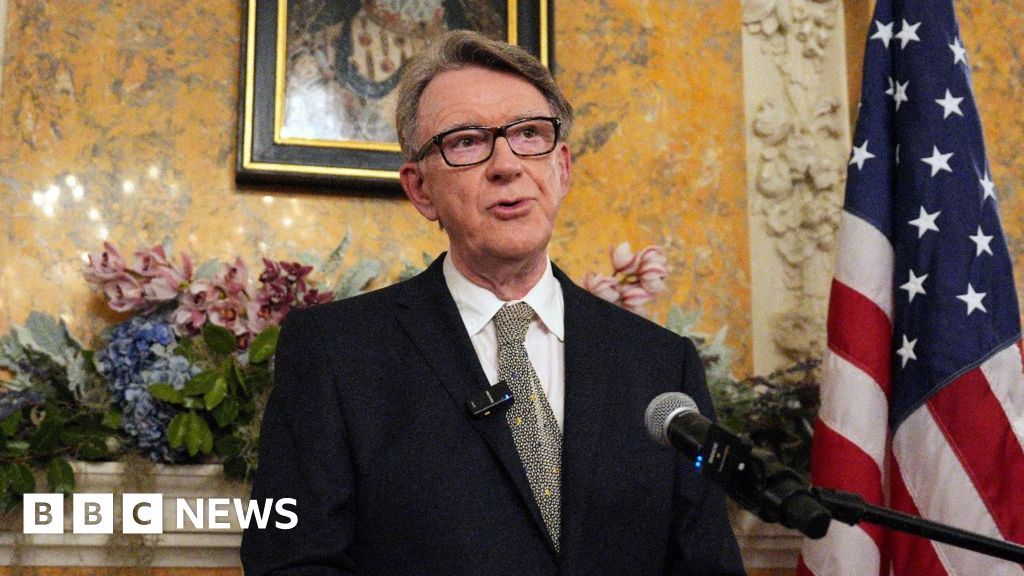
It has emerged that Peter Mandelson was granted a security clearance by the Foreign Office against the recommendation of the government's vetting agency when he was made US ambassador.

The government is under intense pressure to explain how Mandelson came to be granted Developed Vetting (DV) status, which is needed to view top secret government material, despite concerns flagged during his screening process.

Mandelson was appointed as the UK's ambassador to Washington in December 2024, before being removed last September when further information about his ties to convicted sex offender Jeffrey Epstein came to light.

Mandelson, as with any official whose work is likely to involve having access to top secret material, underwent a process called Developed Vetting during his appointment process.

It is a process employed by the government for those required to access sensitive material and be granted the highest level of security clearance.

It is carried out by United Kingdom Security Vetting (UKSV), a specialist agency within the Cabinet Office, and applies to thousands of relatively junior officials working in government departments and overseas, as well as senior figures like Mandelson.

The process is designed to identify whether people applying for government jobs pose a security risk, either because they might seek to abuse their position, or because their personal lives make them a potential blackmail target - for example, if they are in high levels of debt or are having an affair.

In practice, it means candidates have to fill out various questionnaires, including being asked to provide detailed information about their finances, internet use and medical conditions.

Official records are also checked, including a candidate's credit history and any criminal offences. Records held by the Security Service are also reviewed.

Those being vetted then have to undergo an interview with a specially trained vetting officer, which is designed to be intrusive.

Candidates are asked about very personal areas like friendships, family, health and sex life, sometimes over several hours.

A higher level of clearance, known as Enhanced Developed Vetting, also exists for a small number of positions, though Mandelson did not need to undergo this for the ambassador role.

Downing Street says it learned this week that the Foreign Office, which oversaw Mandelson's DV process, granted him clearance "against the recommendation" of the vetting agency.

BBC News understands UKSV gave the Foreign Office an explicit recommendation not to approve Mandelson's vetting.

It is understood the agency presented the Foreign Office with a list of potential risks as well as a recommendation summing up those risks, which sources said could be described as falling into one of three categories: yes, yes with caveats, or, no.

Sources say the recommendation given to the Foreign Office by the vetting services was a "no".

Sir Olly Robbins, the Foreign Office's top civil servant who was sacked on Thursday over the awarding of clearance to Mandelson, told MPs in November that clearance decisions are usually signed off by low-ranking officials based on the findings of the vetting report, though decisions can be escalated to senior leaders in specific cases.

The Foreign Office is believed to be the only government department in Whitehall with the authority to overrule such a recommendation.

Clearance can be awarded with measures in place to manage to risk. They are:

It is not clear if any of the above applied to Mandelson.

Downing Street has said the decision to override the advice on Mandelson was taken by Foreign Office officials, with neither the prime minister or foreign secretary made aware at the time.

Foreign Secretary Yvette Cooper previously said the vetting process is "independent of ministers who are not informed of any findings other than the final outcome".

Mandelson's vetting only began after the prime minister had announced he would appoint him to the ambassador's role, though other checks had been carried out by that stage, and senior civil servants told a parliamentary committee in November that carrying out vetting post-appointment is standard practice.

A due diligence check was carried out by a team at the Cabinet Office on behalf of Downing Street, as the prime minister was responsible for the appointment, prior to Mandelson's appointment.

The point was to identify reputational risks or potential conflicts of interests that may have needed to be considered in Mandelson's case.

Sir Chris Wormald, the UK's top civil servant, has previously confirmed to MPs that this was largely based on public information, such as media reports.

At the time, it was public knowledge that the peer had maintained his relationship with Epstein after his conviction for soliciting sex from a minor in 2008.

In 2023, the Financial Times reported about emails suggesting he stayed at Epstein's Manhattan mansion in 2009, while the financier was in jail.

The only non-public information that featured, Sir Chris added, were records of a meeting Lord Mandelson facilitated between Epstein and Sir Tony Blair that have since been disclosed by the National Archives.

This appears to be a reference to a meeting in Downing Street in 2002, six years before Epstein's conviction.

Lord Mandelson's file included information about his previous roles inside and outside government, and his "professional and financial relationships".

His prior relationship with Epstein was listed as a reputational risk, Sir Chris added, alongside his previous two resignations as a minister during the last Labour government.

Sir Chris Wormald, who was Cabinet Secretary at the time, has previously told MPs that "mitigations" were put in place regarding potential conflicts of interest arising from Mandelson's business career which were identified during this pre-vetting process.

After reviewing the due diligence findings, No 10 sources said Sir Keir Starmer asked Lord Mandelson to address three specific questions, which were sent to him via email by the prime minister's then chief of staff, Morgan McSweeney.

These questions were: why has he continued contact with Epstein after he was convicted? Why was he reported to have stayed in one of Epstein's homes while the financier was in prison? And was he associated with a charity founded by Epstein associate Ghislaine Maxwell that the financier had backed?

At the time, his answers were considered sufficient for him to be appointed to the role, for it to be announced publicly, and for the vetting process to begin prior to him formally taking up the position.

The BBC understands Mandelson's view is that he answered questions about his relationship with Epstein in the vetting process accurately.

Sign up for our Politics Essential newsletter to keep up with the inner workings of Westminster and beyond.
Comments
You must be logged in to comment.