yahoo Press
Stock market today: Dow, S&P 500, Nasdaq futures mixed amid Iran deal hopes, earnings rush
Images
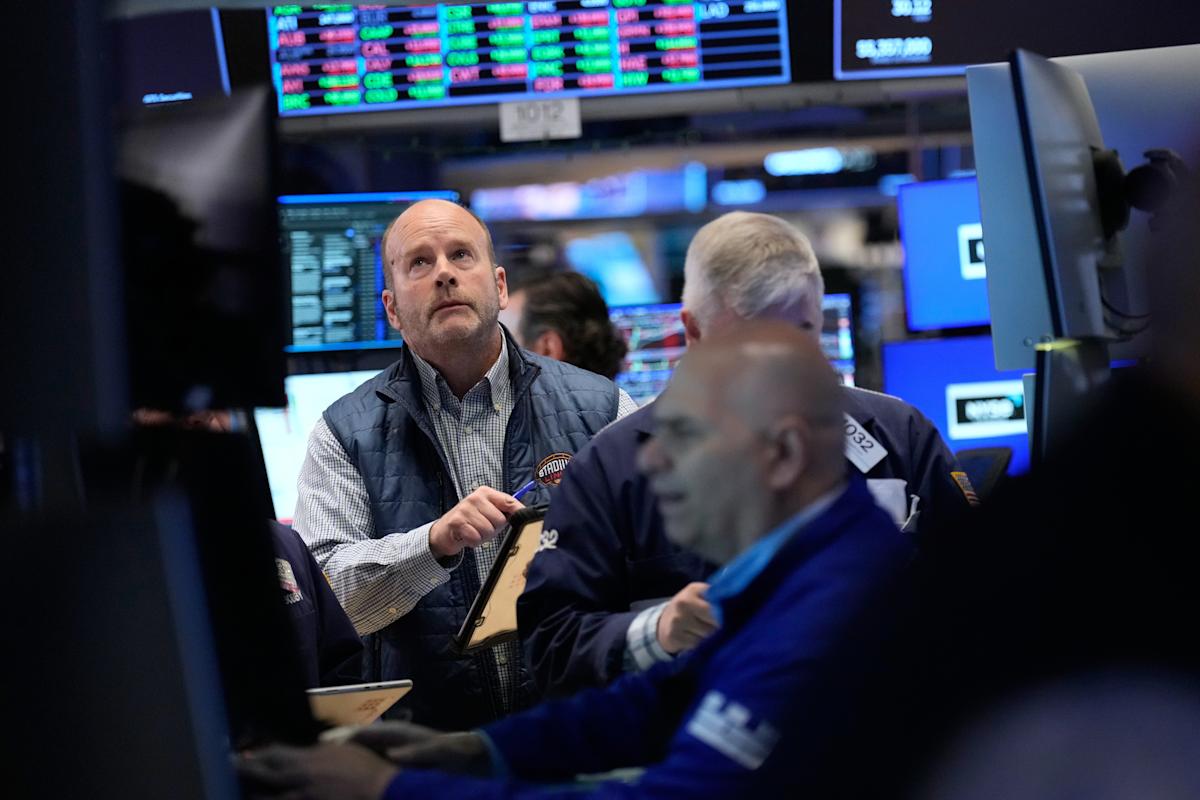
1 / 4

2 / 4

3 / 4

4 / 4
US stock futures diverged on Tuesday, while oil prices fell after President Trump signaled he’s open to further talks with Iran, stoking optimism for a long-term truce. S&P 500 (ES=F) futures edged up 0.1%, while those on the Nasdaq 100 (NQ=F) gained 0.3%. Contracts on the Dow Jones Industrial Average (YM=F), which includes fewer tech names, slipped above the flat line. On Monday, the Wall Street benchmarks eked out small wins after software stocks ripped higher. Washington and Tehran are considering further negotiations to extend their current two-week ceasefire, even with the US naval blockade on Iran’s energy ports now in place. Trump said on Monday that “the right people” — interpreted as Iran — have reached out “to work out a deal.” Optimism that the April 7 truce can be re-upped before it expires next week have added to already growing hopes for longer-lasting peace deal, which on Monday helped the S&P 500 (^GSPC) effectively wipe out losses accumulated since the start of the conflict. Against that backdrop, oil prices dropped back below $100 a barrel, but with investors watching for signs of traffic through the Strait of Hormuz. West Texas Intermediate (CL=F) crude retreated 2.5% to trade below $97 per barrel, while Brent (BZ=F) crude fell slightly to around $99. Looking ahead, attention turns to earnings season. Major banks including Bank of America (BAC), Wells Fargo (WFC), Citigroup (C), JPMorgan Chase (JPM), and Morgan Stanley (MS) all report this week, offering key insight into the health of the financial sector. As the war in Iran rolls into its seventh week, markets are still putting more weight on impacts to inflation than a potential growth shock down the road, Goldman Sachs economists wrote in a client note on Tuesday. Since the war began, yields have increased across all G10 economies, with six of those governments now expected to raise rates in 2026, up from three prior to the outbreak of conflict, economists George Cole and William Marshall wrote. Only the US Federal Reserve is expected to cut rates this year, though the timeline for a cut has been pushed out, the economists said. “Despite the potential for commodity price spikes to lead to weaker growth, this energy price shock has led to higher rates and hawkish forecast revisions for many central banks,” Cole and Marshall wrote. The temporary ceasefire agreement between the US and Iran has reduced the risk of a sudden inflationary shock, the economists noted — though the perception of lower risks “leaves financial conditions looser and growth risks lower.” That said, Cole and Marshall wrote, the economic risks of the conflict remain skewed toward higher inflation. “So far the inflationary aspects of the commodity price shock have dominated growth concerns,” Cole and Marshall wrote. “Unless the market sees forward growth prospects deteriorate sharply, this repricing is likely to remain somewhat sticky even as front-end yields sit higher than most of our baseline forecasts for central bank paths.” JPMorgan Chase (JPM) CEO Jamie Dimon said the US economy is facing "significant" risks, even as the bank reported a 13% rise in profits in the first quarter. "The US economy remained resilient in the quarter, with consumers still earning and spending and businesses still healthy. Several tailwinds are supporting this resiliency, including increased fiscal stimulus, the benefits of deregulation, AI-driven capital investment and the Fed's asset purchases," Dimon said. "At the same time, there is an increasingly complex set of risks," he added, "such as geopolitical tensions and wars, energy price volatility, trade uncertainty, large global fiscal deficits and elevated asset prices. While we cannot predict how these risks and uncertainties will ultimately play out, they are significant and they reinforce why we prepare the Firm for a wide range of environments." Yahoo Finance's David Hollerith reports the bank's earnings: Read more here. Globalstar (GSAT) shares jumped over 13% before the bell, boosted by reports that Amazon (AMZN) is closing in on a purchase of the satellite provider. A deal would position Amazon to take on Elon Musk’s Starlink, seen as an important piece of the highly anticipated SpaceX (SPAX.PVT) IPO. From Bloomberg: Read more here. Novo Nordisk (NVO) said on Tuesday it is partnering with OpenAI (OPAI.PVT) to deploy artificial intelligence across its business, from drug discovery to manufacturing and commercial operations. Shares of the Danish drugmaker rose 2.6% in premarket trading, as investors weighed prospects for Novo, which has fallen behind Eli Lilly in the immensely lucrative weight-loss drug market. Reuters reports: Read more here. Chinese stocks have pulled back after a bolstered rise against global downturn driven by the Iran war. Bloomberg reports: Read more here. Bloomberg reports: Read more here.
Comments
You must be logged in to comment.