yahoo Press
Is Nvidia Acquiring Dell? Why DELL Stock Is Up Today.
Images
1 / 5
2 / 5

3 / 5

4 / 5
5 / 5
The above button links to Coinbase. Yahoo Finance is not a broker-dealer or investment adviser and does not offer securities or cryptocurrencies for sale or facilitate trading. Coinbase pays us for certain activity generated through this link. Prices displayed are informational.

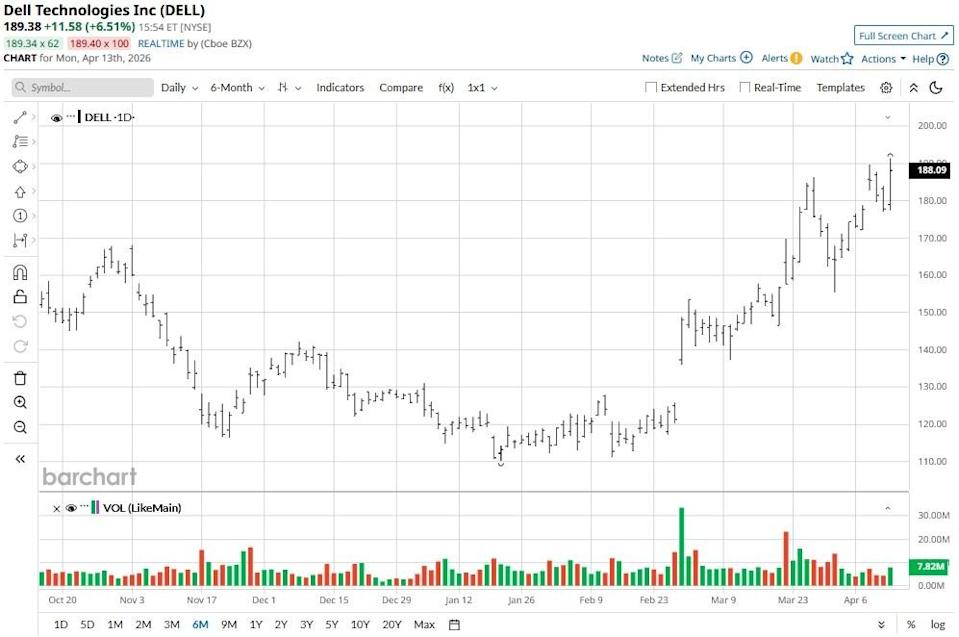
Dell Technologies (DELL) shares extended gains on April 13 following a report from SemiAccurate that Nvidia (NVDA) has been in negotiations for over a year to acquire a major PC-oriented firm.

The report characterized the potential transaction as one that could reshape the industry in a manner unprecedented since the invention of the computer, though it didn’t identify a specific target.

Stocks Recover as Oracle Leads Software Companies Higher

Dear CoreWeave Stock Fans, Mark Your Calendars for April 14

As Super Micro Computer Unveils New Enterprise Solutions, Is SMCI Stock a Buy, Sell, or Hold?

Our exclusive Barchart Brief newsletter is your FREE midday guide to what's moving stocks, sectors, and investor sentiment - delivered right when you need the info most. Subscribe today!

Neither Nvidia nor Dell has confirmed or commented on the reported takeover discussions. DELL shares, nonetheless, climbed to a new year-to-date high of $191 on Monday.

DELL currently holds roughly 17% of the global PC market on top of an artificial intelligence (AI) server business that it believes will generate a whopping $50 billion in revenue this year.

Owning it will position Nvidia to vertically integrate its GPU and AI chip business with hardware assembly and distribution.

This will allow for more aggressive pricing, guaranteed availability of its own silicon in finished products, and direct access to enterprise and consumer end markets.

For NVDA, such a transaction would mean a “fundamental shift” from its current model of selling components to OEM partners.

The company invested $70 billion in partners and customers during its most recent financial year to advance AI adoption, underscoring how central the hardware ecosystem is to its growth strategy.

For Dell stock, a potential tie-up with Nvidia represents the ultimate valuation re-rating.

While the company has successfully evolved from a legacy PC maker to an AI server powerhouse, it still trades at a significant discount (15x forward earnings) to pure-play silicon giants.

An acquisition would likely command a massive control premium, potentially valuing Dell well above its current all-time highs.

Beyond immediate cash or stock windfall, the integration will eliminate supply chain bottlenecks, giving DELL first-row access to Blackwell and Rubin GPUs.

In short, under NVDA’s umbrella, Dell will transform from a cyclical hardware vendor into a core component of the global AI utility, securing its long-term dominance in the enterprise data center.

Investors are still cautioned against loading up on Dell shares solely on the prospect of an NVDA deal because significant regulatory hurdles stand between completing such a transaction.

Nvidia already has a near-monopoly position in several GPU market segments. Therefore, antitrust authorities globally will scrutinize whether acquiring a major OEM partner could harm competition by disadvantaging rival chip suppliers or creating unfair advantages in the server and PC markets.

The report itself acknowledged that no final decisions have been made, and prolonged negotiations reinforce the complexity and sensitivity involved in any potential agreement.

According to Barchart, while the consensus rating on DELL remains at “Moderate Buy,” the mean price target of about $175 now indicates potential downside of roughly 7% from here.

This article was created with the support of automated content tools from our partners at Sigma.AI. Together, our financial data and AI solutions help us to deliver more informed market headline analysis to readers faster than ever.

On the date of publication, Wajeeh Khan did not have (either directly or indirectly) positions in any of the securities mentioned in this article. All information and data in this article is solely for informational purposes. This article was originally published on Barchart.com
Comments
You must be logged in to comment.