yahoo Press
China Seizes An Island While The World Is Watching Iran
Images
1 / 8
2 / 8

3 / 8

4 / 8
5 / 8

6 / 8

7 / 8

8 / 8
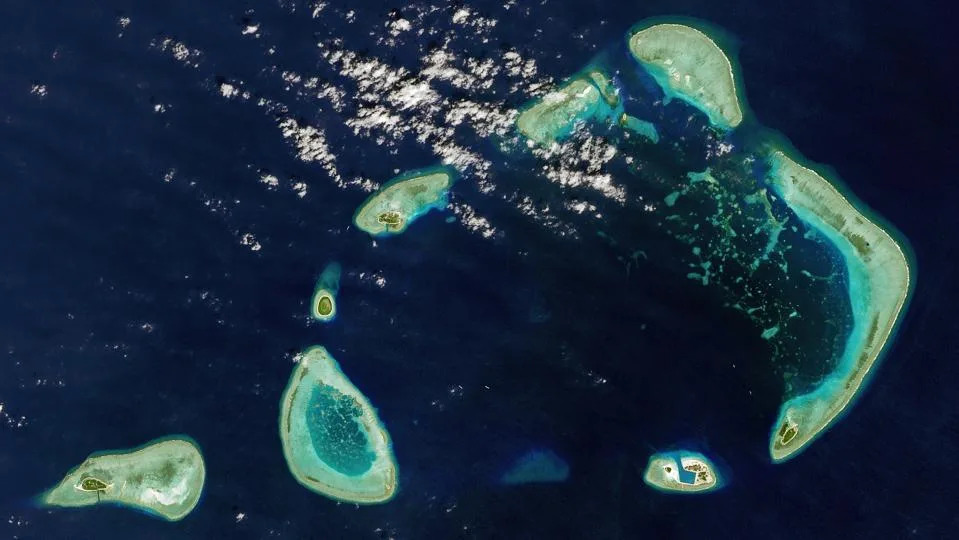
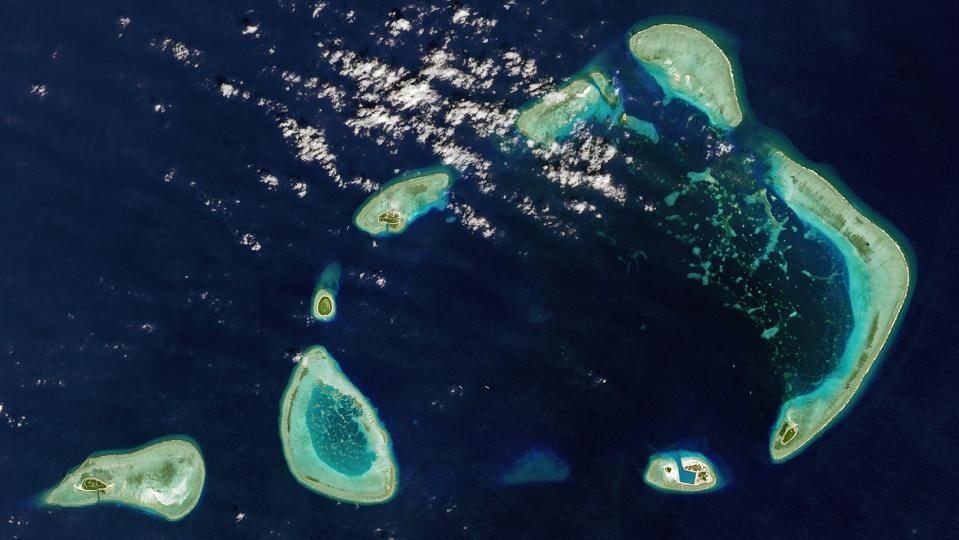
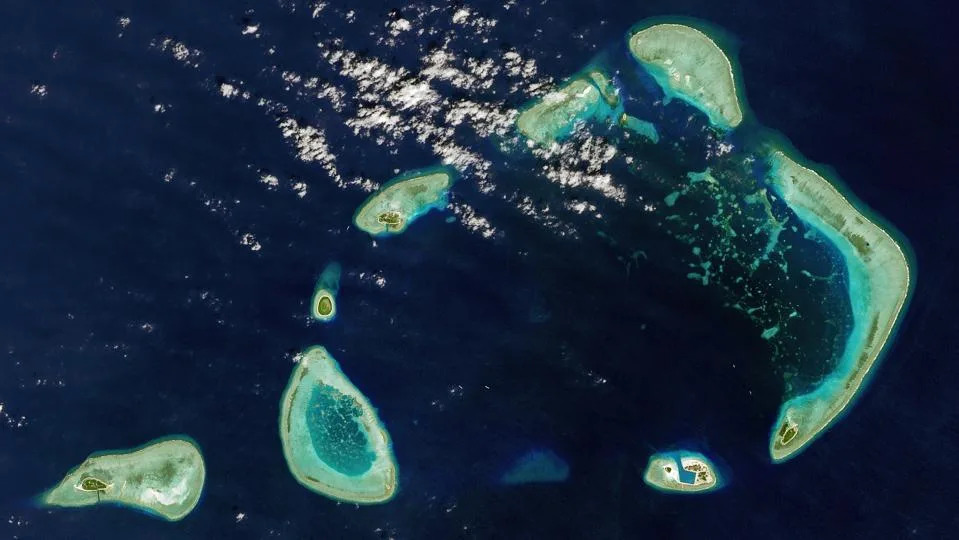
CRESCENT ARCHIPELAGO - JANUARY 2016 (SOUTH AFRICA OUT): A satellite view of the Crescent Group of islands which is part of the disputed Paracel Islands located in the South China Sea. Visible here are Antelope Reef, Pattle Island, Drummond Island, Duncan Island, Palm Island, Robert Island, Observation Bank and Money Island on January 22, 2016. (Photo by USGS/NASA Landsat /Orbital Horizon/Gallo Images/Getty Images)

While the world watches islands in the Persian Gulf, China has seized an island in the South China Sea without firing a shot. Beijing’s dredgers have been hard at work developing an artificial island 400 kilometers off Vietnam’s coast with astonishing speed. Even more shocking is that the world has largely remained silent about China’s move. Vietnam's first strong formal protest did not come until March, more than five months after dredging began. As it has in the Philippines for years, China is conducting lawfare and rehearsing kinetic warfare in plain sight. The international community should counter China's actions at Antelope Reef to avoid another South China Sea crisis—and to stop China from gaining military advantage in a conflict over Taiwan.

Antelope Reef is a maritime feature in the Paracel Islands in the western Crescent Group. The Paracels have been controlled by China since 1974, when it seized them from South Vietnam. Antelope Reef is claimed by China, Taiwan, and Vietnam. Reports differ as to whether Antelope Reef is a rock or a reef under international law. Either way, it is not an island that would legally generate a 12-nautical-mile territorial sea and a 200-nautical-mile exclusive economic zone (EEZ). China claims Antelope Reef under an unlawful reading of the UN Convention on the Law of the Sea (UNCLOS), known as the Constitution of the oceans. Under UNCLOS, a feature's legal status is frozen at its pre-reclamation state. In other words, China cannot build an island on Antelope Reef and then claim that, because it is now an island, China has sovereign rights to all economic resources in a surrounding EEZ.

The world ignored it when China started working on Antelope Reef three years ago. In February 2023, the Hainan provincial government issued a tender for an environmental capacity assessment of Antelope Reef. Satellite imagery showed that dredging began in October 2025. In January 2026, Newsweek first reported construction on the reef including berths for roll-on/roll-off vessels. By February 2026, 22 cutter-suction dredgers were working at the reef. The activity has already created several square kilometers of new land, with significant reclamation visible across more than 15 square kilometers of the reef. Satellite imagery also shows a straight northwestern edge that could easily house a 9,000-foot airstrip. More than 50 gray-roofed structures are visible, including a helipad, a concrete plant, and a causeway.

The dredgers violated international law while creating the reef. The fleet had gathered at the Zhujiang River Estuary between Macau and Hong Kong, and then systematically deactivated their automatic identification signal (AIS) transponders before proceeding south. International. Law requires these transponders to maintain maritime safety. Only one dredging vessel sent an AIS transmission during the first three months of construction. Subsidiaries of the China Communications Construction Company, an entity sanctioned by the United States, appear to be doing the construction.

Similar island-building activity by China has been found illegal under UNCLOS. Between 2013 and 2015, China engaged in extensive land reclamation in the Spratly Islands, building seven artificial islands, mostly in areas claimed by the Philippines and Vietnam. These outposts have improved China’s intelligence and surveillance capabilities, advanced its presence and sovereignty claims, and increased it operational advantages. China’s artificial island-building program has also violated its neighbors’ sovereign rights in their EEZs. In 2016, in a landmark arbitral ruling between the Philippines and China, an arbitral tribunal held that large-scale dredging caused extensive coral reef destruction violate China's obligations under UNCLOS Part XII on the protection and preservation of the marine environment, including duties to prevent, reduce, and control pollution and ecosystem damage.

China's justification for its construction at Antelope Reef echoes what it said about the Spratlys before and after the arbitration. In 2015, China's Ministry of Foreign Affairs said that construction of the artificial islands was aimed at “optimizing their functions, improving the living and working conditions of personnel stationed there, better safeguarding territorial sovereignty and maritime rights and interests.” In 2017, a spokesperson said that the purpose of constructing facilities was to improve the living and working conditions for the personnel stationed there and to better defend its sovereignty. Now, in 2026, China's Ministry of Foreign Affairs said on March 23rd that the Paracels are China's “inherent territory, over which there is no dispute,” and that “necessary construction on our own territory is aimed at improving living and working conditions on the islands and growing the local economy.” China is reframing its construction as routine domestic governance. It is deflecting questions about sovereignty by focusing on civilian use and establishing civilian presence. China is currently making similar arguments about its recently-built structures in the Yellow Sea.

China declared the 2016 ruling "null and void" and a piece of "waste paper." For a time, however, it did stop building new islands in the South China Sea — it stopped building in the Spratlys after the arbitration, and the recent construction at Antelope Reef is the first significant island-building since 2017—and a major escalation of its island-building campaign. China is showing the world that it can build islands much faster than before, revealing its capabilities for any future contingency. Antelope Reef's reclaimed land puts it on pace to be the largest artificial island in the South China Sea. For a time China maintained that it was not militarizing the Spratlys, but it has made no bones about militarizing Antelope Reef. The size of Antelope Reef’s lagoon would make it large enough for large coast guard and maritime militia presences that would give those fleets a formidable base in the Paracels. Antelope Reef is about 300 kilometers from the People's Liberation Army South Sea Fleet's submarine base at Sanya Port. A buildup of forces at Antelope Reef might strengthen China's ability to deter U.S. reconnaissance operations and target submarines around the base.

As the tenth anniversary of the South China Sea arbitration approaches, the international community must pressure China to abide by international law. U.S. freedom of navigation operations in the Paracels should continue. But sailing around an illegal island will not stop it from being built. Law-abiding states must call out China's illegal behavior. Coordinated diplomatic statements and media campaigns from states neighboring the South China Sea, backed by the United States, Japan, Australia, and Europe, can put China on the defensive. Past transparency initiatives have slowed or stopped China's unlawful acts. They also counter China's narrative in the region, which seeks to portray its actions as lawful. The United States can also lead targeted economic pressure on China Communications Construction Company and other entities involved in China's illegal construction. Ships not broadcasting AIS signals can, under appropriate circumstances, be boarded.

China can also be held legally accountable for its illegal behavior. Vietnam should consider a carefully scoped arbitration under UNCLOS, with international support. Hanoi has engaged in its own dredging in the South China Sea, complicating its case. However, a case focused on China's violations of Vietnam's rights in its EEZ and the reef's environmental destruction would stand on strong legal ground.

The 2016 ruling has deterred some of China's illegal behavior and has shaped state behavior in the South China Sea ever since. Emphasizing the ruling, and reinforcing it with a second lawsuit, would compound its legitimacy and cement China's status as a rogue actor in the region. The world must act to counter China’s unlawful actions before the concrete cures.

This article was originally published on Forbes.com
Comments
You must be logged in to comment.