yahoo Press
Think It’s Too Late to Buy Vertiv? Here’s Why the $15 Billion Backlog Says Otherwise
Images
1 / 4
2 / 4

3 / 4

4 / 4
The above button links to Coinbase. Yahoo Finance is not a broker-dealer or investment adviser and does not offer securities or cryptocurrencies for sale or facilitate trading. Coinbase pays us for certain activity generated through this link. Prices displayed are informational.

Vertiv (VRT) trades at 46x forward P/E with 42%-45% projected EPS growth through 2026, yielding a PEG ratio of 1.77, while the company’s order backlog surged to $15 billion with a 2.9x book-to-bill ratio that provides clear visibility into continued revenue acceleration.

Vertiv’s explosive order growth is driven by AI infrastructure buildout demand concentrated in the Americas, though APAC and EMEA revenue declines and insider selling at elevated prices signal execution risks if data center spending momentum slows.

The analyst who called NVIDIA in 2010 just named his top 10 AI stocks. Get them here FREE.

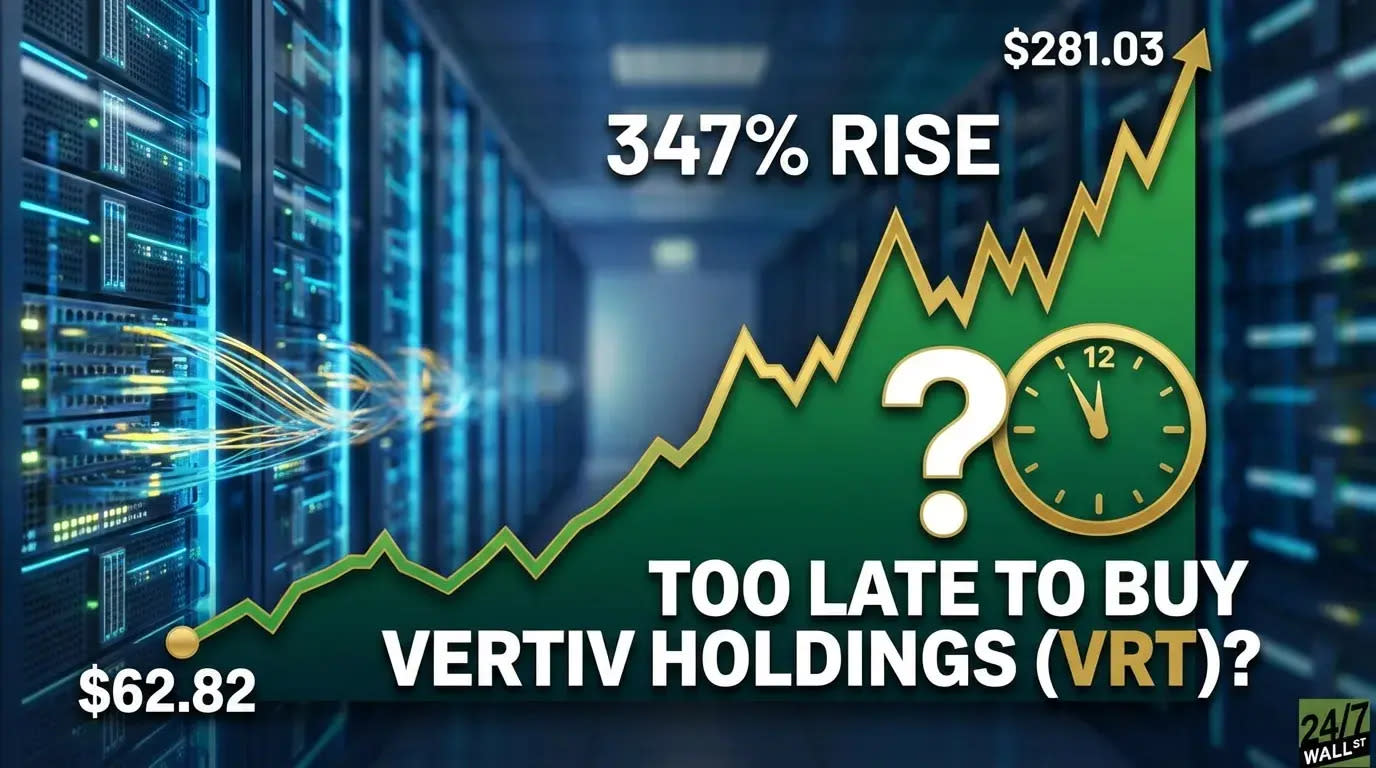
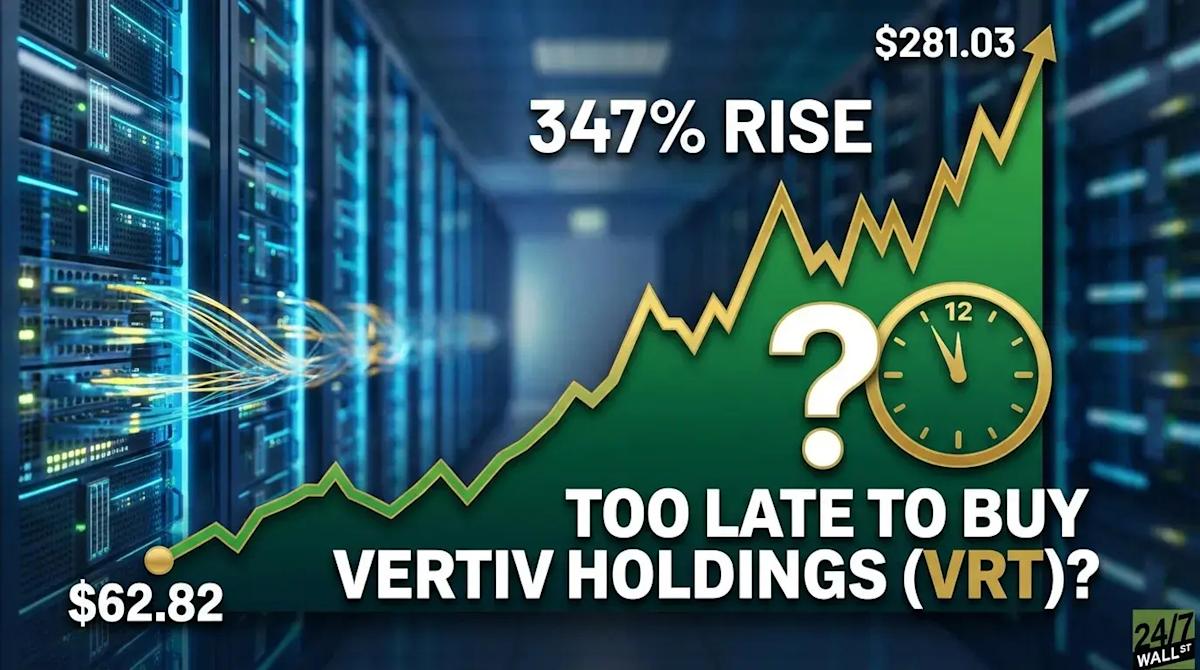
Vertiv Holdings (NYSE:VRT) has risen 347% over the past year, climbing from $62.82 to $281.03. If you watched that move from the sidelines, the question burning in your mind right now is obvious: is there anything left here, or has the stock already priced in the upside?

The honest answer requires working through three things: what the valuation actually looks like today, whether the business has real catalysts ahead, and what the downside looks like if you buy now. Let's go through each.

At $281.03, Vertiv trades at a trailing P/E of 83x and a forward P/E of 46x based on analyst estimates. Those numbers will make any value investor wince. But context matters here. Vertiv guided 2026 adjusted diluted EPS of $5.97 to $6.07, representing 42% to 45% growth over 2025. That EPS growth rate is not a rounding error — it is the kind of acceleration that compresses forward multiples fast. The PEG ratio sits at 1.77, which is elevated but not extreme for a company growing earnings at this pace. The consensus analyst price target is $271.25, which is actually below the current price -- a signal that the stock has run past near-term Wall Street expectations. Investors buying above the consensus target are betting on estimate revisions, not current Wall Street consensus.

READ: The analyst who called NVIDIA in 2010 just named his top 10 AI stocks

The most compelling reason this move may not be over is Vertiv's order book. Q4 2025 organic orders grew 252% year over year -- the strongest order quarter in company history. The backlog now stands at $15 billion, up 109% year over year, with a book-to-bill ratio of approximately 2.9x. That ratio means for every dollar of product shipped, Vertiv is booking nearly three dollars in new orders. CEO Giordano Albertazzi put it plainly on the earnings call: "Our record backlog provides clear visibility into what we expect to be another year of significant growth."

The near-term catalyst is concrete: Q1 2026 earnings are scheduled for April 22, just 13 days away. Vertiv guided Q1 net sales of $2.5 billion to $2.7 billion and adjusted EPS of $0.95 to $1.01. A beat there, combined with any upward revision to full-year guidance, would add another leg to the move. Beyond Q1, the company has flagged a May 2026 investor conference where management will detail the long-term margin roadmap, including a 25% adjusted operating margin target by 2029.

The bear case carries real downside. Vertiv carries a beta of 2.05, meaning it moves roughly twice as fast as the broader market in both directions. The model's bear-case 12-month target sits at $216.78, implying a potential pullback of nearly 23% from current levels. APAC revenue declined 9.6% and EMEA declined 8.2% in Q4 2025, a reminder that the growth story is heavily concentrated in the Americas. Tariff uncertainty adds an unpredictable cost layer. And several board members -- including Director Steven Reinemund, who sold 119,313 shares in late February at prices between $250.14 and $259.09 -- took the post-earnings pop as an exit opportunity. That director-level selling at elevated prices deserves attention from anyone buying at $281.

Vertiv is not cheap, and the stock has already priced in a lot of good news. But the business is generating real earnings growth, the backlog provides genuine revenue visibility, and the AI infrastructure buildout driving demand shows no signs of slowing. For a retirement-focused investor, the high beta and stretched valuation make a full position at current prices a difficult proposition. Investors who believe in the long-term data center infrastructure story and can tolerate a 20%-plus drawdown if sentiment shifts should weigh the April 22 earnings report as the next key data point before forming a view on valuation.

Wall Street is pouring billions into AI, but most investors are buying the wrong stocks. The analyst who first identified NVIDIA as a buy back in 2010 — before its 28,000% run — has just pinpointed 10 new AI companies he believes could deliver outsized returns from here. One dominates a $100 billion equipment market. Another is solving the single biggest bottleneck holding back AI data centers. A third is a pure-play on an optical networking market set to quadruple. Most investors haven't heard of half these names. Get the free list of all 10 stocks here.
Comments
You must be logged in to comment.