yahoo Press
‘Every Idahoan will feel the impact’: Worst-ever winter signals ‘rough’ water year
Images
1 / 12
2 / 12

3 / 12

4 / 12

5 / 12

6 / 12
7 / 12
8 / 12
9 / 12

10 / 12

11 / 12

12 / 12
Idaho’s water supply is typically coded in industry acronyms: CFS, SWE, KAF.

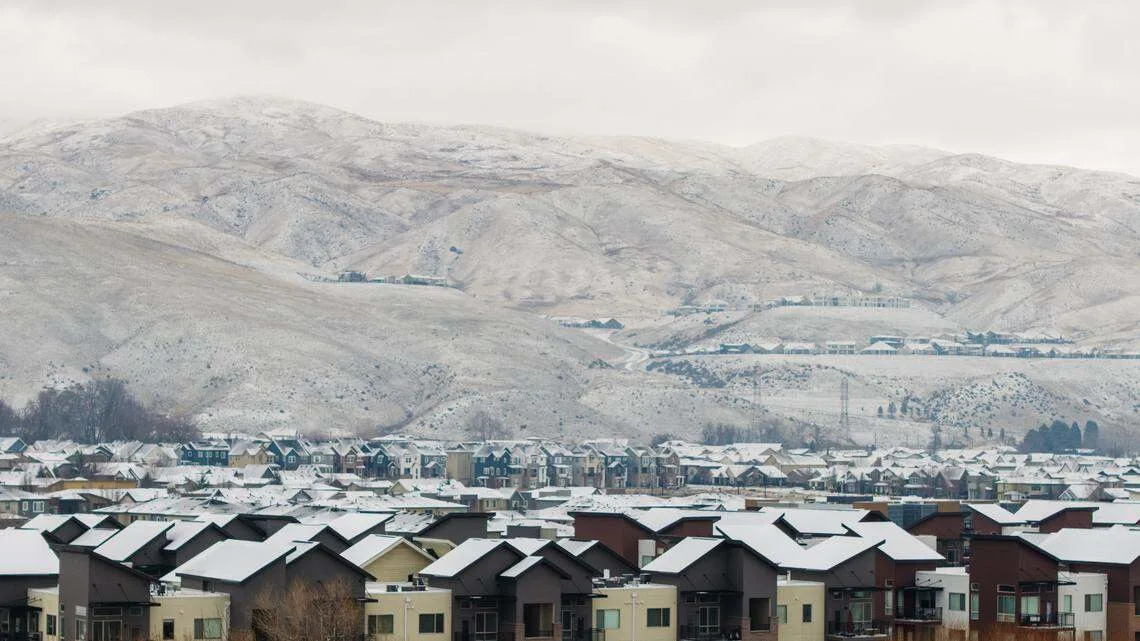
This winter, the grim facts were written plainly on the landscape — in brown hillsides, dry peaks and the early blooms of spring.

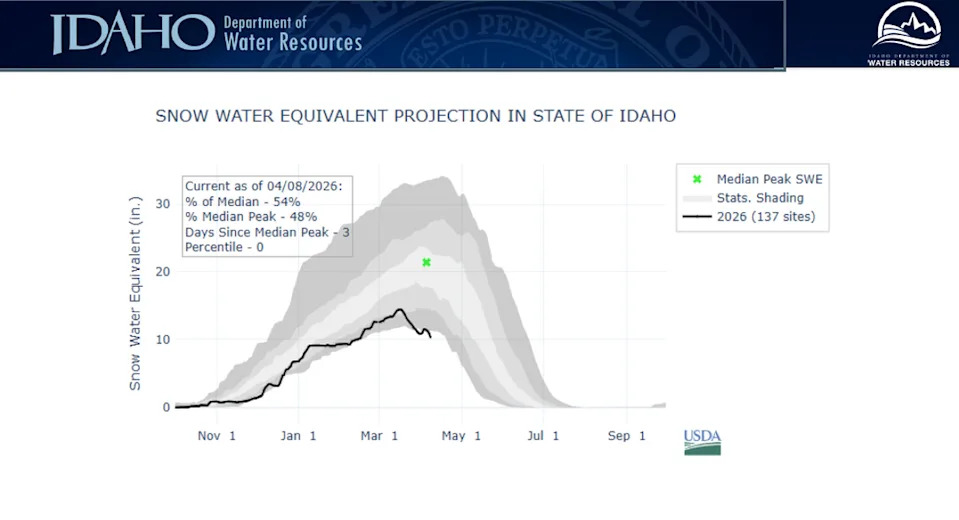
Now, as Idaho’s irrigation season begins in earnest, experts are sounding the alarm about a grim water outlook with few antecedents in state history, whether they’re talking in terms of cubic feet per second, snow-water equivalent, or thousands of acre-feet.

Idaho Department of Water Resources Hydrologist David Hoekema went back to 1934 to find a comparable case — the heart of the Dust Bowl.

At April’s meeting of Idaho’s interagency Water Supply Committee in Boise, experts warned that the stark forecast threatened to reach beyond Idaho’s water-dependent $44.5 billion agricultural economy, affecting how people across the state work, recreate, and even pay the power bill.

“This year, water is so low that every Idahoan will feel the impact,” Erin Whorton, a water supply specialist at the Idaho State Office of the federal Natural Resources Conservation Service, told the Idaho Statesman in an interview.

Whorton spends the winter monitoring snowpack in river basins around the state. She described “mindboggling” scenes in the mountains — bare dirt in March that she’d expect to melt out in May. On April 8, Idaho’s snow-water equivalent — that is, the amount of water contained in its snowpack — was the lowest ever seen on that date, effectively resetting the state’s scale.

Idaho was one of 10 states to see its warmest March ever this year, according to the National Oceanic and Atmospheric Administration, wrapping what Hoekema called “far and away” the warmest winter the state has seen since it began keeping comprehensive records.

“It’s something you wouldn’t expect to see for another 100 years, if that,” he told the Statesman.

That means the little snow that fell melted fast and early. The snowpack was so low, and the weather so warm, that SNOTEL — short for snow telemetry, the West’s automated network of real-time snow monitoring consoles — can’t make sense of it, according to the cadre of hydrologists, meteorologists and other related scientists who gathered downtown Wednesday.

SNOTEL sites “tend to be biased high,” according to Mark Robertson, co-owner of the software company M3 Works, which works with Water Resources to model snowpack in the Boise Basin.

SNOTEL stations measure snow-water equivalent and precipitation. Snow lands on a “pillow,” where the station measures its depth, density and surrounding soil moisture. From there, it’s a math problem, extrapolating data from available sites to estimate the amount of water in a basin. The equation assumes a historical average snowline at around 4,000 feet in most basins, Hoekema said. This year, warm weather drove the snowline much higher.

SNOTEL said the Boise Basin received 60% of annual moisture — already dire, according to Robertson. A different model Robertson ran to account for the extreme heat put the figure much lower: around a third of the typical water. A third, hand-sampled estimate agreed with Robertson, estimating the basin had 42% of what it would typically receive.

At that level, there’s “virtually no chance” of getting to a “so-called normal snowpack,” Brad Gillies of the NOAA’s Oregon-based Northwest River Forecast Center, told the committee.

“We just didn’t really have a winter,” Water Resources Deputy Director Brian Patton told the Statesman on April 2, “and we are very worried about the water supply.”

Idaho’s low snowpack broke “tons of records” for scarcity all over the state, Whorton said. Those figures led the National Resource Conservation Service to forecast “below normal” natural streamflows across all of Idaho, with the median projection for the Boise River around half of what it usually hits.

Most of the water that Treasure Valley residents see in the river isn’t a natural flow — it’s regulated by the dams and reservoirs upstream. And that’s why Boise area water users are in better shape than their peers that rely on the Snake, the Owyhee or other regional drainages, Hoekema said.

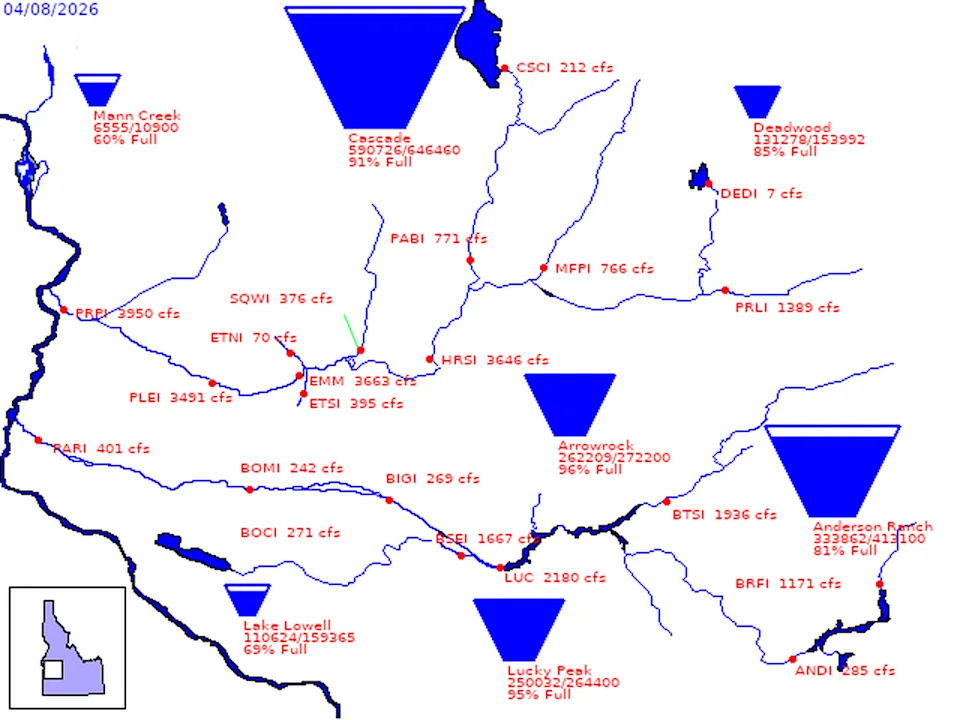
The Boise Basin has enough water stored in reservoirs at Anderson Ranch, Arrowrock and Lucky Peak to handle one bad year, he said. Both he and Whorton used the same analogy: “Water in a reservoir is like money in the bank,” Whorton said.

This year, Hoekema said, the Boise Basin will most likely draw that account down to zero by year’s end, starting almost as soon as water is released.

“I expect to see the reservoir system completely depleted,” he told the Statesman. “We’ll get through this year, but next year, we’ll be in really, really bad shape.”

Boise’s reservoir system is designed to manage a one-year drought, he said. If it extends much longer, without water in reserve, Hoekema expects “to see some really, really bad outcomes.”

Still, spring can change quickly in Idaho’s mountains. While forecasters agreed it would be hard to make up much ground, the weather in the weeks ahead traditionally “plays a really critical role” in water supply, Hoekema said.

“We’ll see what happens,” he said. “If we dry out, wow — it’ll be rough.”

Unfortunately, that’s the most likely weather pattern, according to Troy Lindquist, a senior hydrologist with the National Weather Service.

Idaho has a “pretty strong probability” of seeing above-normal temperatures and below-normal precipitation in the months ahead, he told the committee. Further out, Lindquist sees a good chance of an El Niño weather pattern building in the Pacific. Here, that likely — but not always — carries warm, dry weather.

Despite the dim outlook, Boise is in better shape than other parts of the state — and Idaho is in better shape than other states in the region.

To the east, users who rely on the Snake River are in much worse shape, Hoekema said. Farms south of Twin Falls, which get much of their water from northern Nevada and Idaho’s South Hills, may run out of water by the end of May, he said.

A week before the meeting, Whorton spoke to water users near Oakley who are planning for a single cutting of hay before leaving fields fallow. Other farmers, Hoekema said, are already considering moving on from water-intensive cash crops like potatoes, sugar beets and soybeans in favor of alfalfa or wheat.

In an interview, Whorton emphasized that the impact of a bad water year extends beyond Idaho’s agricultural economy. Everyday recreation will take a hit, she said, as well as the businesses that depend on it. Low water hurts outfitters, fisheries, boaters, even hunters, she said.

Electricity costs could rise. The price in Idaho follows water supply, according to an Idaho Power representative at the water-supply meeting. Hydropower is the company’s lowest-cost resource, he said: Lower streamflows mean dams produce less electricity, so Idaho Power fills the gaps with pricier options.

“Planning is really key for us,” the Idaho Power rep said, adding that “we’re not as bad as Colorado or California.”

Christina Lazar, a spokesperson for the Idaho Office of Emergency Management, said it’s always a “horrible day” when she hears about a low water year. Her office deals with things you can’t plan for, namely wildfire. Lazar told the committee that her organization — as well as peers across the West — are “gearing up” for an intense fire season, stoked by the dry conditions left after winter’s low tide.

“Everyone’s having the same problem at once,” she said.

Boise just broke a century-old temperature record. Here’s how hot it got

Warm weather, light snow: How an unusual winter has affected Idaho ski areas

Bogus Basin will close weeks earlier than usual. Blame the abnormal weather
Comments
You must be logged in to comment.