yahoo Press
Stock market today: Stocks mixed as Nasdaq rises, Dow falls after March CPI data shows surging energy costs
Images
1 / 5

2 / 5

3 / 5

4 / 5

5 / 5
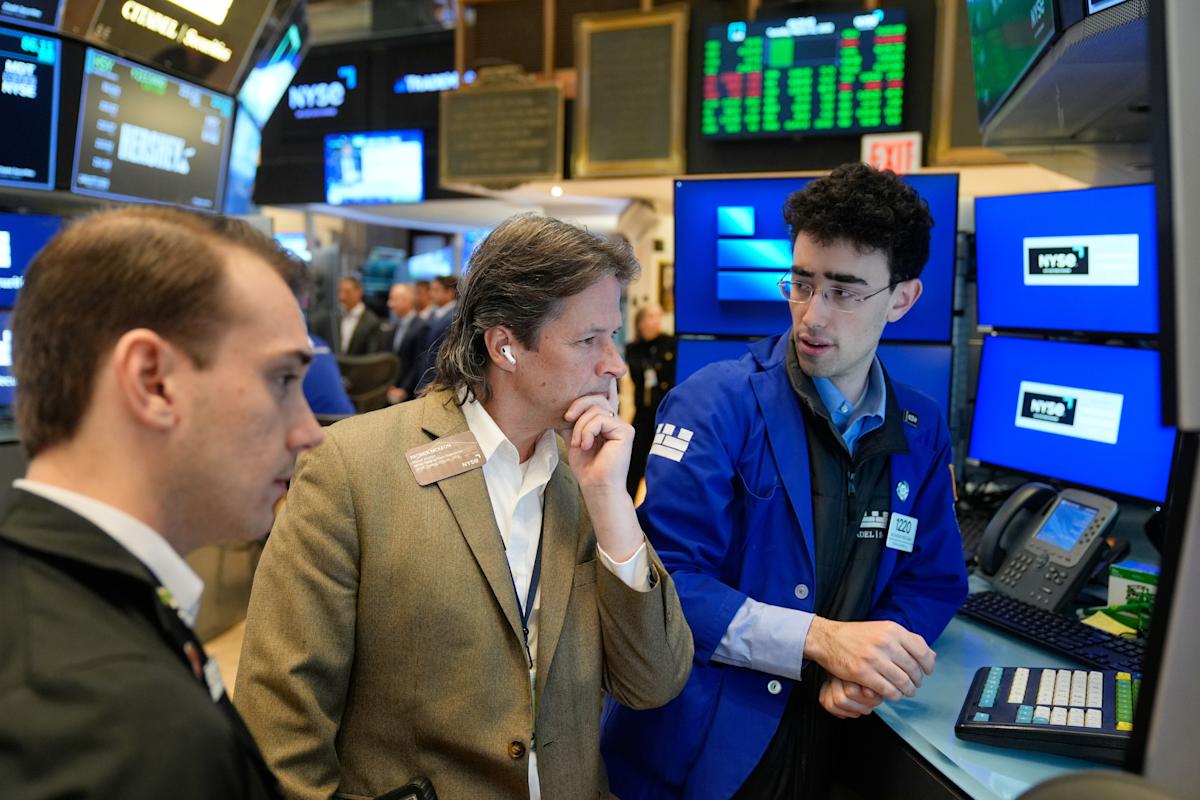
US stocks opened Friday's session mixed, with the tech-heavy Nasdaq rising as much as 0.5% and the blue-chip Dow falling about 0.4% after the March inflation report showed energy costs surged last month, and investors await the results of weekend talks on the tenuous ceasefire in the US-Iran war. About 20 minutes into Friday's session, the Dow Jones Industrial Average (^DJI) — which moved back into green figures for the year on Thursday — fell about 0.4%. The Nasdaq Composite (^IXIC), meanwhile, rose 0.4%. The S&P 500 (^GSPC) split the difference and was up less than 0.1%. After rising for seven straight days, on Friday the S&P 500 will look to clinch its first winning Friday since Feb. 20. On Thursday, the Dow closed higher to push the blue-chip index into positive territory for 2026. The S&P 500 and Nasdaq both remained about a tenth of a percentage point away from erasing this year's losses as of the close. The release of consumer price index data on Friday showed annual headline rate soared in March to 3.3%, for the largest monthly gain since 2022. The rapid acceleration from February's inflation level of 2.6% came as the US-Iran war sent gas prices skyrocketing. Investors are now focused on the Iran-US talks slated to occur this weekend, looking for signs the fragile two-week truce might lead to a longer-lasting plan for peace. Ahead of the meeting, President Trump ramped up pressure on Iran to lift its blockade of the Strait of Hormuz, with little sign of success. Traffic through the world's most critical chokepoint for energy supply is still thin. Oil futures were broadly flat, erasing the slight gains that followed Saudi Arabia's warning that Iran's recent attacks have lowered its production capacity. US benchmark West Texas Intermediate futures (CL=F) hovered just above $97 a barrel, while the international counterpart Brent crude futures (BZ=F) slid below $96. The financial sector was the biggest laggard in Friday's trading session with insurance stocks dragging down the XLF (XLF) after a report from A.M. Best published Friday morning warned of growing risks on the balance sheets of insurance giants tagged to private credit. The biggest losers in the financial sector Friday were shares of Ares (ARES), Arthur J. Gallagher (AJG), Aon (AON), and Willis Towers Watson (WTW). In the report, which the Wall Street Journal first broke early Friday morning, A.M. Best notes risks within annuity products that fared well during the financial crisis, but now face a new "undercurrent of financial instability in some asset classes against a backdrop of greater economic and geopolitical instability." The report warned that annuity reserves, or the capital that backstops the payment guarantees made by an annuity, have moved to lower-quality issuers and often to overseas affiliates that offer less transparency to investors. "PE/AM-backed insurers have entered the annuity market in a frenzy over the last five years as annuity premiums have surged," the report adds. "These asset managers have used the higher yields earned from their private credit portfolio to offer higher crediting rates on product offerings and winning some market shares." To oversimplify a bit, more companies have moved into the annuities space because it's an attractive source of capital: win upfront payments, earn a return on that capital, pay it out slower than it comes in the door, keep the spread. And as the report notes, a lot of that capital has moved into private credit, which itself operates on a similar dynamic: gather assets, deploy them to earn a return, pay out some of that return your investors, keep the spread. But with rising questions about the private credit asset class — both in terms of the quality of their investments and the durability of the investor base — more analysts are calling out more risks in new areas of the financial system. Semiconductors are on fire again ,while software is getting left behind. The iShares Semiconductor ETF (SOXX) is up nearly 25% from its March 30 low and has tagged a record intraday high in each of the last three sessions. Meanwhile, the iShares Expanded Tech-Software ETF (IGV) is down 4% over the same stretch, headed for a third straight loss, and back near late-2023 levels. On Wednesday, I asked TrendLabs founder J.C. Parets what would be a warning sign that the market could roll over again, and his answer was simple: software making new lows. That warning just flashed. His other canary is the USdollar index (DX-Y.NYB) pushing back above 101. For now, that one has not triggered. The dollar is in a fifth straight down session and still trading with a 98 handle. Palantir stock fell sharply on Thursday after Michael Burry — he of "The Big Short" fame — said the company is being outcompeted by Anthropic. Burry has been short the stock since last year. Palantir stock has also fallen amid a broader decline in software stocks pressured by the release of new AI models some investors fear will create cheaper replacements for all kinds of applications. This is even as companies like Palantir are among those most aggressively incorporating AI into their work. On Friday, President Trump backed Palantir's ability to help the US fight wars. In a post on Truth Social, Trump wrote: "Palantir Technologies (PLTR) has proven to have great war fighting capabilities and equipment. Just ask our enemies!!!" Palantir stock — which is down another 1.7% on Friday — moved off its lows of the day on the post. US consumers have never felt worse, according to the latest data from the University of Michigan. The preliminary look at consumer sentiment in April, published Friday, showed the University of Michigan's index of consumer sentiment fell to 47.6 this month, the lowest reading on record. "Demographic groups across age, income, and political party all posted setbacks in sentiment, as did every component of the index, reflecting the widespread nature of this month’s fall," said Joanne Hsu, director of the survey, in a statement on Friday. "One-year expected business conditions plunged about 20% and is now 6% below last April. Assessments of personal finances declined about 11%, with consumers expressing a substantial increase in concerns over high prices and weaker asset values," Hsu added. Stocks opened Friday's trading session higher after March inflation data showed prices rose mostly in-line with forecasts last month. The Dow Jones Industrial Average (^DJI), S&P 500 (^GSPC), and Nasdaq Composite (^IXIC) each opened up about 0.3%. On Friday, the S&P 500 will look to clock its eighth-straight winning session. The index will also look to clinch its first winning Friday since February. Consumer prices in March saw the largest monthly gain since 2022 as the US-Israel war against Iran sent gas prices skyrocketing past $4 a gallon. Yahoo Finance's Emma Ockerman reports: Read more here. Investing in the hardware piece of the AI trade just got more validation. Yahoo Finance's Hamza Shaban lays out how: Read more here in the takeaway from today's Morning Brief. Yahoo Finance's Jared Blikre reports: The S&P 500 (^GSPC) just reclaimed its 200-day moving average again, tilting the stock market back toward the bulls. See label (5) on this chart: It's never quite that simple, but it doesn't need to be much more complicated. The last time the index broke below the 200-day moving average — in March 2025, near label (4) — it lost the line, then bounced back to test it from underneath before selling off hard after "Liberation Day" on April 2. When the S&P later reclaimed that average, it tested it from above. Then it took off. Those two retests — first from below, then from above — were textbook. Read more here. TSMC (TSM), the world's largest contract chipmaker, posted a 35% surge in first quarter revenue on Friday, beating Wall Street forecasts thanks to unabated interest in AI applications. Shares of the Taiwanese supplier to Nvidia (NVDA) rose 2% in premarket trading on Wall Street. Reuters reports: Read more here. Government data out Friday will show how much consumer prices rose in March — and forecasts point to soaring inflation, notes Yahoo Finance's Emma Ockerman. She reports: Read more here. Bloomberg reports: Gold (GC=F) was headed for a third weekly gain, as hopes for a diplomatic resolution to the war in Iran and sustained buying by central banks outweighed persistent risks around inflation. Read more here. Bloomberg reports: Read more here. Reuters reports: Read more here.
Comments
You must be logged in to comment.