yahoo Press
Gas tumbles as Qatar prepares to restart production
Images
1 / 6
2 / 6

3 / 6

4 / 6
5 / 6

6 / 6
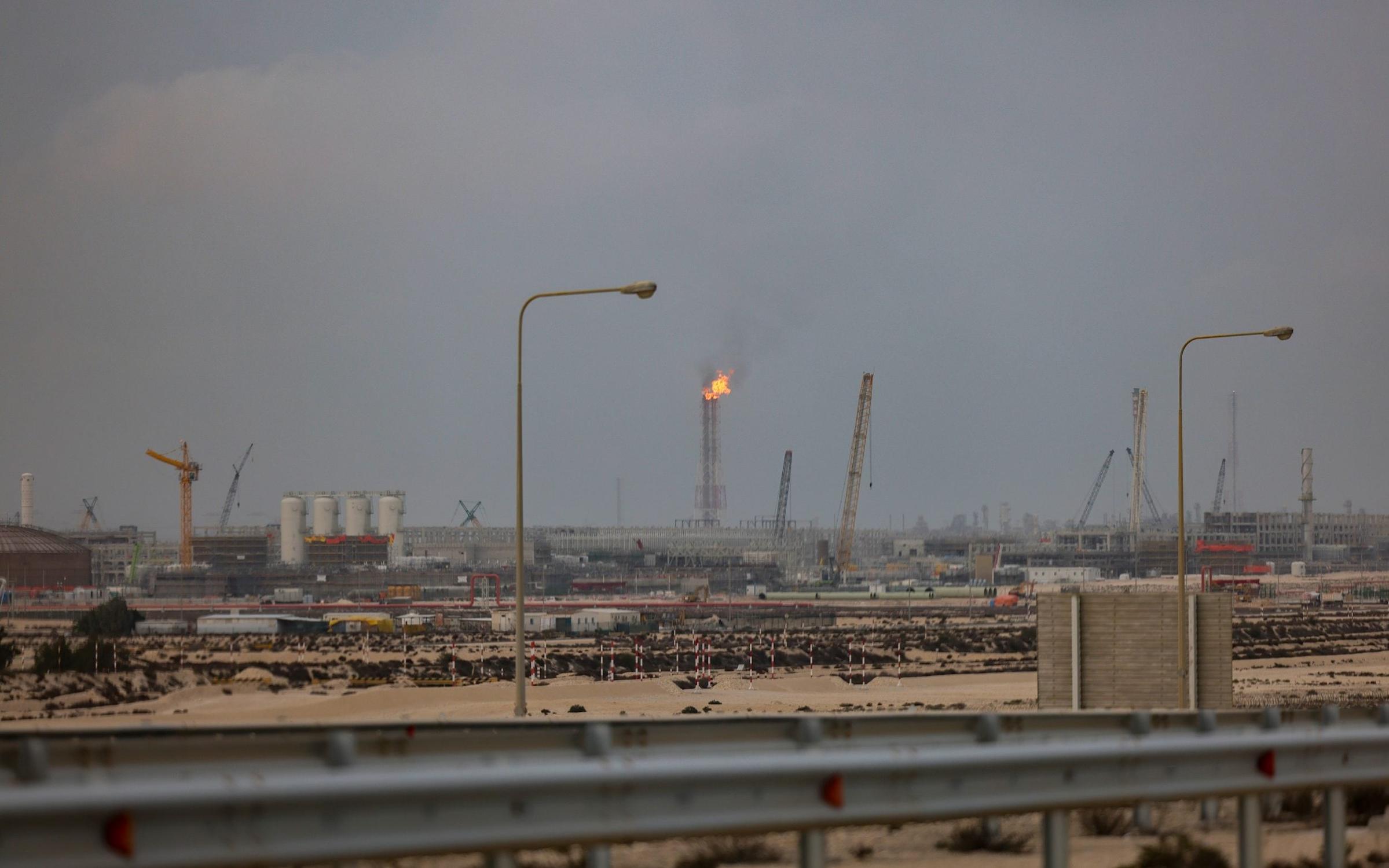
Gas prices have plummeted as Qatar prepares to restart production following the US-Iran ceasefire announcement.European gas prices fell by 17pc on Wednesday to €45 per megawatt hour as the Gulf state began mobilising engineers to resume production at the world’s biggest liquefied natural gas (LNG) export plant.Gas prices have fallen from a peak of €62 during the height of the Iran conflict and €53 just before the two-week ceasefire deal was announced on Tuesday night.It brings relief for Sir Keir Starmer, the Prime Minister. The UK is particularly exposed to higher prices because households are heavily dependent on gas for heating and the UK has limited storage facilities.Qatar shut down its Ras Laffan plant, which produces around a fifth of the world’s LNG, in the early days of the conflict at the start of March. The facility was also damaged in a missile attack.Iranian attacks on the plant have wiped out 17pc of its capacity and it could take as much as five years to get back to full production, but restarting any operations would still be a significant turning point for energy markets.Improved security conditions after the US president declared a “double sided ceasefire” means it has begun the necessary maintenance works so that it can reopen its Ras Laffan plant, Bloomberg reported on Wednesday.Gas prices remained lower despite signs that the hours-old ceasefire deal was already cracking. Iran has stopped oil tankers passing through the Strait of Hormuz, breaching the terms of its deal with the US. 06:52pm That’s all from us today. You can read all our latest business and economics news here. Have a lovely evening. 06:51pm Markets swung massively on Wednesday as Donald Trump’s ceasefire announcement overruled fears of fresh escalation in the war in Iran. Energy prices tumbled on hopes that supply pressures could be alleviated, with the price of Brent crude falling by 13pc. Stock markets surged, with the FTSE-100 and the US benchmark S&P 500 both jumping by 2.5pc. Hopes for reduced inflationary pressures meant government borrowing costs fell and traders slashed bets on interest rate rises. But the energy market reaction was tempered by signs of strain in the ceasefire, with drone attacks continuing in the Gulf. Oil prices had fallen as low as $90.60 earlier in the day, but were above $95 by Wednesday evening. 06:04pm A flurry of betting activity before Donald Trump announced the ceasefire on Tuesday night has raised fresh suspicions of insider trading. Traders placed bets worth roughly $950m on oil prices falling, just before the US president declared a pause on strikes that sent energy prices tumbling, according to Reuters. Investors sold a combined 8,600 Brent and US crude futures at 7.45pm UK time on Tuesday evening, LSEG data shows. This cluster of trades was made just a few hours before the US president’s Truth Social post announcing a ceasefire at 11.32pm, which sent the value of these futures tumbling by around 15pc. 05:05pm Traders have slashed their bets on interest rate rises from the Bank of England as the temporary ceasefire eases fears of a new inflation wave. Investors are now pricing in only one UK interest rate rise this year instead of the two they were expecting as of Tuesday. They now see only a 15pc chance of an interest rate rise at the Bank’s next meeting at the end of April, and a 48pc chance of a rise in June. On Tuesday, they saw these respective probabilities as 36pc and 76pc. 04:53pm Oil prices have begun reversing their losses as fears mount that the ceasefire is on increasingly shaky ground. The price of Brent crude has climbed back to $94.84 per barrel, up from a low of $90.49 earlier on Wednesday, as drone and missile attacks continue across the Gulf. However, benchmark oil prices are still down by 13pc since the ceasefire was announced on Tuesday. 04:18pm Prime Minister Keir Starmer has warned there is still “a lot of work to do” to reopen the Strait of Hormuz and get energy supplies flowing following the ceasefire announcement. On a visit to Saudi Arabia on Wednesday, Sir Keir said: “We now ... have ⁠a ceasefire, but there’s a lot of work ⁠to do, as you will appreciate, a lot of work to ​make sure that that ceasefire becomes permanent and brings about the peace that we all want ​to ⁠see. “But also a lot of ​work to do in relation ​to the ​Strait of Hormuz, ⁠which ⁠has an impact everywhere across the world.” 04:06pm The Prime Minister of Pakistan has warned that reports of ceasefire “violations” are undermining the peace process. Shehbaz Sharif wrote on X: “Violations of ceasefire have been reported at few places across the conflict zone which undermine the spirit of peace process. “I earnestly and sincerely urge all parties to exercise restraint and respect the ceasefire for two weeks, as agreed upon, so that diplomacy can take a lead role towards peaceful settlement of the conflict.” Attacks are continuing across the region, including on Kuwait, Saudi Arabia and the UAE. 02:48pm US stocks have surged as Wall Street opened on Wednesday after Donald Trump secured a two-week ceasefire deal with Iran. Markets rebounded on news of the Strait of Hormuz reopening, while Mr Trump claimed the US was making progress in its talks for a lasting deal with Tehran. The S&P 500 climbed 2.7pc, as did the Dow Jones Industrial Average. The tech-heavy Nasdaq opened up 3pc. The recovery comes after a weeks of turbulence for US stocks as investors grappled with Mr Trump’s strikes on Iran and Tehran’s choke hold over the strait, which accounts for about 20pc of global oil and gas shipping. Shares in major US airlines were amongst the biggest climbers, with United Airlines up 12pc and Delta up 9pc, as the peace talks signalled a potential return for long-haul flights to the Middle East and relief for fuel prices. Cruise giants including Carnival and Royal Caribbean both also registered double digit rises. Shares in Nvidia, the world’s most valuable company, were up by 3pc. Dan Ives, an analyst at Wedbush Securities, said the ceasefire news had been a “major positive development for overall markets with a risk-on appetite now set to return”. 02:14pm A key Saudi Arabian oil pipeline connecting its oil fields to the Red Sea has been hit by a drone attack, the Financial Times reported. The East-West pipeline was struck on Wednesday afternoon. The damage to the pipe is still being assessed. The oil pipeline had acted as a key route for transporting Saudi oil to global markets via the Red Sea after the Strait of Hormuz was closed. Saudi Aramco was contacted for comment. 01:46pm US stocks were poised to leap higher after Donald Trump secured a ceasefire deal with Iran late last night. S&P 500 futures climbed 2.7pc in pre-market trading. Nasdaq futures were up 3.3pc and Dow Jones futures were seen 2.6pc higher. Shares in Tesla were up more than 4pc in pre-market trading, as were shares in Alphabet. Nvidia, the world’s largest company, was up 3.5pc before markets opened on Wall Street. Global shares rebounded on Wednesday on the back of Mr Trump’s agreement with Iran for a two-week ceasefire and the reopening of the Strait of Hormuz. The FTSE 100 was up 3pc in the afternoon session, while the FTSE 250 was up 4.8pc. 01:12pm Donald Trump has claimed the US is “talking tariff and sanctions relief with Iran” just hours into a two-week ceasefire deal with Tehran. The US President said the two sides were now discussing lifting sanctions. Some form of sanctions have been imposed on Tehran by the US since the Iranian revolution in 1979. Stopping these sanctions was a key part of Iran’s 10-point ceasefire proposal. However, Mr Trump also added that there would be “no enrichment” of Iranian, despite Iran making its enrichment programme one of its 10 proposals. Mr Trump also added that the US would impose 50pc tariffs on any country caught selling weapons to Iran. This most likely applies to Russia, which has reportedly been preparing to supply the country with suicide drones, according to Western intelligence officials. 12:38pm Exxon Mobil has warned that as much as 6pc of its global oil production was knocked out in the first three months of the year after a series of strikes on its sites in Qatar and the UAE. In a trading update, Exxon said that the Middle East accounted for about 20pc of its oil production. Exxon said two of its oil production lines at a site in Qatar. “As a result, the company expects Middle East disruptions to lower global oil-equivalent production by approximately 6% in first quarter compared with fourth-quarter 2025,” Exxon said. 12:22pm Officials in UAE and Kuwait have warned they have come under drone and missile attack from Iran, just hours into a fragile ceasefire agreed by Donald Trump. In a post on X, spokesman for Kuwait’s Ministry of Defence said that its forces had been dealing with “an intense wave of hostile Iranian criminal attacks” since 8am. The spokesman said 28 drones were intercepted that were targeting its oil and power facilities. “The Kuwaiti Armed Forces succeeded in intercepting a large number of hostile drones, some of which targeted vital oil facilities and power stations in the south of the country, resulting in significant material damage to oil infrastructure facilities, power stations, and water desalination plants.” Separately, the UAE Ministry of Defence said its air defence forces were “currently engaging with missile and drone attacks originating from Iran”. Earlier, officials in Bahrain said two people had been injured in another strike that apparently occurred after the ceasefire. Iran’s Mehr news agency, meanwhile, said its Lavan oil facility had been hit by an “enemy” strike earlier this morning. 11:51am Very few ships are braving the Strait of Hormuz, despite Donald Trump’s declaration of a two-week ceasefire deal with Iran. There are still plenty of doubts over how long the ceasefire might hold. Many shipping companies may also still be figuring out whether they need to pay any fees to bypass what has been dubbed the “Tehran tollbooth”. Oman, which also controls waters in the strait, has reportedly insisted it will not charge any fees to shipping. According to TankerTrackers, which monitors marine traffic: “Ten hours later: We’re not seeing much happening.” 11:26am 11:00am A month after the outbreak of the Iran war, the Organisation for Economic Co-operation and Development (OECD) published its latest Economic Outlook. The title of the update was “Testing Resilience”. Unfortunately, Britain is at serious risk of failing that test. Indeed, the OECD downgraded the outlook for the UK by more than any other major economy. Growth is now expected to be just 0.7pc this year, 0.5 lower than the OECD’s December 2025 forecast. This would be only half the 1.4pc achieved last year. More importantly, it would mean that the economy is already poised to undershoot the official UK forecast of 1.1pc that was baked into the OBR’s analysis for last month’s Spring Statement. The bond vigilantes have their sights on Britain too. UK government borrowing costs were already relatively high before the Iran war. But they rose by more last month than in any other comparable country. So why, then, does Britain’s economy appear to be especially vulnerable? 10:21am Stocks are set to be boosted by a flood of US retail investors piling back into markets if the conflict in the Middle East continues to ease, analysts at JP Morgan said. The analysts said they expect American investors will soon start reinvesting in markets, using the huge cash piles they’ve built up since the start of 2026. American investors have stashed $380bn (£283bn) into bank accounts and money market funds since the start of the year, as they have mostly avoided markets due to the ongoing volatility. They will likely pile this cash back into stocks, if there are signs of a more permanent end to the Iran war and a re-opening of the Strait of Hormuz. “This strong US liquidity creation makes it more likely that investors re-deploy cash into financial assets over the coming months,” JP Morgan’s analysts said. “Cash balances are still rising strongly,” the analysts added, as they noted that at the current rate of saving, US investors will have roughly $1.8trn stashed away by the end of this year. 09:57am Investors pulled £44m out of property funds in March amid concerns about the war in the Middle East, writes Pui-Guan Man.Fund outflows were more than double those of February’s volumes, according to funds network Calastone.Overall, investors withdrew more than £1.4bn in equity funds, surging from £927m on the prior month.Edward Glyn, head of global markets at Calastone, said it marked the biggest sell-off since the Chancellor’s Budget in November.“The conflict in the Middle East represents another economic shock and the fallout in the UK could be significant,” he said. 09:49am Inflation is likely to remain hot in the coming months as higher oil prices continue to push up the cost of goods. Analysts said UK inflation would continue to climb this year as elevated global energy and fuel costs push up prices. Brent crude was trading at around $95 on Wednesday morning, which is still more than 50pc higher than at the start of the year. Neil Shearing, group chief economist at Capital Economics, said: “Inflation in the major advanced economies also has further to rise. We expect it to peak at around 4.5pc in the UK and between 3.5pc and 4pc in the US and the euro-zone. US inflation data due later this week will provide an early indication of how quickly those pressures are building.” Susannah Streeter, chief investment strategist, Wealth Club, said energy costs were expected to remain significantly higher than compared to before the outbreak of the war. She added new tolls in the Strait of Hormuz could keep the cost of oil high. She said: “It’ll add to longer-term costs for ships using the strait, which is likely to be reflected in the prices of a whole raft of products going forward - from oil and gas to fertiliser and helium, a critical component for high-tech manufacturing. So although the crisis may start easing, chronic problems may remain.” 09:20am Iran and Oman will be able to charge fees to ships travelling in the Strait of Hormuz, the Associated Press reports. A regional official said Iran would use the money raised for reconstruction. The passage was previously an international way and ships have never had to pay tolls for the key lane before. Iran had previously been seeking to charge as much as $2m per tanker. This could amount to an additional levy of about $1 per barrel of oil. 08:53am UK borrowing costs are tumbling after the US and Iran agreed to a two-week ceasefire and a reopening of the Strait of Hormuz. The yield on 10-year gilts fell to 4.7pc, down around 20 basis points from 4.9 yesterday, their lowest level since March 18. Sterling climbed about 1pc against the dollar to $1.34. 08:41am Airline stocks surged as the fragile ceasefire between the US and Iran signalled a return to air travel through the Middle East. Tourism to the region has collapsed since the US launched a series of strikes on Iran while critical transport hubs in Dubai, Abu Dhabi and Qatar have been cut off for long haul carriers. Shares in budget airlines on the FTSE 250 surged as markets opened on Wednesday. Easyjet was up 11pc and Wizz Air was up 14pc. Shares in IAG, which owns British Airways, were up 8pc. In Dublin, Ryanair climbed 10pc. 08:30am Shell has confirmed a major drop in gas production following damage to the oil giant’s facilities in Qatar. The FTSE 100 company on Wednesday said output from its integrated gas division had dropped from 948,000 barrels per day to between 880,000 and 920,000 barrels per day in the first three months of 2026. That reduction implies an overall drop of up to 6.1 million barrels across the quarter, or a fall of about 7pc. Damage in later quarters could also worsen, as Shell’s Pearl gas-to-liquids facility was hit by Iranian aerial attacks on March 18 -- meaning the output figures represent less than a fortnight’s impact so far. Shell’s gas volumes are also affected by the shutdown of QatarEnergy’s liquefied natural gas (LNG) facilities, some of which it partly owns. Ashley Kelty, an oil and gas analyst at Panmure Liberum, said: “The cost of repairing Pearl will be high and I’d expect it to take around a year before it’s back to pre-conflict levels.” Still, the company also flagged “significantly higher” revenues in other areas of its business as a result of the crisis, including energy trading. Mr Kelty said this meant the cost of the output drop to Shell would likely be “entirely mitigated by the higher revenues made over last month from higher commodity prices.” He added: “The company has an exceptional trading business who will have done extremely well out of the recent market volatility too.” Shares in Shell fell by more than 7pc on Wednesday morning as oil prices crumbled. Shares in BP dropped by more than 8pc. 08:20am The FTSE 100 has opened up more than 2.4pc as stocks rebounded on the US ceasefire deal with Iran. The FTSE 250 was up more than 3.8pc in early trades. Shares in commodities and mining giants led the FTSE 100, with Antofagasta and Fresnillo both up more than 10pc. Major banks including Barclays and Natwest also rose. Rolls Royce was up around 10pc. Energy giants including BP and Shell were both down around 7pc in early trading as oil prices fell. 07:43am Oil prices have slumped in the wake of Donald Trump’s late-night, last ditch ceasefire announcement that has brought relief to global markets and eased pressure on energy costs. Brent crude was seen down about 15pc at 7.30am on Wednesday morning at about $92.85 per barrel. America’s West Texas Intermediate fell 16pc to $94.78. Dubai crude fell 18.8pc. The falls would mark the biggest one-day drop in oil prices since the Gulf War in 1991. Those prices are sharply down on the highs seen on oil contracts in March. May contracts for Brent crude briefly hit $119. However, a newly fractured and unstable Middle East means oil prices remain severely elevated on the start of the year, when Brent was closer to $60-a-barrel. 07:32am Shares in Dubai have surged as Donald Trump declared a two-week halt to fighting in the Gulf with Dubai’s General Market climbing as much as 8pc. Shares in the state-own Emirates NBD Bank jumped as much as 14pc. Abu Dhabi’s ADX index was up 3.6pc. 07:25am European natural gas tumbled on Wednesday morning as the reopening of the Strait of Hormuz eased pressure on global energy markets. Gas benchmark futures dropped as much as 20pc to after Donald Trump agreed to a two-week ceasefire with Iran that will see shipping return to the crucial waterway. The Strait carries about a fifth of the world’s oil and liquidifed natural gas, but shipments have been cut off by Iranian forces since the end of February. Dutch front-month oil futures were trading at €43.70 at 8am on Wednesday, Bloomberg reported. 07:08am FTSE 100 futures were seen up just under 3pc on Wednesday morning as traders prepared for a surge of activity. 06:36am Donald Trump has claimed there will be “big money to be made” as the US secures the Strait of Hormuz as he claimed Iran had “had enough” of the conflict. In a post on Truth Social this morning, Mr Trump said the “loading up with supplies of all kinds” and US would still be “hangin’ around” in the Gulf in order to “make sure that everything goes well”. Mr Trump said: “A big day for World Peace! Iran wants it to happen, they’ve had enough! Likewise, so has everyone else! The United States of America will be helping with the traffic buildup in the Strait of Hormuz. There will be lots of positive action! Big money will be made.” 06:29am Global markets have rebounded overnight as Donald Trump revealed a two-week ceasefire with Iran, reopening the Strait of Hormuz, a crucial waterway that accounts for 20pc of oil traffic. Japan’s Nikkei was up more than 5.1pc just after 6am on Wednesday. Hong Kong’s Hang Seng climbed 3pc and South Korea’s Kopsi jumped 7.3pc. Shares in some of Asia’s biggest companies surged as fears of a global energy shock retreated. South Korea’s Samsung jumped 4.5pc and Taiwan’s TSMC was up 4.8pc. The S&P 500 erased losses from earlier in the day and last night closed up. US stocks jumped in after-hours trading as news of the proposed ceasefire emerged. Meanwhile, Brent crude tumbled more than 14pc, reaching its lowest point since 11 March, and was trading at around $94. 06:05am Good morning. Thank you for joining me. Markets were poised for a rebound this morning as Donald Trump unveiled an 11th hour ceasefire deal with Iran that would reopen the Strait of Hormuz after more than a month of fighting. Asian markets opened up and oil plunged below $100 after Mr Trump said Iran had agreed to a “COMPLETE, IMMEDIATE, and SAFE OPENING of the Strait of Hormuz”. 1) Rayner’s workers’ rights police get power to force their way into offices | Fair Work Agency can search property, make arrests and use force to support Labour’s reforms 2) What a cigar-smoking spy saw on his ‘field trip’ to the Strait of Hormuz | ‘Analyst #3’ even took a dip in his mission to get a first-hand view of the choke point 3) The youth unemployment crisis fuelling chaos on London’s streets | One in four young people in the capital are out of work, with few prospects of getting a job 4) Years of failure have left Britain dangerously exposed to the Iran war | Successive governments are guilty of underinvestment in the UK’s energy infrastructure 5) Flight cancellations hit Britain as jet fuel prices soar | Small airlines facing sharp rises in costs halt services to far-flung UK destinations Markets experienced a moment of relief amidst hopes of a diplomatic resolution to the war in the Middle East as Donald Trump agreed a two-week ceasefire on the condition Iran reopened the Strait of Hormuz. The S&P erased a 1.2pc drop on Tuesday night as Brent crude dropped as much as 16pc in the wake of the announcement. Bond yields and the dollar also fell. Sterling was up almost 1pc against the dollar. Asian markets rebounded after the US announcement. Japan’s Nikkei index was up 5.4pc to 56,322 and Hong Kong’s Hang Seng climbed 2.8pc to 25,821. Gold climbed to $4,798.20. Try full access to The Telegraph free today. Unlock their award-winning website and essential news app, plus useful tools and expert guides for your money, health and holidays.
Comments
You must be logged in to comment.